
Key Takeaways
- Fused silica quartz glass provides low, isotropic thermal conductivity (~1.4 W/m·K) that increases predictably with temperature.
- Precise control of thermal performance depends on material purity, manufacturing tolerances, and surface quality.
- Impurities like OH and metals scatter phonons, reducing thermal conductivity; specifying OH content is crucial for high-temperature applications.
- Double-side polishing and cleanroom cleaning eliminate micro-defects that create thermal resistance.
- Consistent thermal properties can be maintained across large-volume orders through rigorous in-line metrology and statistical process control.
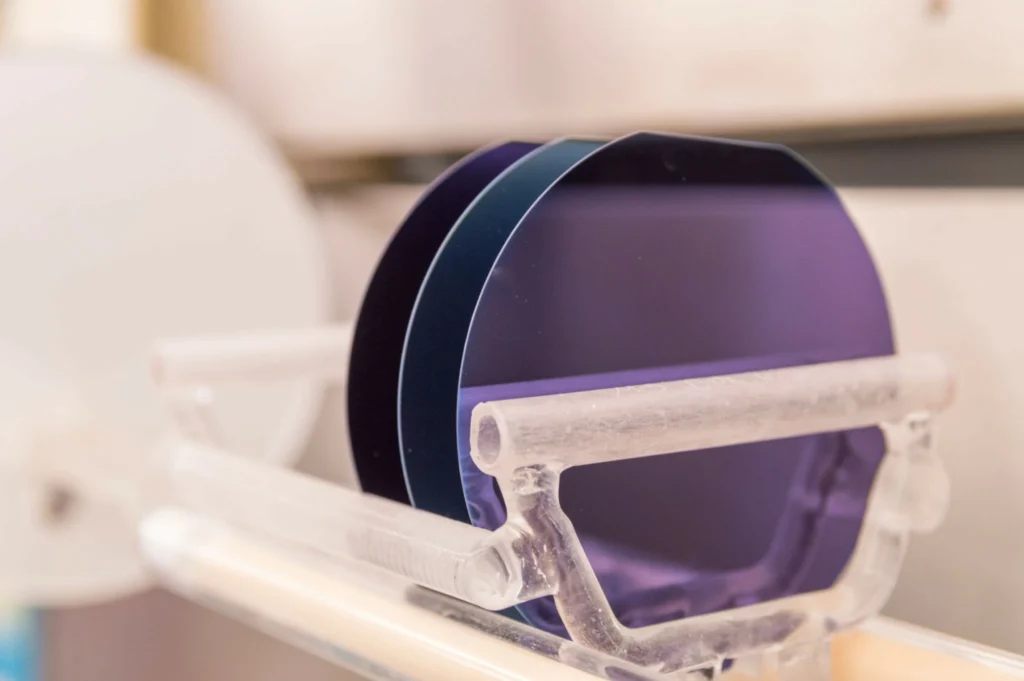
In a metrology lab, a technician positions a polished fused silica wafer in a laser flash analyzer. A rapid pulse of energy heats one face, and an infrared detector tracks the temperature rise on the opposite side. The resulting thermal diffusivity measurement confirms what every high-precision equipment designer relies on: the quartz glass component will dissipate heat exactly as specified, maintaining stability under demanding thermal loads. Thermal conductivity is not an afterthought in precision glass manufacturing—it is a process outcome engineered from raw material selection to final inspection.
Base Materials and Inputs: The Foundation of Thermal Performance
The thermal conductivity of quartz glass begins with the feedstock. High-purity synthetic fused silica, produced from silicon-containing gases, yields an amorphous structure with exceptionally low and predictable thermal conductivity—typically around 1.4 W/m·K at room temperature. In contrast, natural quartz powder (crystalline silica) must be melted and vitrified to eliminate the ordered lattice that otherwise conducts heat anisotropically. The resulting fused quartz retains isotropic thermal properties, with conductivity gently rising as temperature increases—a rare trait among glasses. For less demanding applications, borosilicate or soda-lime glasses are chosen, offering higher thermal conductivity but inferior thermal shock resistance. Sapphire, a crystalline material, provides superior thermal conductivity but at far greater cost, making it a niche option for specialized windows. Each base material’s purity and structural order directly influence the final component’s thermal behavior, so procurement teams closely evaluate feedstock certificates and trace elements.
Step-by-Step Manufacturing Stages and Their Impact on Thermal Uniformity
Producing quartz glass components with consistent thermal conductivity requires precise control at every stage.
- Cutting and Scribing: Diamond wheels or laser scribing dice the raw glass into near-net shapes. Subsurface damage from aggressive cutting can introduce stress gradients that locally alter thermal diffusivity, so feed rates and coolant flow are tightly managed.
- Grinding and Lapping: Progressive abrasive processes remove material to achieve parallelism and thickness tolerance. Uneven lapping can create thickness variations that lead to non-uniform heat flow, so double-side lapping machines with real-time thickness monitoring are standard.
- Polishing: Chemical-mechanical polishing (CMP) or pitch-polishing yields optically flat surfaces below 1 nm RMS roughness. Surface roughness affects thermal contact resistance when the glass mates with heat sinks or other components; a mirror finish ensures predictable interfacial conductance.
- Edging and Drilling/CNC: CNC machining with diamond tools creates complex geometries, holes, and notches. Coolant application and tool pressure are calibrated to avoid micro-cracks that could become thermal bottlenecks.
- Coating: Magnetron sputtering or ion-assisted deposition applies anti-reflective, high-reflective, or conductive coatings. These layers, often only hundreds of nanometers thick, must adhere without delamination under thermal cycling. In-line spectrophotometers verify coating uniformity, which indirectly assures stable thermal emissivity.
- Strengthening: Chemical tempering via ion exchange (for suitable glass types) or thermal toughening increases resilience. The process must not introduce stress birefringence that could indicate irregular thermal expansion paths.
- Cleaning: Ultrasonic and megasonic cleaning in Class 100 cleanrooms removes all residues. Contamination on a surface acts as a thermal barrier, so final cleanliness is verified by contact angle or particle counting.
Equipment and Techniques: Why Process Precision Matters for Thermal Results
The production line integrates tools that directly affect thermal outcomes. Double-side polishing machines maintain parallelism within micrometers, essential for uniform heat spreading in wafer form. CNC centers with micron-level positioning drill coolant channels or sensor pockets in quartz diffusion tubes, ensuring the thermal environment inside a furnace remains laminar. Magnetron sputtering systems deposit coatings with ±1% thickness uniformity across a 300 mm substrate, preventing hot spots caused by emissivity variations. These processes unfold in ISO Class 5 cleanrooms, where temperature and humidity are stable enough that dimensional metrology—and thus thermal interface flatness—remains repeatable over thousands of units. Laser flash thermal diffusivity instruments are often integrated near the end of the line for batch sampling, giving real-time process feedback.
In-Line Quality Checkpoints and Consistency for Bulk Orders
High-volume buyers require that every quartz window or wafer from a lot of 5000 exhibits the same thermal conductivity as the sample tested during qualification. To achieve this, manufacturers insert several checkpoints:
- Post-lapping interferometry detects thickness wedges that could skew heat flow.
- Pre-ship thermal diffusivity measurements on witness samples from each batch confirm conductivity remains within the agreed tolerance band, often ±5% of the nominal value.
- Environmental stress screening (thermal cycling from -40°C to +150°C) ensures micro-cracks do not propagate, which would cause a slow drift in conductivity over the product’s lifecycle.
- Automated optical inspection after coating checks for pinholes or scratches that would create localized thermal resistance variations.
These steps, combined with statistical process control, allow a precision glass manufacturer to commit to thermal conductivity specifications over multi-year supply agreements, a critical factor for industries like semiconductor lithography or high-energy laser systems.
Request a Factory Process Overview
For engineers and procurement teams specifying quartz glass optics, wafers, or precision components, understanding a manufacturer’s thermal management capabilities is essential. A detailed process overview—from raw material handling to final inspection—provides confidence in thermal consistency. Contact us to schedule a factory walkthrough or to discuss your specific thermal conductivity requirements.
Designing Quartz Glass Components for Reliable Thermal Conductivity Control
Achieving precise thermal performance in quartz glass parts—whether for semiconductor wafer chucks, high-temperature viewports, or laser optics—requires specifying the correct material grade, impurity levels, and surface quality from the outset. The thermal conductivity of quartz glass, particularly high-purity fused silica, is primarily governed by the material’s composition and manufacturing consistency, not by a single fixed value.
Material Grade Selection and Its Thermal Implications
Natural fused silica (JGS1) and synthetic fused silica (JGS2) offer distinct thermal profiles due to differences in hydroxyl (–OH) content and metallic impurities. High-purity fused silica glass typically exhibits a low, isotropic thermal conductivity of approximately 1.38–1.40 W/m·K at room temperature, which increases gradually with temperature—reaching around 2.5–3.0 W/m·K near 1000°C. OH groups and trace metals act as phonon scattering centers, so specifying a tight OH range (e.g., <5 ppm for JGS1 vs. 150–300 ppm for JGS2) directly influences thermal uniformity in high-heat-load applications. Crystalline quartz, by comparison, has anisotropic thermal conductivity and higher absolute values, making fused silica the preferred choice when isotropic heat flow is critical.
Manufacturing Tolerances and Thermal Uniformity
Even with a homogeneous material, dimensional variations create thermal gradients. Thickness non-uniformity, wedge, and poor flatness force heat to flow unevenly, generating hot spots. Double-side lapping and polishing reduce thickness variation to within micrometers, ensuring consistent thermal resistance across the entire part. Surface flatness, typically specified as λ/4 or λ/10 at 633 nm, minimizes interfacial air gaps when the component is mounted, lowering contact thermal resistance. Edge chamfering and high-quality drilling further prevent stress concentrations that could distort heat flow near mounting interfaces.
Post-Processing and Its Effect on Thermal Resistance
Anti-reflective (AR) coatings, magnetron-sputtered onto quartz surfaces, alter the spectral emissivity and can fine-tune radiative heat transfer in vacuum or high-temperature environments. Even a thin coating defect—a pinhole or scratch—introduces a localized thermal barrier. Therefore, post-coating automated optical inspection is essential. Cleanroom cleaning removes residues that would otherwise increase interfacial thermal resistance, guaranteeing that the part’s assembled performance matches its as-fabricated specification.
Key Facts About Thermal Conductivity in Quartz Glass
- Fused silica exhibits a low thermal conductivity of approximately 1.38 W/m·K at room temperature, significantly lower than crystalline quartz.
- Thermal conductivity increases with temperature; at 1000°C, it can reach around 2.5–3.0 W/m·K depending on purity.
- OH content and metallic impurities act as phonon scattering centers, reducing conductivity—synthetic grades with <5 ppm OH show the most stable thermal behavior.
- The isotropic structure of fused quartz provides uniform thermal conductivity in all directions, unlike crystalline quartz, which is direction-dependent.
- Surface quality (scratch-dig ≤ 20–10) and coating integrity are critical for eliminating localized thermal resistance variations.
Specifying Thermal Properties in Purchasing Documents
When requesting quotes, engineers should reference: material type and grade (e.g., JGS1, Corning 7980 equivalent), OH content target, maximum allowable thermal conductivity deviation at the operating temperature, surface finish (scratch-dig), and dimensional tolerances including flatness. Clear documentation of these attributes enables the manufacturer to select the appropriate raw material lot and apply process controls that lock in thermal performance.
| Aspect | Details |
|---|---|
| Base Material | High-purity silica sand or synthetic precursors; impurity levels and OH content determine thermal conductivity and optical properties. |
| Key Manufacturing Stages | Cutting, CNC grinding, lapping, polishing, edging, drilling, coating (AR, reflective), chemical strengthening, and cleanroom cleaning; each step impacts surface quality and dimensional accuracy. |
| Critical Quality Control | Interferometric flatness checks, scratch-dig inspection, laser interferometry for thickness uniformity, and thermal conductivity testing on witness samples; statistical process control ensures batch consistency. |
| Thermal Conductivity Control | Achieved by material purity, uniform thickness (via double-side polishing), and defect-free surfaces that minimize interfacial thermal resistance; post-processing (coating, cleaning) maintains integrity. |
| Typical Applications | Semiconductor wafer chucks, high-energy laser windows, furnace viewports, medical device components, and optical filters; where low and predictable thermal conductivity is critical. |
Request a Thermal Performance Consultation
To ensure your quartz glass components meet the required thermal specifications, contact our engineering team with your application details. We provide material certifications, thermal conductivity test reports, and process validation data. Submit your drawings for a custom quote.
Frequently Asked Questions
What is the thermal conductivity of quartz glass?
Quartz glass, specifically high-purity fused silica, has a thermal conductivity of approximately 1.38–1.40 W/m·K at room temperature. This value is significantly lower than that of crystalline quartz, making fused silica an effective thermal insulator in many precision applications. The conductivity increases with temperature, reaching about 2.5–3.0 W/m·K near 1000°C depending on material purity.
How does temperature affect the thermal conductivity of fused quartz?
The thermal conductivity of fused quartz increases gradually as temperature rises. At cryogenic temperatures it is very low, then rises to around 1.4 W/m·K at 20°C, and can exceed 2.5 W/m·K at 1000°C. This positive temperature coefficient is due to increased phonon contributions, and the exact rate of increase depends on OH content and impurity levels in the glass.
What is the difference between quartz and fused quartz in terms of thermal properties?
Crystalline quartz has anisotropic thermal conductivity that varies with crystallographic direction (typically higher along the c-axis), while fused quartz is amorphous and has isotropic thermal conductivity. Fused quartz also exhibits lower absolute thermal conductivity, making it more predictable for engineering designs. Additionally, fused quartz has a lower coefficient of thermal expansion, providing superior thermal shock resistance.
Which quartz glass grade offers the most stable thermal conductivity?
High-purity synthetic fused silica, such as JGS1 with very low OH content (<5 ppm) and minimal metallic impurities, provides the most stable thermal conductivity over a wide temperature range. Its reduced phonon scattering ensures repeatable thermal performance in demanding applications like semiconductor lithography and high-power laser optics.
How do manufacturing processes influence the thermal conductivity of quartz parts?
Manufacturing steps such as double-side polishing ensure uniform thickness, eliminating thermal gradients caused by wedge or thickness variation. Surface quality directly affects interfacial thermal resistance—scratches or pits act as barriers. Post-process cleaning and inspection remove contaminants that could compromise thermal uniformity, while coatings can modify surface emissivity for radiative heat transfer control.