
Key Takeaways
- Tempered glass panels for smart oven controls must balance optical clarity, thermal resistance, and precise dimensional tolerances to ensure reliable touch performance and safety.
- Material selection—soda-lime, borosilicate, or aluminosilicate—affects the panel's thermal shock resistance and maximum operating temperature.
- Edge finishing (seamed, ground, polished) and coatings (AR, anti-fingerprint) are critical for integration and user experience.
- Compliance with IEC/UL standards and regional regulations is essential for global market access.
- Customization options include varying thickness, printed graphics, cutouts for displays, and specialty coatings; collaboration with the manufacturer early in the design phase streamlines production scaling.
The Application Goal and Critical Constraints
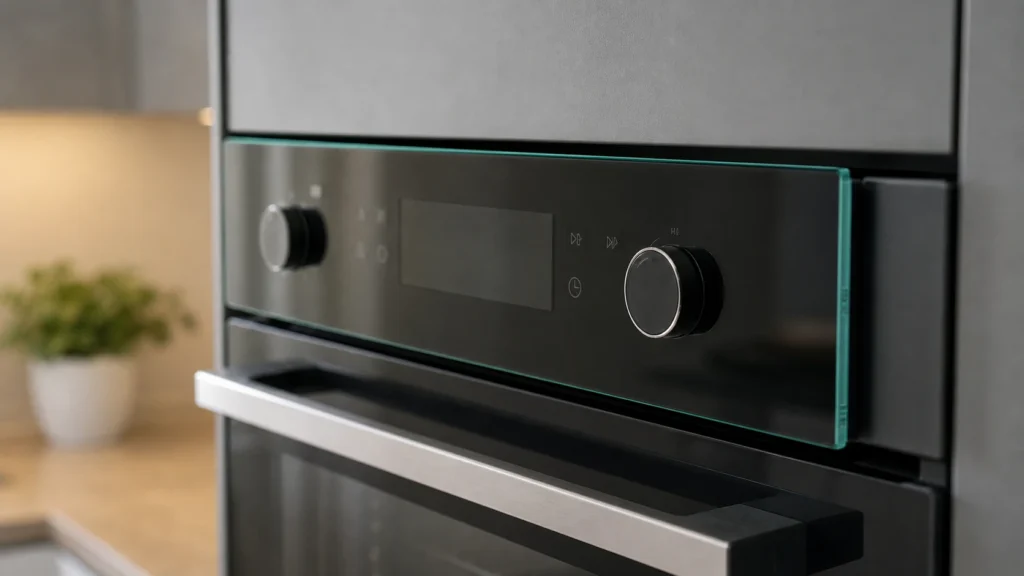
On the production floor, a quality engineer holds a smart oven control module prototype, tilting it under a bright inspection lamp. The glass surface catches the light—a seamless black panel with capacitive touch zones and a high-contrast display window. For the OEM developing this next-generation appliance, the oven control panel glass must do more than cover the electronics. It must survive daily thermal cycles, tolerate accidental impacts from cookware, maintain pristine optical clarity for LCD or OLED readouts, and pass mandatory safety certifications. Any clouding, delamination, or touch insensitivity after thermal aging is a reject—and a potential recall risk. These modules typically sit above the oven door, where ambient temperatures can climb rapidly, and the glass must handle sustained heat without warping or losing strength. Tight dimensional tolerances are non‑negotiable because the panel must align perfectly with housing frames and hidden touch‑sensor arrays.
How Custom Tempered Glass Fits the Requirement
Precision-tempered glass panels are engineered specifically for these demanding control interfaces. Unlike consumer-grade glass, custom tempered glass for appliances undergoes controlled thermal or chemical strengthening to enhance impact resistance and thermal stability. The result is a panel that can withstand rapid temperature changes without fracture—critical when a cold spray of cleaner hits a hot oven front. Fabrication capabilities allow the glass to be cut to exact dimensions with clean edges, drilled for indicator LEDs, and screen-printed with opaque borders, icon legends, and anti-glare coatings. The glass can also serve as a robust substrate for touch-sensitive circuits, supporting both projected capacitive and infrared touch technologies. By using high-transmission float glass as the base, the panel delivers the brightness and color accuracy that modern TFT displays require, while a tempered surface shrugs off the scratches and smudges common in kitchen environments.
Selection Criteria for This Application
Choosing the right appliance glass panel for a smart oven control module means evaluating several interrelated properties:
- Transmission and color neutrality: The panel must pass >90% visible light with no greenish tint if a high‑fidelity display sits behind it. Anti‑reflective coatings can be added to maintain readability under bright kitchen lighting.
- Thermal expansion coefficient (CTE): Glass with a CTE close to the mounting frame’s material reduces stress during heating cycles, preventing seal failure or edge chipping.
- Flatness and surface quality: Superior flatness (often specified in waves per inch or µm) is essential for uniform capacitive sensing and lamination of touch films. Surface defects—pits, scratches, or bubbles—can degrade the user experience and long-term durability.
- Mechanical strength: Tempered glass should reliably meet industry‑standard impact and bending tests, even after thermal aging. Edge strength is particularly important if the panel is clamped rather than bonded.
- Compliance and safety: Panels must align with appliance‑specific standards like IEC 60335 and environmental directives such as RoHS. Glass suppliers with proven material certifications simplify the approval process.
A Realistic Project Walk‑Through
Consider an appliance brand launching a premium smart oven with a 7‑inch color touchscreen. During the design phase, the engineering team provides the glass manufacturer with a 3D CAD model of the control bezel and the display stackup. Initial conversations focus on glass thickness—4 mm is typical for this size—and surface treatments: a dark ceramic border prints onto the back surface, leaving a clear window for the screen and a series of translucent icons for touch buttons. The manufacturer produces a batch of first‑article samples using their standard soda‑lime tempered glass. Testing reveals that after 500 hours of cycling between ambient and 85°C, the anti‑fingerprint coating begins to show slight wear. The glass specification is adjusted to a harder oleophobic coating, and a new sample set passes the full battery of thermal shock and abrasion tests. With the design frozen, the project moves to a small qualification run, and then to full production, with regular quality audits ensuring batch‑to‑batch consistency.
What to Plan For: Sizing, Tolerance Stack‑Up, Coating, Integration, Logistics
Successful integration starts with a comprehensive tolerance analysis. The glass panel’s outer dimensions must account for the bezel opening, gasket compression, and thermal expansion of surrounding plastic or metal parts. Typical final glass tolerances fall within ±0.2 mm, but tighter requirements are achievable with CNC edge grinding. When specifying coatings, consider both functionality and process compatibility: a conductive ITO layer for touch, an anti‑glare etched surface, and a hydrophobic topcoat must not interfere with one another or with UV‑curing adhesives. Integration methods vary—frameless designs often rely on VHB tape or structural adhesives, while drop‑in panels may use mechanical clips—and each approach imposes different demands on edge profile and flatness. Logistics planning should address packaging: individual foam‑lined trays or vacuum‑sealed packs prevent transit damage, and bulk shipment may require climate‑controlled containers if coatings are moisture‑sensitive.
Discuss Your Project Requirements
Whether you are in early-stage prototyping or scaling up for mass production, the right custom tempered glass design can streamline your oven control panel development. Reach out with your specifications, CAD files, and target price points—our engineering team can provide technical feedback, recommend the most durable glass stack‑up, and deliver samples that align with your validation timeline.
Key Specifications for Tempered Oven Control Panels
The performance and longevity of a smart oven control panel depend directly on the tempered glass’s material composition, dimensional accuracy, thermal stability, and surface treatments. Specifying these parameters correctly during the design phase prevents field failures and ensures a premium user interface.
Material Selection: Balancing Thermal and Optical Demands
Common substrate materials include soda-lime glass, borosilicate glass, and aluminosilicate glass. Soda-lime offers cost efficiency and is adequate for control panels mounted away from direct oven heat, typically rated for continuous use up to 250°C. For applications closer to the oven cavity or requiring higher thermal shock resistance, borosilicate glass (such as Borofloat® 33) provides a lower coefficient of thermal expansion (CTE) and can withstand rapid temperature shifts. Aluminosilicate glass, often chemically strengthened, delivers enhanced scratch resistance and impact toughness, making it suitable for heavy-use commercial kitchen equipment.
Surface Treatments and Optical Coatings
A bare glass surface reflects ambient light and attracts fingerprints, degrading the user experience. Anti-reflective (AR) coatings applied via magnetron sputtering reduce glare and increase light transmission through the glass, ensuring the underlying display remains readable. For touch-enabled panels, a transparent conductive coating—such as indium tin oxide (ITO)—can be deposited to enable capacitive sensing. This approach often leverages custom ITO glass fabrication, where the coating is patterned to match the control layout. Additional anti-fingerprint (AF) oleophobic layers simplify cleaning and maintain a pristine appearance over thousands of operating cycles.
Quality Certifications and Compliance
Oven control panels fall under household appliance safety regulations. Manufacturers should provide tempered glass certified to IEC 60335-1 and relevant regional standards such as UL 858 in North America. RoHS compliance is standard for the European market. Testing typically includes thermal shock cycling (e.g., 200°C to 20°C water quench), impact resistance per ANSI Z97.1, and scratch hardness measurement. Supply chain traceability and batch-level test reports help procurement teams validate quality consistently.
Key Facts for Specifiers
- Tempered soda-lime glass withstands continuous temperatures up to approximately 250°C; borosilicate and aluminosilicate options extend this range further.
- Thicknesses commonly range from 2 mm to 6 mm, with tight dimensional tolerances of ±0.1 mm achievable for precise fit.
- Edge finishing—seamed, ground, or polished—affects both safety during handling and the aesthetics of a frameless installation.
- Anti-reflective coatings can reduce surface reflectance below 1%, significantly improving display legibility.
- Custom screen-printed borders and cutouts for rotary knobs or displays are standard offerings from advanced glass fabricators.
- Prototyping runs often start with low minimum order quantities (MOQ), scaling up to high-volume production with consistent lead times once tooling is finalized.
Customization and Scalability
Every oven model places unique demands on the control glass. CNC precision cutting allows complex outer contours and internal cutouts for displays or knobs, while screen printing applies durable graphic overlays. For non-rectangular designs, a custom glass plate can be fabricated to match the appliance’s styling. Production scalability matters: initial samples are often hand-finished, but as volumes grow, automated handling and optical inspection maintain repeatability. Suppliers experienced in appliance glass can support a seamless transition from prototyping to mass production, offering guidance on design for manufacturability (DFM) to avoid costly re-tooling.
Start Your Smart Oven Control Panel Project
Defining the right tempered glass stack-up early prevents integration headaches. Share your CAD models, temperature requirements, and targeted certifications with our engineering team. We collaborate on material selection, coating optimization, and testing protocols, delivering samples that align with your product launch schedule. Request a detailed quote and technical proposal today.
| Aspect | Key Details |
|---|---|
| Material Options | Soda-lime (cost-effective, up to 250°C), borosilicate (low CTE, high thermal shock resistance), aluminosilicate (high scratch/toughness) — selected per thermal and durability needs. |
| Critical Dimensions | Thickness 2–6 mm, tolerances ±0.1 mm or better; edge profiles: seamed, ground, polished based on integration method. |
| Surface Coatings | AR coatings for glare reduction, ITO for touch sensing, anti-fingerprint oleophobic layers for easy cleaning. |
| Typical Standards | IEC 60335-1, UL 858, ANSI Z97.1, RoHS; includes thermal cycling and impact tests. |
| Customization Scope | CNC cutouts, screen-printed graphics, special shapes, and various coating stacks. Prototyping MOQ low, scalable to high-volume. |
| Integration Methods | VHB tape, structural adhesives, or mechanical clips; frameless designs require polished edges and flatness control. |
| Logistics Handling | Foam-lined trays or vacuum-sealed packs; climate-controlled shipping for moisture-sensitive coatings. |
Frequently Asked Questions
Can you replace a cracked tempered glass control panel on a smart oven?
Generally possible but requires exact dimensions, thermal rating, and coating match; it's often more cost-effective to source from the OEM or a precision glass fabricator.
What is the temperature rating of tempered glass for ovens?
Standard tempered soda-lime glass typically withstands continuous exposure up to 250°C, while borosilicate and aluminosilicate can handle higher temperatures, making them suitable for oven control panels exposed to heat.
What thickness is best for oven control panel glass?
Most panels range from 2 mm to 6 mm, depending on the size and mechanical stress; design engineers should balance durability with touch sensitivity requirements.
How is tempered glass for appliances tested?
It undergoes thermal cycling, impact resistance, and scratch tests, and must meet IEC/UL safety standards for household appliances.
Can you customize the shape and printing on tempered glass panels?
Yes, precision glass fabricators offer CNC cutting for complex shapes, screen printing for logos and icons, and various coatings for enhanced functionality.