
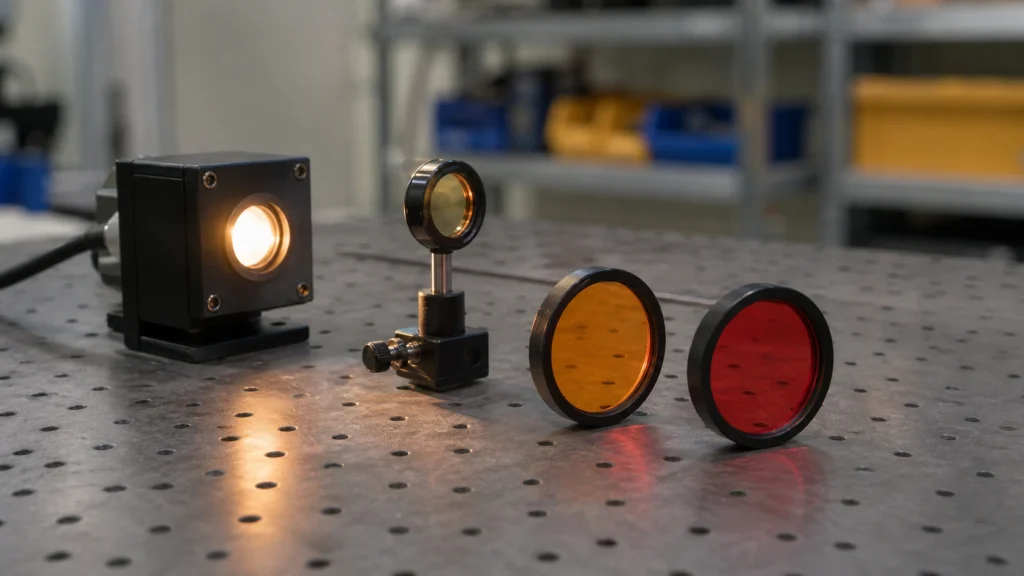
Key Takeaways
- Longpass filter glass provides a wavelength cutoff essential for accurate appliance sensor calibration.
- Common substrates like borosilicate and fused silica offer different thermal and chemical resistance profiles.
- Optical specifications such as cut-on wavelength, transmission, and surface quality directly impact sensor performance.
- AR coatings on filters improve transmission and durability in appliance environments.
- Custom sizing, low prototype MOQs, and fast sampling support quick design cycles.
The Application Goal and Typical Constraints
On a production line for smart home appliances, an infrared thermometer module must deliver reliable readings whether the ambient light is bright kitchen daylight or dim warm-white LED. The calibration routine compensates for detector drift and optical path variations, but it cannot correct for a sensor that sees too much short-wavelength noise. For engineers specifying the optical front end, the goal is to isolate the target infrared band—often 850 nm to 1050 nm—while blocking visible and UV light that can saturate the detector or skew the baseline. The constraints are practical: the filter must withstand years of thermal cycling from room temperature to 80°C, resist humidity and occasional exposure to cleaning agents, and maintain dimensional stability so the sensor’s aiming geometry stays consistent after thousands of cycles.
How Longpass Filter Glass Fits the Requirement
Longpass filter glass acts as an optical gate, absorbing or reflecting wavelengths below a defined cut-on and transmitting longer wavelengths with high efficiency. In an appliance sensor, this characteristic directly addresses the stray light problem. By selecting a longpass filter with a cut-on wavelength just below the emitter’s peak—say, 700 nm for an NIR LED at 850 nm—the sensor sees only the intended signal while rejecting ambient visible light. Unlike thin-film interference filters, absorptive colored glass longpass filters offer wide angular acceptance without shifting the cut-on, a valuable trait when the sensor views a broad area or when the filter is mounted close to the photodiode. The material’s inherent thermal and chemical robustness also aligns with appliance lifetimes, reducing the need for additional protective coatings in many designs.
Selection Criteria for This Application
Choosing the right longpass filter glass involves balancing several technical criteria:
- Spectral transmission and cut-on position: The filter’s 50% transmission wavelength should be placed to maximize signal while attenuating ambient light. For IR-based sensors, a cut-on between 600 and 720 nm is common.
- Coefficient of thermal expansion (CTE): If the filter is bonded or pressed into a metal or plastic housing, mismatched CTEs can cause stress or delamination. Borosilicate or fused silica substrates may be preferred for their low expansion.
- Surface quality and flatness: Scratches or digs can scatter light and reduce signal-to-noise ratio. A 60-40 or better surface finish is often specified, with flatness held to a few waves per inch.
- Durability and chemical resistance: The glass should meet MIL-strength abrasion and humidity tests to survive production handling and field conditions.
- Regulatory compliance: RoHS compliance is standard, and for food-contact appliances, the filter must not leach hazardous substances.
Often, the selection starts from a standard catalog size and cut-on wavelength, then is refined through prototype testing.
A Realistic Project Walk-Through
Consider a development team working on a new built-in oven with an automatic burner control that uses a flame sensor. The sensor must detect the characteristic flicker of a gas flame while ignoring the glow of the oven’s heating element and any kitchen lighting. The optical design calls for a photodiode behind a 5 mm diameter aperture, with a longpass filter to block visible light below 650 nm. The team sources sample filters in three cut-on variations: 630 nm, 665 nm, and 695 nm, each 1 mm thick. Early bench tests show the 695 nm filter provides the best signal contrast, so the team iterates on the mechanical holder to accommodate the filter’s thickness tolerance. After thermal cycling and humidity exposure, the chosen glass shows no measurable transmission shift, confirming its stability. The calibration algorithm is then fine-tuned with the filter in place, yielding consistent flame detection across the specified ambient light range.
What to Plan For: Sizing, Tolerances, Coating, Integration, Logistics
Moving from prototype to production requires attention to detail:
- Dimensional sizing: Custom diameters from 3 mm to 100 mm are available, but stock sizes can reduce lead time. Thickness typically ranges from 0.3 mm to 3 mm, with thicker glass providing greater absorption but adding weight.
- Tolerance stack-up: The filter’s thickness tolerance (+/- 0.05 mm) and wedge angle can affect the optical path length and spot size on the detector. Early modeling of the optical train minimizes surprises.
- Coatings: A broadband anti-reflective coating on both surfaces can improve transmission by several percent and reduce ghost images, especially if the detector is sensitive to back reflections.
- Mechanical integration: Options include press-fit, epoxy bonding, or retention rings. The mounting method must not induce stress that would cause birefringence or cracking.
- Logistics and handling: Filters are typically shipped in waffle packs or vacuum-sealed trays to prevent scratching. For high-volume appliance programs, just-in-time delivery schedules can be coordinated to align with production line rates.
Discuss Your Project Requirements
When you are ready to move forward with an appliance sensor design that demands repeatable optical performance, our engineering team can help you narrow the longpass filter glass options. We can provide transmission data from your specific emitter wavelength, discuss custom sizing, and arrange sample parts quickly. Reach out to begin a technical conversation—no formulas, just a practical path to a filter that fits your calibration needs.
Key Characteristics of Longpass Filter Glass for Sensor Calibration
Longpass filter glass ensures reliable sensor calibration by transmitting wavelengths above a defined cut-on while attenuating shorter unwanted light. This selectivity is fundamental for appliance sensors that use optical triggers for position detection, fluid level sensing, or contaminant monitoring.
Key Facts
- Longpass filters block shorter wavelengths and pass longer ones, defined by a cut-on wavelength (e.g., 550 nm).
- Common substrate materials include borosilicate glass, fused silica, and specialty optical glasses like Schott OG series.
- Filters can be supplied as bare substrates or with anti-reflective (AR) coatings to maximize transmission.
- Typical surface quality is 60-40 scratch-dig or better, with flatness down to λ/4 per inch depending on requirements.
Selecting the Right Material for Appliance Sensor Filters
The choice of glass material directly affects thermal stability, chemical resistance, and transmission range. For most appliance environments, longpass filter glass made from borosilicate offers a balance of cost and durability, handling moderate temperature fluctuations and exposure to humidity. For sensors operating near high-heat sources, fused silica provides lower thermal expansion and higher temperature resistance, reducing the risk of stress-induced birefringence.
Optical and Mechanical Specifications
When specifying a longpass filter for an appliance sensor, several parameters need to align with the optical design. These are typically discussed with the manufacturer to match the exact emitter wavelength and sensor sensitivity.
- Cut-on wavelength: Determined by the glass type and thickness; typically ranges from UV to near-IR.
- Transmission: Above the cut-on, transmission generally exceeds 85% without AR coating, and can reach over 95% with a coating.
- Blocking: Below the cut-on, optical density (OD) can be specified to ensure sufficient blocking of the excitation source.
- Substrate materials: Borosilicate, fused silica, or colored glass like Schott OG550.
- Surface quality: Typically 60-40 scratch-dig per MIL-PRF-13830, with tighter specifications available.
- Flatness: Depends on the application; often λ/2 per inch is adequate, but λ/4 or better can be achieved.
- Dimensional tolerance: Standard ±0.1 mm, with fine-tuning to ±0.05 mm for press-fit integration.
- MOQ: Low volumes for prototypes and ramp-up; higher volume pricing available for production quantities.
Ensuring Long-Term Reliability in Appliance Environments
Appliances introduce challenges like thermal cycling, vibration, and exposure to cleaning agents. Longpass filter glass from reputable suppliers is tested for durability under such conditions. Optical filter glass with proper edge finishing and mounting avoids crack propagation. AR coatings should be specified to resist humidity and abrasion, often meeting MIL-C-675 or similar standards. For outdoor appliances, UV resistance of the glass itself must be considered.
Consolidated Overview of Longpass Filter Glass for Appliance Sensor Calibration
| Parameter | Typical Range/Options | Importance |
|---|---|---|
| Cut-on wavelength | 280–1000 nm (UV to IR) | Defines the boundary for sensor operation |
| Substrate materials | Borosilicate, fused silica, Schott OG series | Impacts thermal and chemical stability |
| Transmission (coated) | >95% in passband | Maximizes signal-to-noise ratio |
| Surface quality | 60-40 to 20-10 scratch-dig | Reduces scatter and false signals |
| Flatness | λ/2 to λ/8 per inch | Maintains beam quality and reduces aberrations |
| AR coating durability | Per MIL-C-675 | Ensures long life in harsh environments |
| Integration methods | Press-fit, epoxy, retention rings | Must minimize stress on the glass |
Note: Exact values depend on the specific filter design and are confirmed during engineering review.
Start Your Custom Filter Evaluation
When you have defined the optical path and operating conditions for your appliance sensor, share your specifications with our engineering team. We can recommend a longpass filter configuration, provide transmission data, and deliver prototypes quickly. Send your drawings or contact us to begin.
Frequently Asked Questions
What is the typical cut-on wavelength range for longpass filter glass used in appliance sensors?
Cut-on wavelengths for appliance sensor applications commonly range from 280 nm in the UV to 1000 nm in the near-IR. The exact value depends on the emitter wavelength and the sensor's sensitivity band.
Can longpass filter glass be supplied with anti-reflective coatings?
Yes, applying an AR coating can increase transmission in the passband to over 95%. Coatings also enhance durability against humidity and cleaning agents, which is beneficial for appliance environments.
How does substrate material choice affect performance in appliance sensors?
Borosilicate glass offers good chemical resistance and moderate thermal stability at a lower cost, while fused silica excels in high-temperature settings due to its low coefficient of thermal expansion. The material must suit the specific appliance's operating conditions.
What surface quality and flatness are standard for longpass filter glass?
A surface quality of 60-40 scratch-dig is typical, with options for 20-10 or better. Flatness is often specified as λ/2 per inch, though λ/4 or tighter can be achieved for more critical applications.
Is there a minimum order quantity for custom longpass filter glass?
Manufacturers often support low MOQs for prototype and development phases, with volume pricing for larger production runs. The exact MOQ depends on the complexity and size of the filter.