
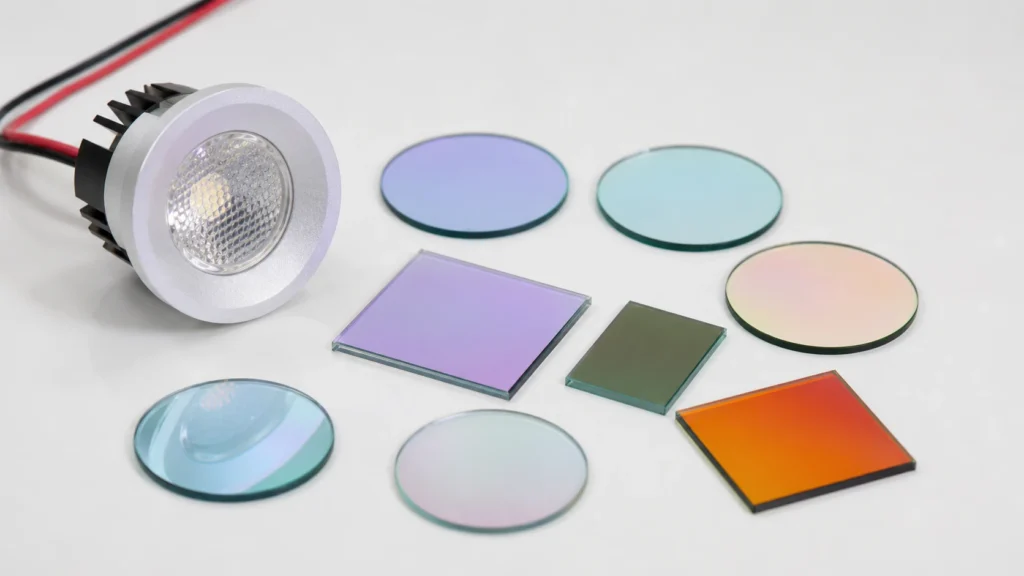
Key Takeaways
- Dichroic filter glass provides stable, accurate color separation for smart appliance LED lighting modules.
- Borosilicate and fused silica substrates offer thermal resistance essential for oven and range hood applications.
- Multi-layer hard coatings withstand humidity, temperature swings, and cleaning agents typical in home appliances.
- Custom cut-on/cut-off wavelengths and angle of incidence are optimized per module design.
- Cleanroom packaging ensures components arrive free of contamination and ready for automated assembly.
Introduction
Integrating reliable, high-precision optical filters into smart appliance lighting modules presents unique challenges. Whether for status indicators, control-panel backlighting, or decorative illumination, the optical glass must combine consistent color performance with long-term durability. Dichroic filter glass from a specialist B2B manufacturer offers an engineered solution that meets these demands—delivering sharp wavelength selectivity while withstanding the environmental conditions typical in home appliances.
Specification Overview
Dichroic filter glass for appliance lighting is manufactured to tight tolerances, with the following common specification parameters:
- Base material: Optical-grade borosilicate glass, fused silica, or B270, selected for thermal stability and transmission requirements.
- Dimensions & thickness: Custom cut to design specification; typical thickness range from 0.3 mm to 3.0 mm, with standard sheet sizes up to 300 mm x 300 mm.
- Dimensional tolerances: ±0.1 mm or better, depending on application needs.
- Flatness: λ/4 per 25 mm area (typical) to avoid distortion in collimated or imaging light paths.
- Parallelism: < 3 arc minutes for consistent angular performance.
- Scratch-dig: 60-40 per MIL-PRF-13830B, suitable for non-imaging appliance optics; tighter grades available on request.
- Edge finish: Ground, seamed, or polished, with CNC edge profiling for drop-in assembly.
- Coatings: Multi-layer dielectric dichroic coating on one or both sides, with optional anti-reflective (AR) coating on the reverse face to maximize transmitted light. Coatings are engineered for specific cut-on/cut-off wavelengths and angle of incidence (typically 0° or 45°).
Variants and Grades
The product line encompasses several standard and custom variants to suit different appliance lighting functions:
- Long-pass dichroic filters: Transmit wavelengths above a specified cut-on (e.g., >500 nm) while reflecting shorter wavelengths. Ideal for warm-white or colored indicator lights.
- Short-pass dichroic filters: Transmit below a cut-off wavelength, often used to block infrared heat from high-brightness LEDs.
- Bandpass dichroic filters: Isolate a narrow spectral band (e.g., 450–470 nm) for pure-blue appliance accents or sensor synchronization.
- Dual-band dichroics: Transmit two distinct wavelength bands while reflecting others, enabling dual-color status signals through a single glass element.
- Custom curve filters: Tailored spectral profiles designed from buyer-provided transmission targets.
All variants can be manufactured with enhanced durability coatings for high-humidity or thermal-cycling environments common in kitchen and laundry appliances.
Typical Applications and Buyer Scenarios
Dichroic filter glass finds use across several industries, but smart appliance lighting is a growing segment with unique requirements. Procurement teams and design engineers specify these filters for:
- Refrigerator and freezer displays: Backlit panels that require consistent color and clarity without bulk absorption filters that fade.
- Oven and cooktop control interfaces: Heat-resistant filters that maintain color accuracy near high-temperature surfaces.
- Washing machine and dishwasher status lights: Moisture-resistant dichroic glass that ensures long life in wet environments.
- Smart home console backlighting: Uniform, high-transmission filters for capacitive touch panels.
- Sensor windows in appliances: Dichroic mirrors used to separate visible light from IR for proximity or gesture detection.
Beyond appliances, the same precision filters are applied in medical diagnostic devices, industrial machine vision, and architectural lighting, giving buyers confidence in a versatile, field-proven technology.
Customization and Ordering Parameters
As a B2B supplier, we work directly with OEM and contract manufacturing partners to deliver dichroic filter glass engineered to their mechanical and optical specifications. Customization options include:
- Dimensions and shape: Rectangles, circles, and free-form contours cut via CNC or waterjet.
- Holes and notches: Precision drilling for mounting or alignment pins, with positional accuracy to ±0.05 mm.
- Edge finishing: Safety seamed, pencil ground, or polished bevels to facilitate automated pick-and-place assembly.
- Coating specification: Custom wavelength transition points (e.g., cut-on at 550 nm ±5 nm, AOI 0°), with CWL tolerance of ±2 nm available on request.
- Packaging: Cleanroom-processed and sealed in vacuum trays or Gel-Pak style carriers to prevent contamination and scratching during shipping.
While MOQ and lead times vary based on substrate size and coating complexity, we support both prototype quantities and high-volume production with a flexible supply chain. Contact our engineering team with your drawings to receive a technical proposal tailored to your project timeline.
Send Your Specifications for a Tailored Quote
To start a procurement discussion or to request a sample for evaluation, send your specifications and target optical performance data. Our application engineers will provide a detailed review and cost estimate for your dichroic filter glass requirements.
How Dichroic Filters Enhance Appliance Lighting Performance
Manufacturers of smart refrigerators, ovens, and washing machines are adopting dichroic filter glass to deliver precise, stable illumination that resists thermal drift and chemical exposure. Unlike dyed plastic filters, hard-coated optical glass components maintain color accuracy over the appliance’s lifetime, even when exposed to heat from adjacent heating elements or repeated condensation cycles.
Substrate and Coating Considerations for Appliance Environments
Glass Substrate Options
The base glass must balance thermal expansion, mechanical strength, and optical clarity. Dichroic filter glass substrates are often fabricated from borosilicate glass, such as Borofloat 33, due to its low thermal expansion and high resistance to thermal shock—critical in oven and range hood applications. Fused silica substrates offer even higher thermal stability and UV transmission, though at a higher unit cost. For cost-sensitive projects where thermal demands are moderate, soda-lime glass can be an option, provided the coating compensates for the substrate’s lower inherent transmittance.
Coating Durability and Design
The dichroic coating—typically a multi-layer stack of metal oxides deposited via ion beam sputtering (IBS) or plasma-assisted reactive evaporation—must withstand environmental stressors common in appliances: humidity, frequent temperature swings, and occasional contact with cleaning agents. An overcoat layer is often applied to protect the optical stack, and adhesion is tested per MIL-C-675 or similar standards. For smart appliance modules that indicate status (e.g., wash cycle complete), the coating can be designed for a sharp cut-on at a specific wavelength, such as 550 nm for green indicators, with high transmission in the passband and deep blocking in the reflection band.
Key Procurement Facts for Dichroic Filter Glass
- Substrate materials: borosilicate glass (e.g., Borofloat 33), fused silica, soda-lime; thicknesses from 0.3 mm to 3.0 mm commonly available.
- Coating design: custom cut-on/cut-off wavelengths from UV to IR, with steep transition slopes; angle-of-incidence (AOI) optimized for 0° or 45° as required by the module geometry.
- Environmental resistance: coatings tested for humidity, thermal cycling, and chemical exposure; meets MIL-C-675 adhesion requirements.
- Surface quality: 60-40 scratch-dig typical; better upon request. Flatness λ/4 per 25 mm, parallelism ≤ 5 arcmin.
- Packaging: cleanroom-processed, sealed in vacuum trays or Gel-Pak carriers to maintain pristine surfaces during shipment.
| Aspect | Details |
|---|---|
| Substrate Materials | Borosilicate (Borofloat 33), fused silica, soda-lime; thicknesses 0.3–3.0 mm |
| Tolerances & Surface Quality | Flatness λ/4 per 25 mm, parallelism ≤5 arcmin, scratch-dig 60-40 or better |
| Coating Capabilities | Custom dichroic cut-on/cut-off wavelengths; steep transition slopes; AOI 0° or 45°; hard-coated for environmental resistance |
| Typical Appliance Applications | Refrigerator interior lighting, oven status indicators, washing machine cycle indicators, water dispenser light modules |
| Customization Options | Dimensions from small chips to sheets; drilled holes, notches; AR coatings on reverse side; cleanroom packaging |
| Certifications | Coating adhesion per MIL-C-675; cleanroom processing per ISO Class 5 or better |
To receive a technical proposal and discuss your specific appliance lighting module requirements, send your drawings and performance targets to our engineering team.
Frequently Asked Questions
What are the advantages of using dichroic filter glass over absorptive filters in smart appliances?
Dichroic filters reflect unwanted wavelengths rather than absorbing them, so they generate less heat and do not fade or bleach over time. This makes them ideal for appliance lighting that must endure high temperatures and frequent cycling, maintaining consistent color output throughout the product's life.
How does substrate material affect dichroic filter performance in appliances?
The substrate must match the thermal and mechanical demands of the appliance environment. Borosilicate glass is often chosen for its low thermal expansion and shock resistance, while fused silica offers superior thermal stability and UV transmission for demanding applications.
Can dichroic filter glass be customized for specific smart appliance lighting designs?
Yes, manufacturers offer custom shapes, sizes, drilled holes, and notch cuts. The coating design can be engineered for exact wavelength cut-on/cut-off points and angle-of-incidence to align with LED emission spectra and module geometry.
What durability standards apply to dichroic filter glass for appliances?
Coatings are typically tested per MIL-C-675 for adhesion and abrasion resistance. They must also withstand humidity, thermal cycling, and exposure to common household cleaners without delaminating or shifting spectral performance.
How does angle of incidence affect dichroic filter performance in appliance lighting?
Dichroic coatings are designed for a specific angle, commonly 0° (normal incidence) or 45°. Using the filter at a different angle shifts the spectral transition, so the coating is optimized for the exact mounting orientation within the appliance module to achieve the desired color and efficiency.