
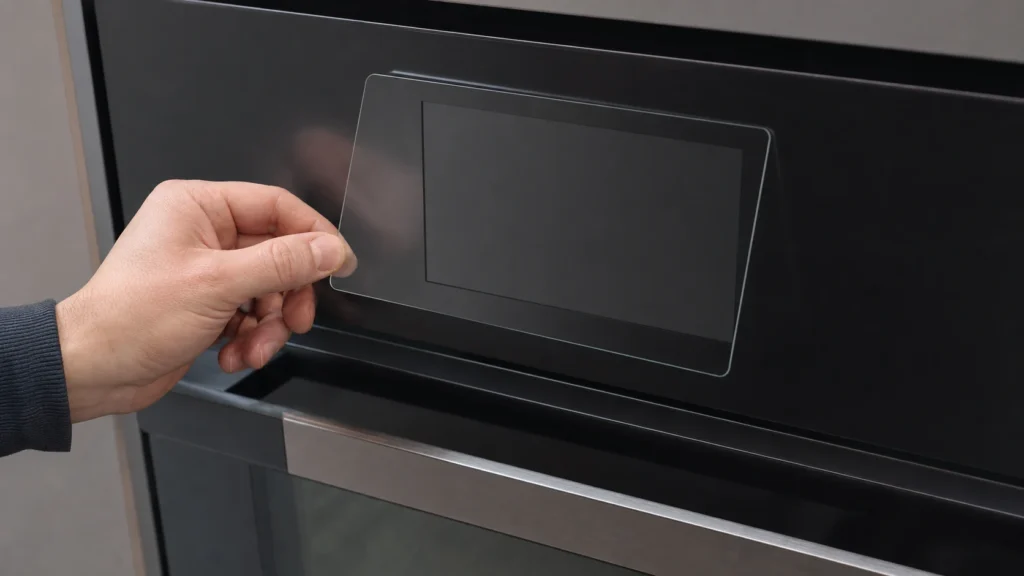
Key Takeaways
- AR coated glass for appliance touch screens reduces surface reflections to less than 1% per side, significantly enhancing display visibility and energy efficiency.
- Chemically strengthened aluminosilicate glass is a preferred substrate for its high break resistance and suitability in user-facing panels exposed to daily cleaning.
- Environmental testing for thermal shock, damp heat, and chemical resistance is critical to ensure long-term reliability in household appliances.
- Custom AR coated glass windows are manufactured with precise dimensional tolerances, surface quality, and edge finishing to meet specific integration and safety requirements.
Application Goals and Operating Constraints
A quality inspector lifts a washing machine control panel from the assembly line and tilts it toward the overhead fluorescent lights. The screen must remain crisp and legible, without reflections that mask the wash-cycle icons. This is the daily reality for appliance OEMs: the glass cover of a touch screen needs to perform under variable lighting, endure frequent finger contact, and withstand household cleaners—all while maintaining precise touch sensitivity.
Modern kitchen and laundry appliances integrate capacitive touch interfaces that users expect to respond instantly. Any loss of contrast, glare, or smudging erodes the perceived quality of the machine. The glass window thus becomes a critical component that directly influences the user experience and the brand’s reputation for reliability.
How AR Coated Glass Fits the Requirement
An anti-reflective (AR) coating applied to the glass surface reduces surface reflections from about 4% per side to well below 1%. Less reflected light means more of the display’s brightness reaches the user’s eye, improving readability without increasing backlight power. For appliance touch screens, this translates into easy-to-read icons, even under bright kitchen spotlights or near a sun-lit window.
It is important to distinguish AR from anti-glare (AG). AG treatments scatter light to soften reflections but can reduce sharpness; AR coatings use thin-film interference to cancel reflections, preserving image clarity. In many applications, an AR coating is combined with an oleophobic top layer to repel fingerprints, creating a durable, easy-to-clean surface. Buyers should specify whether the AR coating is needed on one side (usually the front) or both, depending on whether the glass is bonded directly to the display.
Selection Criteria for Appliance Touch Screen Glass
When evaluating AR coated glass sheets for an appliance panel, several technical parameters come into play:
- Optical transmission: Look for high visible-light transmission to maximize display efficiency. AR coatings can boost transmission by several percentage points, which is especially valuable when using low-power displays or when deep blacks are required.
- Coefficient of thermal expansion (CTE): The glass substrate and coating must survive the thermal cycling typical of appliances—ovens, refrigerators, and washing machines experience temperature swings. Matching the glass CTE to adjacent materials prevents delamination or stress cracks.
- Flatness and thickness tolerance: Consistent thickness and low warp ensure uniform air gap or optical bonding, which affects touch sensitivity. Tight flatness specs also help with high-speed automated lamination processes.
- Chemical and abrasion resistance: The coated surface should resist common kitchen oils, cleaning agents, and repeated wiping. Durability testing under IEC or ASTM standards for mechanical wear and chemical exposure provides assurance.
- Regulatory compliance: Verify RoHS, REACH, and any food-contact regulations if the panel is near food preparation areas.
A Realistic Project Scenario: From Prototype to Production
Consider an OEM developing a new touchscreen oven controller. During the design phase, the engineering team prototypes a 7-inch display with a soda-lime glass cover. Initial samples without AR coating show distracting reflections that wash out the temperature readout. The team requests AR coated samples from their glass supplier, specifying a single-sided AR with an additional oleophobic layer.
The supplier provides small-batch prototypes with documented transmittance curves, flatness data, and environmental test results. After passing the OEM’s in-house drop-test and thermal cycling (from -10°C to 85°C), the design is frozen. The supplier then supports a tooling phase to fabricate the exact outer dimensions with a polished edge finish and a black printed border. Pilot runs confirm consistency, and mass production ramps up with quality checks on coating uniformity and cross-hatch adhesion.
What to Plan For: Sizing, Tolerances, Coating, Integration, and Logistics
Integrating a custom AR coated glass window into an appliance demands early attention to several manufacturing details:
- Dimensions and edge finishing: Final glass size with tolerances of ±0.1 mm or better, plus edge treatments like CNC seaming or polishing, ensure a seamless fit into the bezel.
- Coating specification: Clarify if the AR coating must be deposited on one or both sides, and whether additional functions—AG, AF (oleophobic), or anti-fog—are required. Confirm the coating can withstand the bonding process temperature.
- Integration methods: Choose between air-gap mounting and optical bonding. Optical bonding eliminates internal reflections but adds cost; the AR coating must be compatible with the chosen adhesive.
- Logistics and packaging: Packaged in antistatic, scratch-preventive trays; shipped in climate-controlled containers if needed. Forecast lead times for custom-size orders, which typically range from weeks to months depending on volume.
Discuss Your Project Requirements
Every appliance touch screen program presents a distinct combination of optical, mechanical, and environmental demands. Engage early with a glass supplier who can translate your concept into a production-ready specification. Whether you need a chemically strengthened panel for a refrigerator door or a thin, lightweight window for a portable kitchen appliance, the right AR coated glass solution exists.
Optimizing Appliance Touch Screen Clarity with AR Coated Glass
AR coated glass for appliance touch screens must deliver high visible light transmission, robust mechanical strength, and resistance to frequent cleaning and thermal changes. A well-specified ar coated glass component reduces reflections to less than 1% per surface, dramatically improving display readability in bright kitchen or laundry environments. This performance stems from a multi-layer dielectric coating applied via a precision anti reflective coating process that ensures uniform optical properties across the entire viewing area.
Material Selection for Appliance Touch Screen Glass
The substrate material directly influences impact resistance, thermal stability, and coating adhesion. Chemically strengthened aluminosilicate glass is a common choice for its high break resistance and scratch durability, essential for user-facing panels that endure repeated touches and wiping. Borosilicate glass provides superior thermal shock resistance and is suitable for appliances exposed to high temperatures, such as oven doors and range hoods. Soda-lime glass, often used in cost-sensitive applications, may require thicker cross-sections to achieve comparable strength. Fused silica is reserved for extreme thermal or UV exposure scenarios, though rarely needed in standard residential appliances.
Surface Quality and Optical Specifications
Post-coating transmission typically exceeds 95% per surface in the visible spectrum (400–700 nm), measured with a spectrophotometer. Surface quality is defined by scratch-dig standards, with 60–40 being a common specification that balances cost and performance. Tighter specifications like 40–20 are achievable for premium displays but increase processing time and cost. Flatness is critical for lamination and optical bonding; a specification of λ/2 per inch is generally sufficient, though tighter tolerances are available. Edge finishing options include seamed, ground, or polished edges, depending on integration requirements and safety considerations.
Environmental Durability and Compliance
Appliance touch screens encounter humidity, temperature cycling, and exposure to household chemicals. Suppliers should provide test data for thermal shock (e.g., -40°C to +85°C cycling), damp heat (85°C/85% RH), and resistance to common cleaners like ammonia-based solutions. The AR coating must withstand abrasion from cleaning cloths; a steel wool rub test is often used to verify durability. Compliance with RoHS and REACH is standard, and some OEMs may request additional certifications such as UL or IEC 60335 for household appliance safety. Ensure the glass and coating are tested as a complete assembly to replicate real-world performance.
Key Facts for Specifying AR Coated Appliance Glass
- AR coatings reduce surface reflection to <1% per side, enhancing display contrast and energy efficiency.
- Chemically strengthened aluminosilicate glass offers high break resistance, making it ideal for user-facing panels.
- Surface quality of 60-40 scratch-dig is typical, with tighter specs available for premium applications.
- Environmental testing should include thermal shock, damp heat, and chemical resistance to validate long-term reliability.
- Custom sizes, shapes, and edge finishes are produced to match the appliance’s industrial design and integration method.
Attribute Comparison for Sourcing
When evaluating AR coated glass suppliers for appliance touch screens, compare these attributes:
Material options: Aluminosilicate, borosilicate, soda-lime, fused silica.
Thickness range: Custom from 0.5 mm up to several millimeters, depending on strength and weight requirements.
Surface quality: Scratch-dig 60-40 or better; flatness down to λ/4 per inch if optical bonding is used.
AR coating type: Broadband multi-layer dielectric, designed for the visible spectrum; anti-smudge or oleophobic topcoats optional.
Environmental testing: Thermal shock, damp heat, chemical resistance, abrasion (e.g., steel wool).
Certifications: RoHS, REACH; additional appliance-specific certifications like IEC 60335 upon request.
Minimum order quantity: Varies by project scale; prototypes and low-volume runs are often accommodated.
Lead time: Typically several weeks for custom-cut and coated parts; expedited options may exist.
| Specification Aspect | Typical Considerations | Importance for Appliance Touch Screens |
|---|---|---|
| Substrate Material | Aluminosilicate, borosilicate, soda-lime, fused silica | Balances strength, thermal resistance, and cost |
| AR Coating | Multi-layer dielectric, <1% reflection per surface | Maximizes transmission and readability |
| Surface Quality | 60-40 scratch-dig, λ/2 flatness | Ensures visual clarity and bonding uniformity |
| Thickness | 0.5 mm to several mm | Affects durability, weight, and touch sensitivity |
| Edge Finishing | Seamed, ground, or polished | Safety and seamless integration into bezels |
| Thermal Stability | Tested for thermal shock and damp heat | Prevents failure in oven or range hood applications |
| Chemical Resistance | Resists ammonia-based cleaners and other household agents | Maintains coating integrity over years of cleaning |
| Compliance | RoHS, REACH; optional IEC 60335 | Meets regulatory and OEM safety requirements |
Request a Custom Quote for Your Appliance Touch Screen Glass
Every appliance design has unique optical, mechanical, and environmental requirements. By engaging with a specialized precision glass manufacturer early in the design phase, you can optimize the AR coated glass window for performance and manufacturability. Whether you need a prototype for testing or a production-ready solution, our engineering team can help translate your specifications into a reliable component. Submit your drawings and performance requirements to receive a tailored recommendation and quotation.
Frequently Asked Questions
What is the difference between AR coated glass and regular glass for touch screens?
AR coated glass incorporates a thin, multi-layer dielectric film that reduces surface reflections, improving light transmission and display readability. Regular glass reflects a higher percentage of light, leading to glare and reduced contrast in bright environments.
Is AR coating the same as anti-glare for appliance displays?
No, anti-glare treatments typically involve a textured surface to scatter reflected light, which can reduce sharpness. AR coating uses optical interference to cancel reflections without diffusion, maintaining high clarity and contrast.
What material is best for AR coated appliance touch screen glass?
Chemically strengthened aluminosilicate glass is commonly chosen for its high break resistance and scratch durability. Borosilicate glass may be preferred for high-temperature applications like oven displays, while soda-lime glass can be used in cost-sensitive designs.
Can AR coated glass be cleaned with standard household cleaners?
Yes, but it is recommended to use mild, non-abrasive cleaners and a microfiber cloth. Abrasive cleaners or rough cloths can scratch the AR coating over time, degrading optical performance.
What specifications should I look for when sourcing AR coated glass for appliances?
Key specifications include substrate material, coating transmission percentage, surface quality (scratch-dig), dimensional tolerances, edge finishing, and environmental test data. Also verify compliance with RoHS, REACH, and any appliance-specific safety standards like IEC 60335.