
Key Takeaways
- Fused silica viewports maintain UV transmission and hermetic seals far longer than borosilicate alternatives, directly stabilizing optical monitoring signals.
- A vacuum‑side AR coating tuned to the process wavelength delivers a measurable signal‑to‑noise improvement without introducing outgassing risks.
- Retrofitting with fused silica viewports cuts rework rates and downtime by eliminating mid‑campaign window fogging or pressure‑related drift.
- Planning flange material, clear aperture, and coating durability up front prevents integration surprises and extends maintenance intervals.
The Business Problem: Yield Loss and Downtime from Viewport Failure
Operators of vacuum chambers and optical systems often face a recurring challenge: the viewport, that small window into a critical process, becomes a bottleneck. A semiconductor fab experiences a drift in plasma etching endpoints because a fogged borosilicate window scatters the optical emission signal. A laser processing station sees its alignment drift as heat cycling micro-cracks the glass, breaching vacuum and contaminating the beam path. These events trigger unplanned maintenance, scrap batches, and lower throughput. The root cause is typically the viewport material—standard glasses degrade under intense UV, rapid thermal swings, or corrosive process chemistries. For B2B operators and buyers, the goal is clear: eliminate this failure point to maximize tool availability, measurement repeatability, and overall equipment effectiveness (OEE).
How Fused Silica Viewports Eliminate the Root Causes
Fused silica—often called quartz glass—directly addresses the weaknesses of conventional viewport materials. Its ultra‑high purity and amorphous structure give it a uniquely broad transmission range from deep ultraviolet (down to 170 nm) through visible and into the near‑infrared, with negligible absorption bands that would otherwise heat the window. This material can withstand continuous exposure to UV‑rich plasma or eximer laser light without darkening or creating color centers.
Thermal behavior is equally important. Fused silica has a coefficient of thermal expansion roughly 15 × lower than borosilicate glass. In practice, this means a viewport can endure rapid thermal transients—such as a chamber bake‑out or a high‑power laser pulse—without cracking or distorting the seal. The resulting hermeticity stays stable across wide temperature ranges, preserving the vacuum environment and preventing contaminants from entering.
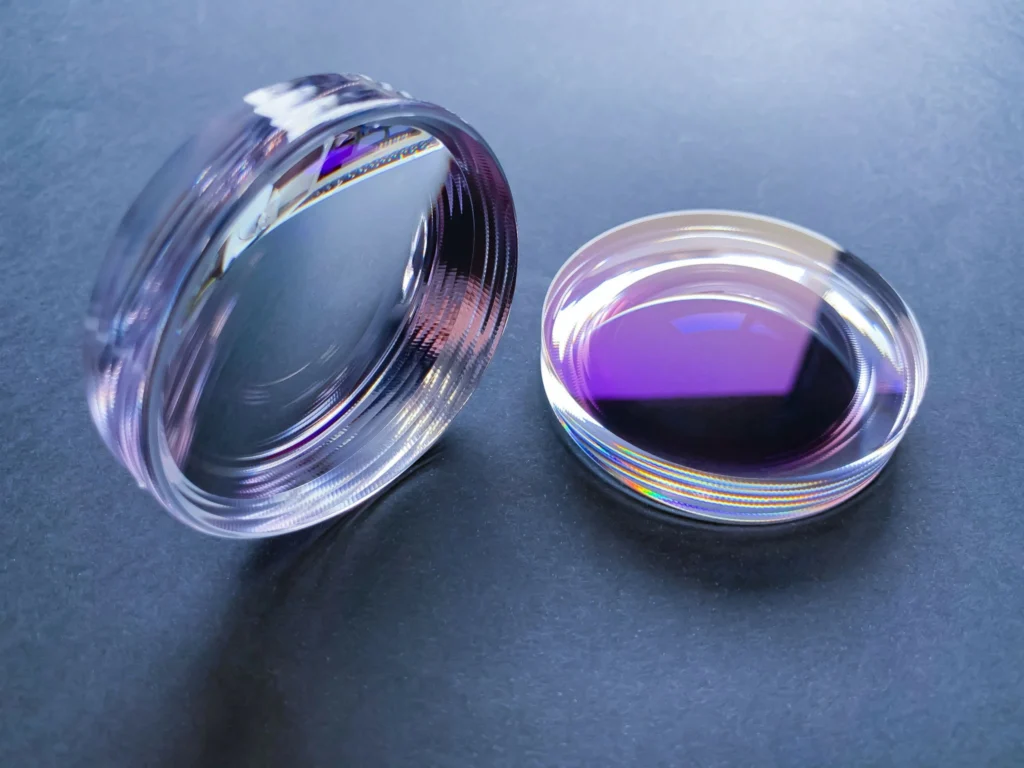
For demanding applications, viewport assemblies are offered with UV‑grade or deep‑UV laser‑grade material, often fused to a variety of standard flange types (CF, ISO‑K, KF) using proven sealing techniques. Optional antireflection coatings can be applied to boost transmission at specific wavelengths, further enhancing signal‑to‑noise ratios in metrology or process control. By removing the need for frequent window replacement and recalibration, fused silica viewports keep tools running longer between preventive maintenance cycles, directly cutting labor costs and raising line productivity.
A Realistic Application Scenario: Ion Beam Sputtering in Precision Optics
Consider a mid‑volume manufacturer of high‑damage‑threshold laser mirrors. Their process uses an ion beam sputtering (IBS) system operating under high vacuum. An operator must monitor deposition uniformity through a chamber viewport using an optical monitor that measures reflectance at 355 nm. The original viewport was made of borosilicate glass, mounted on a CF40 flange. After as few as 20 process runs, the window exhibited a measurable loss of UV transmission and microscopic cracks from repeated thermal cycling of the ion source. Vacuum integrity began to degrade, causing fluctuations in the base pressure that shifted the deposition rate and compromised film stoichiometry. The resulting rework rate exceeded 15%.
The company retrofits the chamber with a fused silica viewport—UV‑grade material hermetically sealed into the same CF40 flange. A single‑layer AR coating for 355 nm is applied to the vacuum side. After installation, the optical monitor signal stabilizes, and the chamber maintains its base pressure within 2 × 10⁻⁷ mbar over months of operation. Process engineers observe that the coating runs now hold consistent optical thickness, reducing scrap to near zero. The maintenance team appreciates that the viewport only needs a wipe‑down during routine service, not replacement. Overall, the equipment uptime improves by roughly 5%, and the annual cost of consumable windows drops significantly.
Measurable Improvements That Stick
Operators who switch to fused silica viewports see a cascade of production benefits that are easy to connect to the physical properties of the material. Because the glass resists devitrification and ion bombardment in harsh vacuum environments, the optical path stays clear over thousands of pump‑down cycles. A consistent signal from the thickness monitor or spectrometer means fewer manual corrections to process recipes, so the line runs longer without operator intervention. One laser optics house found that after upgrading its vacuum chamber windows to UV‑grade fused silica with a single‑layer AR coat, the need to stop the batch for viewport fogging vanished. The resulting uptime gain came not from faster processing but from the elimination of mid‑campaign window swaps.
The quality story follows the same logic. When the monitoring signal drifts due to a clouded or etched port, film properties slip before a visible defect appears. By keeping the signal crisp, the window helps hold optical thickness within tighter bands, which translates directly to higher first‑pass yield. Scrap rates that once hovered in the double digits because of subtle film‑thickness errors drop to negligible levels. Labor shifts from fighting fires to fine‑tuning throughput.
Planning a Clean Integration
Specifying a fused silica viewport is more than picking a flange size. Start by matching the transmission range to your diagnostic or laser wavelength. For excimer lines at 193 nm or tripled YAG at 355 nm, JGS1‑grade material virtually eliminates absorption at the working wavelength. If the system uses a broadband light source for plasma emission spectroscopy, uncoated fused silica delivers flat transmission from the deep UV through the near‑infrared.
Next, settle the coating requirements. A simple broadband AR layer on the vacuum side can boost transmission by several percent, but consult on the coating’s durability under your specific plasma chemistry. For chambers that run oxygen‑rich processes, some deposition shops prefer a protective overcoat to prevent oxidation of the AR stack. The flange weld must remain hermetic after repeated thermal cycling, so work with a supplier that helium‑leak‑tests every assembly and can offer a choice of flange materials if your chamber body is a specialty alloy.
Capacity planning often overlooks the service port. If the viewport does double duty as an access window for beam alignment, specify a clear aperture that suits the tooling without over‑constraining the flange. A well‑dimensioned window lets the maintenance team perform a wipe‑down during routine pump service while keeping the chamber sealed. That simple change can trim another 10–20 minutes from each preventive‑maintenance event.
Start with a Conversation
No two vacuum systems are identical, and a supplier that understands both glass science and process integration can help you avoid the pitfalls of off‑the‑shelf solutions. Whether you need a single UV‑grade quartz port for a prototype R&D chamber or a set of AR‑coated optical windows for a full production line, reaching out early ensures that material grade, coating design, and flange integration are all in lockstep. Share your pressure and temperature curves, your laser fluence, and your target baseline for transmission stability. A good partner will run the thermal‑shock calculations and recommend a design that gives you predictable optical performance without over‑engineering your budget.
| Challenge | How a Fused Silica Viewport Responds | End Result |
|---|---|---|
| Standard window degrades in UV/vacuum | UV‑grade fused silica resists devitrification and ion damage | Stable optical monitoring over long campaigns |
| Pressure fluctuations from leaky seals | Hermetic metal‑on‑glass seal tested for helium leak rate | Consistent base pressure, reduced deposition drift |
| Signal loss from uncoated surfaces | Vacuum‑side AR coating optimized for process wavelength | Higher signal‑to‑noise ratio, better thickness control |
| Frequent window replacement disrupts uptime | Hard, chemically durable material requires only wipe‑downs | Reduced consumable cost, fewer unplanned breaks |
| Opaque window hides early process shifts | Sustained clarity enables real‑time plasma or beam diagnostics | First‑pass yield improvement, lower scrap rates |
| Mismatched flange or coating for process | Custom flange materials and AR stacks matched to chamber chemistry | Seamless retrofits, no compromise on vacuum integrity |
Frequently Asked Questions
How does a fused silica viewport improve optical monitoring over a borosilicate window?
Fused silica offers superior transmission in the UV range and far greater resistance to ion‑induced devitrification. While borosilicate can cloud after exposure to energetic plasma, UV‑grade fused silica remains clear, keeping the signal from thickness monitors or spectrometers stable through extended deposition runs.
Why is an AR coating important on a vacuum viewport?
An anti‑reflection coating on the vacuum side reduces reflective losses at the glass‑vacuum interface, recovering several percent of the signal that would otherwise be lost. In optical monitoring systems, this higher signal‑to‑noise ratio enables tighter control over film thickness and reduces the need for manual recalibration.
What wavelength ranges can fused silica viewports handle?
High‑purity synthetic fused silica transmits from about 185 nm in the deep UV through the visible spectrum and into the near‑infrared up to roughly 2.5 µm. This wide band makes it suitable for excimer laser diagnostics, plasma‑emission spectroscopy, and many common process‑control wavelengths.
How do you specify a fused silica viewport for a vacuum chamber?
Key parameters include the flange type and size (such as CF, ISO, or KF), the desired clear aperture, transmission wavelength for any coatings, and the material grade—typically JGS1 for UV or JGS2 for visible applications. The supplier should also verify helium leak rate and temperature range for your process.
What maintenance is required for fused silica viewports?
Under normal vacuum operation, a fused silica viewport needs only an occasional wipe with a lint‑free cloth and optical‑grade solvent during routine pump service. The material’s chemical durability means it rarely requires repolishing or replacement, which reduces labor and consumable costs compared to softer glass windows.