
Key Takeaways
- Custom glass microfluidic chips provide the optical clarity and chemical inertness required for reliable appliance fluid detection across a range of chemistries.
- Substrates like BF33 borosilicate, fused silica, and sapphire are selected based on transmission requirements, thermal exposure, and mechanical durability in the appliance environment.
- Precision laser etching and wet chemical etching enable microchannel features with repeatable dimensions that ensure consistent fluidic behavior and sensor response.
- ISO 9001 manufacturing practices and optional lot-specific certificates provide quality assurance from prototype to volume production.
The Application Goal: Reliable Fluid Detection in Confined Spaces
How do you integrate precise fluid level or quality sensing into a compact appliance while ensuring years of trouble-free operation? Appliance manufacturers face demanding requirements: the detection system must fit within a tightly packed enclosure, resist chemical attack from water, detergents, and cleaning agents, and perform consistently across wide temperature cycles. For products like washing machines, coffee brewers, or water dispensers, fluid detection is not a standalone lab function — it must be an embedded, low-maintenance, and cost-effective solution that aligns with high-volume production. Achieving this means selecting a sensor platform that delivers optical clarity, dimensional stability, and chemical inertness without sacrificing design flexibility.

How a Custom Glass Microfluidic Chip Fits the Requirement
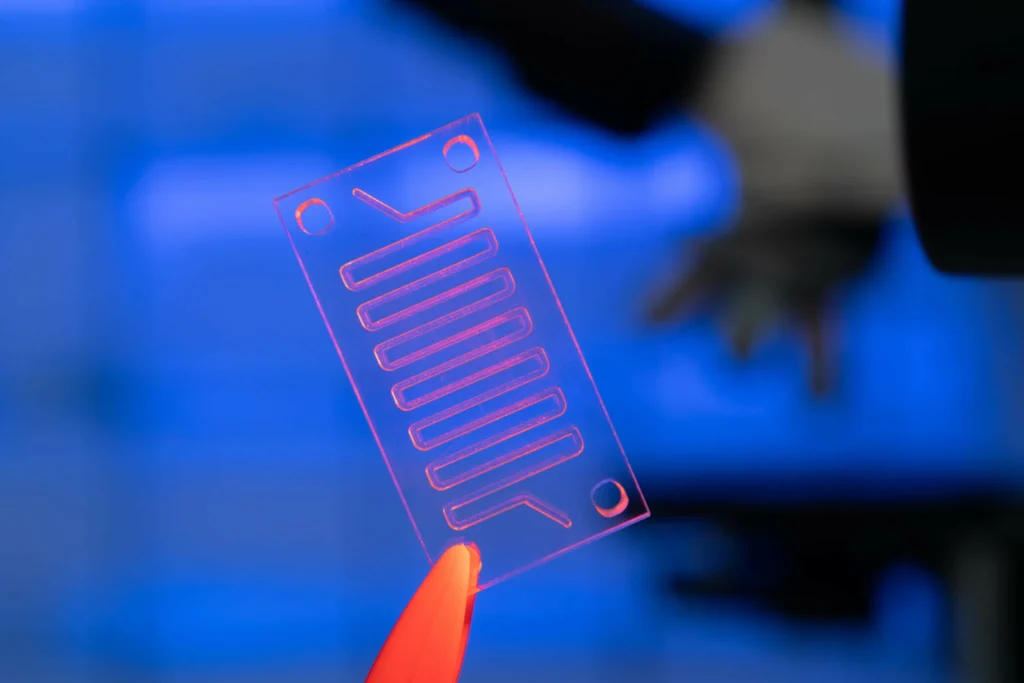
A custom glass chip engineered as a microfluidic device integrates precisely structured microchannels, optical paths, and fluidic ports into a single substrate. The inherent properties of glass — high transparency across UV-VIS-NIR wavelengths, exceptional flatness, and resistance to swelling or leaching — make it the material of choice for appliance fluid detection. Unlike polymers, glass does not degrade when exposed to aggressive cleaning solutions or prolonged hot water. Its thermal expansion coefficient can be matched to silicon or metal components, preserving optical alignment during thermal cycling. The glass microfluidic chip can be designed with buried channels, integrated light guides, or electrode layering, enabling both optical (absorbance, fluorescence, turbidity) and capacitive detection methods. This adaptability allows appliance engineers to consolidate multiple functions — such as sample transport, mixing, and detection — into a miniaturized, robust component that can be directly mounted on a PCB or fluid manifold.
Selection Criteria for Appliance Fluid Detection Chips
Several factors must be evaluated when specifying a glass chip for fluid detection:
- Optical Transmission: The glass must transmit the wavelength(s) used for sensing with minimal auto-fluorescence or scatter. Borosilicate and fused silica are common choices for their broad transparency and low background signal.
- Thermal Expansion (CTE): Matching the CTE of the glass to adjoining materials (e.g., silicon photodiodes, plastic housings) prevents stress fractures and misalignment during repeated heating/cooling cycles.
- Flatness and Surface Quality: Channel floor and cover flatness directly affect bonding integrity and flow characteristics. A surface roughness of a few nanometers is typical for reliable anodic or thermal bonding.
- Chemical Durability: The glass must withstand long-term contact with water, detergents, and any additives without leaching ions or altering surface energy. Fire-polished or coated surfaces can enhance resistance.
- Design Compliance: Materials and processes should align with relevant regulations (e.g., RoHS, FDA if food contact) and withstand standard appliance sterilization or cleaning protocols.
A Realistic Scenario: From Design to Flawless Detection
Consider a front-load washing machine that requires real-time turbidity measurement to optimize rinse cycles. The engineering team defines a detection principle based on 90-degree light scattering. Working with a glass microfluidics manufacturer, they co-develop a chip featuring a serpentine channel with a cross-section of 200 × 200 µm, a recessed window for an LED source, and a perpendicular collection path for a photodetector. Early prototypes are tested for bubble entrapment; minor geometry adjustments eliminate dead zones. The chip is then coated with a thin hydrophobic layer to prevent detergent residue buildup. Once the design is frozen, the wafer-scale fabrication process yields thousands of identical chips, each verified for channel dimensions and optical throughput. The chips are shipped in cleanroom-grade carriers, ready for automated pick-and-place integration onto the appliance’s main control board. This collaborative, iterative approach minimizes development risk and accelerates time-to-market.
Planning for Production: Sizing, Tolerances, and Integration
Successful deployment of a custom glass chip in an appliance requires careful upfront planning:
- Channel Sizing: Feature dimensions typically range from 50 µm to several millimeters, depending on flow rate and detection volume. Tighter tolerances (±1–2 µm) are achievable but influence cost.
- Tolerance Stack-up: Alignment of optical axes, fluidic interconnects, and electrical contacts must account for chip-to-chip variation and assembly tolerances. Early involvement of the chip vendor helps define realistic specifications.
- Surface Coatings: Functional coatings (hydrophilic, hydrophobic, or anti-reflective) can be applied during fabrication to improve wetting, prevent biofouling, or enhance optical coupling. Specify the desired contact angle or reflection loss.
- Integration Features: Include fiducial marks for vision-based assembly, defined bond pads for anodic bonding, and standardized port interfaces (e.g., miniature luer, press-fit) to simplify system plumbing.
- Logistics: Glass chips are fragile; a packaging scheme (gel packs, waffle trays) that prevents edge damage and contamination during transport is essential for high-yield assembly lines.
Discuss Your Fluid Detection Project Requirements
Every appliance application presents unique constraints—whether you need a chip for optical clarity in a coffee machine’s water path or a chemically inert sensor for industrial detergent dosing. Our engineering team is ready to review your specifications, from initial concept to volume production. Share your performance targets, dimensional limits, and integration needs, and we’ll help you navigate material selection, chip architecture, and compliance testing. Let’s start a conversation about your next custom fluid detection solution.
Custom Chip Configurations for Accurate Fluid Detection
Our custom glass microfluidic chips deliver the precise fluid handling and optical access necessary for reliable appliance fluid detection—whether measuring water hardness in a dishwasher, monitoring reagent levels in a laboratory washer, or verifying detergent concentration in an industrial dispensing system. Every custom microfluidic chip we produce is backed by in-house design-for-manufacturing review to optimize yield and reliability. By partnering with engineers early in the design phase, we tailor every chip’s channel geometry, material stack, and interface ports to match the specific sensor technology and fluidic requirements of your application.
Common configurations include transparent single-layer chips with simple straight channels for absorbance or fluorescence measurements, multi-layer stacks that separate fluidic and optical layers for integrated waveguides, and chips with patterned electrodes for conductivity sensing. Port styles range from standardized luer interfaces to custom press-fit inlets that simplify tubing connections in compact appliance housings. For optical detection zones, we offer polished windows with surface flatness suited to lensed or fiber-coupled sensor head alignment—critical for maintaining signal-to-noise ratios in embedded systems.
Key Facts About Our Glass Microfluidic Chips for Appliance Fluid Detection
- Borosilicate glass substrates (such as BF33) provide low autofluorescence and high transmission from visible to near-infrared, essential for accurate optical fluid sensing.
- Fused silica variants extend UV transparency for applications requiring UV absorbance or fluorescence excitation below 300 nm.
- Channel features are fabricated via precision laser etching or wet chemical etching, with dimensional control necessary for repeatable fluidic resistance.
- Chips are supplied in cleanroom-compatible packaging (gel packs or waffle trays) to prevent edge chipping and particle contamination during transport and assembly.
- All manufacturing follows ISO 9001 quality management practices, with optional certificates of conformance per lot.
Material and Fabrication Options
Glass Substrate Selection
The choice of glass directly impacts detection performance and chip longevity. Borosilicate glasses such as bf33 glass chip offer excellent chemical durability and thermal shock resistance, making them suitable for applications involving heated cleaning cycles or aggressive detergents. For optical sensing in the deep UV—for instance, detecting aromatic compounds in water—fused silica or high-purity quartz provides superior transmission and minimal measurable fluorescence background. Sapphire, though more costly, is employed when extreme scratch resistance or high-pressure tolerance is mandatory.
Channel Fabrication and Sealing
Microchannels are produced through femtosecond laser machining or hydrofluoric acid-based wet etching, depending on the required aspect ratios and surface roughness. Laser etching allows rapid prototyping and complex 3D channel profiles, while wet etching yields smoother channel walls that reduce scattering in optical detection zones. After cleaning, a cover glass—often of the same material to match thermal expansion—is permanently bonded using thermal fusion bonding for native glass surfaces or anodic bonding when a silicon layer is present. These methods produce leak-tight seals compatible with long-term immersion in appliance service environments.
Surface Quality and Coatings
Optical window surfaces are typically polished to a 60-40 scratch-dig or better, with transmitted wavefront error controlled to λ/4 where needed for interferometric sensors. Anti-reflection (AR) coatings can be applied to minimize reflection losses at specific wavelength ranges, while hydrophobic or hydrophilic coatings tune wettability inside channels for improved capillary action or sample flow control. All coatings are applied in-house or through certified partners, with adhesion and environmental stability verified according to MIL-STD-810 or similar standards upon request.
| Aspect | Options & Details | Relevance to Fluid Detection |
|---|---|---|
| Material | BF33 borosilicate, fused silica, quartz, sapphire | Dictates optical transmission window, chemical resistance, and thermal stability |
| Channel fabrication | Laser etching, wet etching, mechanical drilling | Determines minimum feature size, surface roughness, and prototyping speed |
| Bonding method | Thermal fusion, anodic, adhesive-free | Ensures leak-tight, durable seal without contaminating fluid path |
| Surface finish | Lapped, optically polished, 60-40 scratch-dig | Affects optical clarity and background signal in detection window |
| Integration interfaces | Luer, press-fit, threaded ports | Simplifies plumbing and aligns with existing appliance fluidic connectors |
| Packaging & logistics | Gel packs, waffle trays, cleanroom sealed | Protects chip edges and optical surfaces during shipping and handling |
Discuss Your Custom Chip Project
Every appliance fluid detection challenge involves a unique combination of fluid chemistry, optical paths, and space constraints. Whether you need a single prototype for proof-of-concept testing or are scaling to production volumes, our engineering team is prepared to collaborate on your custom glass microfluidic chip design. Send us your drawings, performance targets, and integration details, and we’ll guide you through material selection, fabrication options, and qualification testing. Let’s start a conversation about your next generation of fluid-sensing appliances.
Frequently Asked Questions
What glass materials are best for microfluidic chips used in optical fluid detection?
Borosilicate glasses like BF33 are commonly used for their low autofluorescence and good visible transmission. For UV detection, fused silica or quartz extends transparency below 300 nm. Each material offers different chemical resistance and thermal expansion coefficients, so selection should align with the fluid chemistry and operating temperature range expected in the appliance.
Can glass microfluidic chips be customized for different sensor types?
Yes, chips can be designed with integrated optical windows, electrode patterns, or multiple fluidic layers to suit absorbance, fluorescence, or conductivity sensors. Port styles and channel geometries are customized to integrate seamlessly with your existing sensor and plumbing interfaces.
What are achievable tolerances for microchannel dimensions?
Depending on the fabrication method, channel widths and depths can be controlled to within a few microns. Laser etching permits rapid prototyping with good accuracy, while wet etching provides smoother walls with precise depth control. Tolerances are confirmed through metrology during production.
How are glass chips sealed to create leak-tight fluid paths?
Common bonding methods include thermal fusion bonding, which uses heat and pressure to join glass layers without adhesives, and anodic bonding for glass-silicon stacks. These methods produce permanent, chemically resistant seals suitable for long-term immersion in appliance fluids.
What packaging do you use to ship glass microfluidic chips?
Chips are typically shipped in individual gel packs or waffle trays within cleanroom-sealed bags. This packaging protects the chips from mechanical shock, edge damage, and particle contamination, ensuring they arrive ready for immediate assembly or testing.