
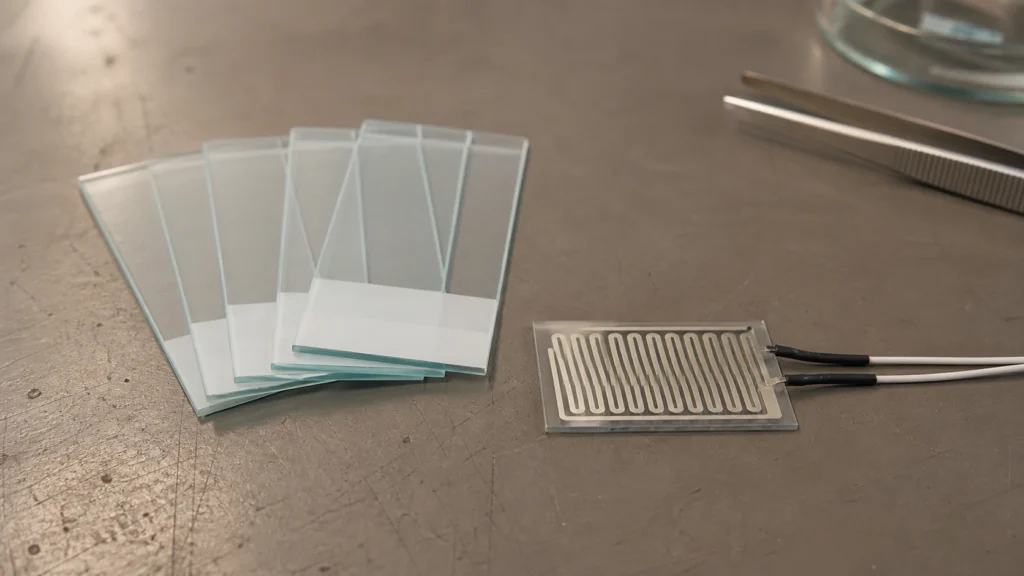
Key Takeaways
- FTO coating on borosilicate glass maintains stable sheet resistance up to 600°C, outperforming ITO in high-temperature appliance heating sensors.
- Custom dimensions, sheet resistance uniformity (±5%), and thickness tolerances (±0.1 mm) ensure seamless integration into smart appliance designs.
- Borosilicate substrates offer low thermal expansion and high chemical durability, while soda-lime provides a cost-effective alternative for less demanding applications.
- Compliance with RoHS and REACH is standard; additional food-contact certifications can be supported for food-zone components.
- Flexible MOQs and rapid prototyping services help procurement teams scale from validation to mass production without supply chain delays.
The Application Goal: Transparent Heating for Smart Sensors
An engineer in an appliance development lab stares at a fogged-over oven door, watching the internal temperature sensor struggle to get a clear reading. The team is designing a new smart oven that uses a transparent heating element integrated into the viewing window — a heater that remains optically clear so users can watch their food while the sensor package behind the glass tracks infrared signatures without interference. The component must deliver uniform heat, survive repeated thermal cycling, and resist the chemical sprays used to clean a kitchen appliance. That is where a conductive glass slide based on fluorine-doped tin oxide (FTO) enters the spec.

For heating sensor windows in smart appliances, the material needs to satisfy demanding electrical, optical, and mechanical requirements simultaneously. It must maintain high visible-light transmission so the user experience is not compromised, yet carry enough current to raise the surface temperature quickly and evenly. The glass must be dimensionally stable enough to align with bus bars and sensor mounts, and its coefficient of thermal expansion (CTE) must not cause delamination when the appliance cycles from room temperature to 200 °C or beyond.
How Precision FTO Glass Fits the Requirement
FTO conductive glass is a transparent conductive oxide (TCO) formed by depositing a fluorine-doped tin oxide thin film onto a glass substrate. Unlike bare glass, an FTO coated glass slide combines electrical conductivity with high optical clarity. In an appliance heating sensor, the coating acts as a resistive element: when a voltage is applied across the film, current flows and Joule heating raises the glass temperature without blocking the view.
Our precision glass line supplies FTO slides manufactured under tightly controlled deposition parameters. The glass substrates can be borosilicate or soda-lime, depending on the thermal budget and cost targets of the project. Borosilicate is often specified when the heater must withstand rapid temperature changes or higher operating temperatures, thanks to its low CTE. The conductive layer is engineered for a consistent sheet resistance—typically in the range that balances heating efficiency with available drive voltages in consumer appliances—and the optical transmission remains above 80% in the visible spectrum, ensuring the window stays clear.
Selection Criteria for Heating Sensor Glass
Choosing the right FTO conductive glass for a smart appliance heating sensor involves evaluating several technical parameters:
- Transmission and haze: The glass must preserve visibility; total visible transmission and low haze are critical for user acceptance and for sensor performance. FTO’s inherent surface roughness can cause slightly higher haze than ITO, but its thermal durability often outweighs this in heated applications.
- Sheet resistance: This determines how easily the film heats. A lower sheet resistance (e.g., 10–15 Ω/sq) draws more current and reaches target temperatures faster, but may require wider bus bars to maintain uniformity. The choice depends on the desired temperature and the available supply voltage.
- Thermal stability: FTO maintains its properties up to approximately 600 °C, far exceeding the typical peak temperatures inside an oven window or a defogging appliance. This makes it the preferred TCO when long-term reliability under heat cycling is required.
- Chemical durability: Appliance surfaces are exposed to cleaning agents; the coating must resist acids, alkalis, and organic solvents to prevent degradation over the product lifetime.
- Mechanical fit: Flatness, thickness tolerance, and edge quality affect how the glass mounts into a frame and how well bus bars or sensor modules bond to the surface. CTE matching with the glass substrate and any adhesives prevents cracking during thermal swings.
- Regulatory compliance: Components inside household appliances must often meet RoHS, REACH, and relevant safety standards for electrical insulation and fire resistance.
Realistic Project Walk-Through: From Prototype to Appliance Integration
Consider a development team tasked with creating a smart toaster oven that includes a self-defogging window. The window must act as a transparent heater and also carry a thin-film temperature sensor printed on the inner surface. The engineering team first defines the target performance: a surface temperature rise to 80 °C above ambient within 30 seconds, >82% transmission at 550 nm, and tolerance to 10,000 heating cycles.
They request FTO conductive glass samples in the required dimensions—say, 120 mm × 80 mm × 1.1 mm thick, with 10 Ω/sq sheet resistance. The samples arrive with edge deletion (a strip where the coating is removed) to prevent short circuits near the frame. Using silver bus bars screen-printed along two opposite edges, they apply a low-voltage DC supply and verify heating uniformity with a thermal camera. The prototype passes initial thermal shock tests: 500 cycles between 25 °C and 200 °C with no visible delamination or change in resistance.
After confirming chemical resistance to common oven cleaners and food-grade detergents, the team finalizes the BOM and begins designing the fixture for mass production. They work with the glass manufacturer to lock in sheet resistance tolerance (±5%) and thickness tolerance (±0.1 mm), then proceed to integrate the heating element with the appliance control board and safety interlocks.
What to Plan For: Sizing, Coating, and Logistics
Moving from prototype to production with FTO conductive glass slides requires careful planning across several dimensions:
- Sizing and tolerances: Glass substrates can be cut to custom dimensions, but tolerances on length, width, and thickness must account for frame allowances and any edge sealing. Typical thickness options range from 0.5 mm to 2.0 mm; 1.1 mm is common for heating windows.
- Coating uniformity: Specify sheet resistance uniformity across the active area (often <5% variation) to avoid hot spots. If the sensor requires an area free of coating, define the pattern and edge deletion early.
- Bus bar and interconnection: The choice of bus bar material (silver frit, printed conductive ink, or wire) affects long-term adhesion and electrical contact. Thermal expansion mismatch between the bus bar and the glass/FTO must be managed.
- Optical enhancements: If reflection or haze needs to be further reduced, anti-reflection coatings can be applied to the reverse side, though this adds cost and lead time.
- Integration and assembly: Coordinate with your mechanical design team on how the glass will be mounted—gasket materials, clamping force, and wiring strain relief can all influence reliability.
- Logistics and packaging: Glass is fragile. The manufacturer will package slides in dedicated trays or foam-lined boxes to prevent damage during transit. Plan for minimum order quantities that may apply for custom sizes or specific sheet resistances, and discuss lead times early in the design cycle.
Discuss Your Project Requirements
Every smart appliance heating sensor design has its own set of constraints. Whether you are developing a defogging window for a connected oven, a transparent heater for a refrigeration humidity sensor, or a washdown-resistant panel for a commercial cooking appliance, the FTO glass solution can be tuned to fit. Reach out with your target specifications — including dimensions, desired sheet resistance, operating temperature range, and anticipated annual volumes — and our technical team will propose a configuration that balances performance, durability, and cost-effectiveness for your application.
Why FTO Conductive Glass Outperforms Alternatives in Smart Appliance Heating Sensors
For appliance heating sensors that must sustain high operating temperatures and aggressive cleaning cycles, fluorine-doped tin oxide (FTO) coated glass delivers unmatched thermal and chemical endurance compared to indium tin oxide (ITO) alternatives. ITO degrades above 300°C, whereas FTO conductive glass material maintains stable sheet resistance up to 600°C, making it the preferred choice for oven doors, defogging windows, and heated display panels. Its inert surface resists degradation from food-grade detergents and common oven cleaners, ensuring long-term optical clarity and electrical performance.
When specifying a custom FTO conductive glass slide, buyers prioritize a balance of high visible light transmission (over 80% for 1.1 mm borosilicate) and low sheet resistance (commonly 7–15 Ω/sq) to enable fast, uniform heating without compromising the user’s view. Unlike polymer-based heaters, the rigid glass substrate eliminates warpage and delamination risks in repeated thermal cycling.
Material and Coating Attributes for Heating Sensor Integration
Selecting the optimal substrate and coating parameters directly impacts sensor performance and manufacturability.
Substrate Material Options
- Borosilicate glass (e.g., Borofloat 33): Low thermal expansion coefficient (3.25 × 10⁻⁶/K), excellent thermal shock resistance, and high chemical durability. Recommended for applications with rapid temperature swings.
- Soda-lime glass: Cost-effective for moderate temperature ranges, though thermal stability is lower than borosilicate. Suitable for budget-sensitive designs with less demanding cycling.
- Quartz or fused silica: For extreme thermal loads beyond 600°C, but more expensive and harder to process. Used where ultrapure transparency is required.
Key Coating Specifications
- Sheet resistance uniformity: ±5% variation across the active area ensures even heat distribution.
- Thickness tolerance: ±0.1 mm for standard slides, enabling consistent frame integration and edge sealing.
- Edges: CNC-ground, seamed, or safety-beveled to prevent chipping during assembly and thermal expansion.
- Surface quality: 60-40 scratch-dig typical; finer grades available for optical clarity in display-facing applications.
Key Facts
- FTO coated glass withstands temperatures up to 600°C with minimal sheet resistance drift.
- Chemical inertness against alkaline cleaners and acidic food residues ensures appliance-grade longevity.
- Custom dimensions up to 300 × 300 mm can be supplied, with thicknesses from 0.5 mm to 2.0 mm.
- RoHS and REACH compliance is standard; additional food-contact certifications can be supported upon request.
- Prototype quantities are available with low minimum order requirements, scaling to full production volumes.
Compliance and Supply Chain Reliability
Appliance manufacturers must verify that glass components meet regional safety and environmental regulations. FTO conductive glass slides can be supplied fully compliant with EU RoHS and REACH directives; statements of compliance are provided with each shipment. For food-zone applications, materials can be sourced to support FDA or LFGB requirements. Shipments are packed in cleanroom-grade trays with interleaved protective films to preserve surface quality, and custom labeling supports traceability from batch to finished component.
Procurement teams benefit from flexible minimum order quantities (MOQs) that accommodate both pilot runs and mass production. Lead times typically scale with order complexity—rapid prototyping services are available for urgent validation cycles, while high-volume orders follow scheduled frame agreements.
Engineering Support and Customization Workflow
From initial design review to production release, the engineering workflow for conductive glass slides focuses on seamless integration. Clients share 2D drawings or 3D models specifying the active heating area, bus-bar positions, and any edge cutouts. The manufacturer then proposes the optimal substrate, coating uniformity, and dimensional tolerances, often providing a free feasibility report and sample lots for accelerated testing. A detailed quality dossier—including transmission spectra, sheet resistance mapping, and mechanical dimension reports—accompanies each pre-production batch.
| Aspect | Details |
|---|---|
| Primary Application | Transparent heating elements in oven doors, display defoggers, and sensor windows for smart appliances |
| Coating Type | Fluorine-doped tin oxide (FTO) on glass, providing electrical conductivity and high thermal stability |
| Substrate Materials | Borosilicate, soda-lime, and fused silica/quartz for extreme thermal demands |
| Key Performance Properties | Visible light transmission >80% (1.1 mm borosilicate); sheet resistance 7–15 Ω/sq; stable up to 600°C; chemically resistant to cleaners |
| Customization Options | Custom dimensions up to 300×300 mm, thicknesses 0.5–2.0 mm, edge finishing, and tailored sheet resistance patterns |
| Compliance & Certifications | RoHS, REACH; food-contact certifications available on request |
| Logistics & Supply | Flexible MOQs for prototypes to mass production; cleanroom packaging; batch traceability |
To discuss your heating sensor project or request a quote for custom FTO conductive glass slides, connect with our engineering team—we’ll review your specifications and provide a detailed proposal.
Frequently Asked Questions
What is FTO conductive glass used for in smart appliances?
FTO conductive glass serves as a transparent heating element in smart oven doors, display defoggers, and sensor windows. Its fluorine-doped tin oxide coating converts electrical current into uniform heat while maintaining optical clarity, making it ideal for applications where both visibility and temperature control are critical.
How does FTO glass compare to ITO for high-temperature applications?
FTO glass withstands temperatures up to 600°C with minimal change in sheet resistance, whereas ITO begins to degrade above 300°C. This makes FTO the superior choice for appliances that undergo high-heat cycles, such as self-cleaning ovens and heated outdoor displays.
Can FTO coated glass be cut to custom sizes for appliance integration?
Yes, FTO coated glass slides can be CNC-cut to precise dimensions, with tolerances down to ±0.1 mm and custom edge finishes. Typical sizes range up to 300 × 300 mm, and thickness options from 0.5 mm to 2 mm accommodate various frame and sealing requirements.
What substrate materials are typically used for FTO conductive glass slides?
Borosilicate glass (e.g., Borofloat 33) is most common for its low thermal expansion and thermal shock resistance. Soda-lime glass offers a more economical option for moderate temperatures, while fused silica or quartz substrates are reserved for extreme thermal or purity demands.
What certifications should FTO conductive glass comply with for appliance use?
At a minimum, FTO glass should meet RoHS and REACH directives for environmental safety. For food-contact applications, materials can be sourced to support FDA or LFGB compliance, and statements of compliance are provided with each order.