
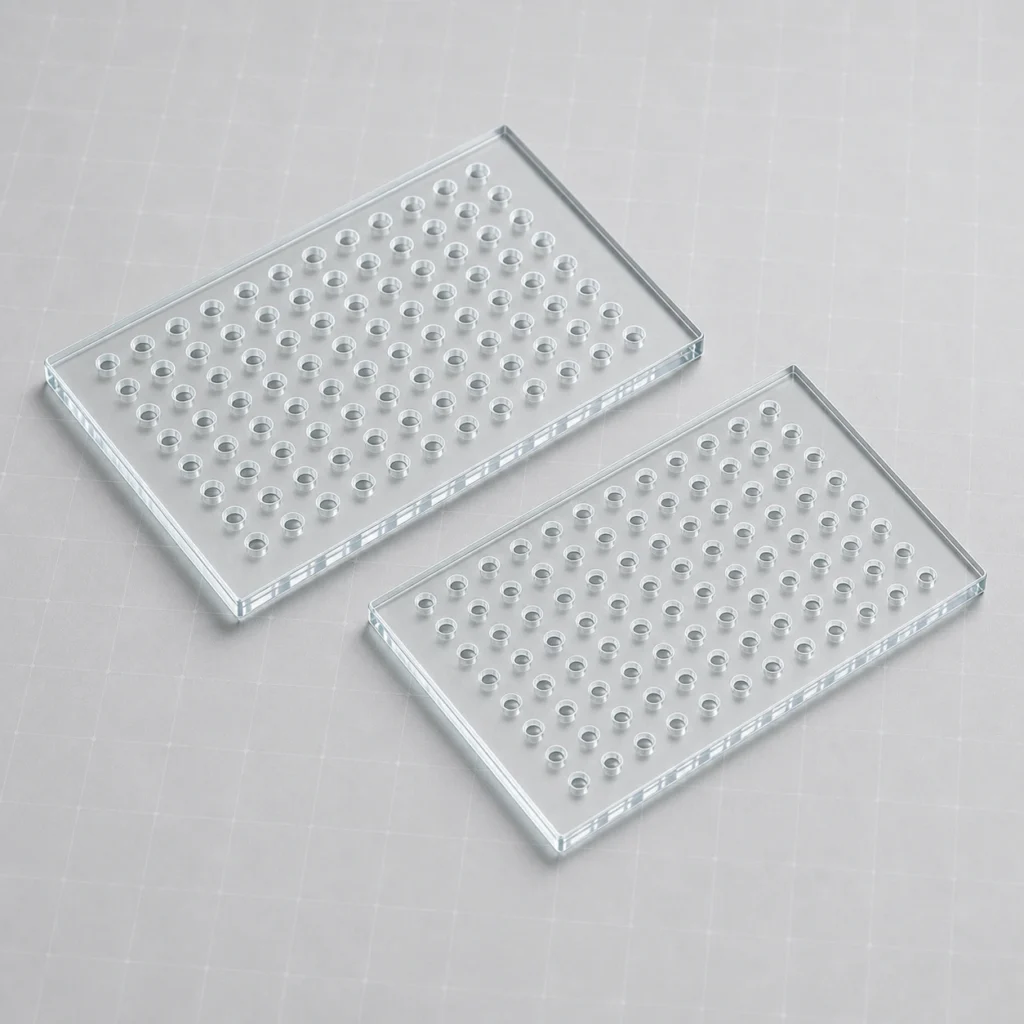
Key Takeaways
- Fused silica quartz plates maintain dimensional stability and optical clarity from -50°C to over 1,000°C, essential for hot-air sensor paths.
- Hole patterns can be CNC-drilled with diameter tolerances as tight as ±0.02 mm, preserving airflow characteristics.
- JGS2 fused silica offers a cost-effective balance of thermal and mechanical properties for most appliance sensor applications.
- Anti-reflection and hydrophobic coatings can be applied to quartz plates to boost signal-to-noise ratio and prevent condensation.
How do you maintain precise airflow measurement in a high-temperature appliance sensor without compromising durability or optical signal quality?

The Application Goal and Constraints
Modern appliance airflow sensors—found in smart ovens, clothes dryers, HVAC systems, and industrial heating units—must reliably detect and measure air movement while exposed to extreme conditions. The goal is twofold: ensure a stable, unobstructed path for airflow (or for an optical beam that detects airflow) and protect sensitive internal sensor elements. Constraints are severe: continuous operating temperatures often exceed 300 °C, with rapid thermal cycling that can shatter ordinary materials. Chemical resistance is critical to withstand cooking fumes, cleaning agents, and humidity. The sensor window or plate must also offer high dimensional stability so that hole diameters, pitch, and flatness remain consistent over the product’s lifetime. Any deviation can cause drift in sensor readings, leading to appliance malfunction or safety hazards.
How a Custom Perforated Quartz Plate Meets the Requirement
Fused quartz—high‑purity amorphous silica—is uniquely positioned for this task. Its coefficient of thermal expansion (CTE) is approximately 0.55 × 10⁻⁶ /°C, far lower than soda‑lime glass or metals, meaning it barely moves with temperature swings. This eliminates warping and keeps hole geometries stable. Quartz glass softens above 1,700 °C and can be used continuously at 1,100 °C, providing a generous safety margin for appliance airflow sensors. It is chemically inert, resisting corrosion from acids, alkalis (except hydrofluoric acid), and organic vapors. Optical transmission from the ultraviolet (UV) through the near‑infrared (NIR) range makes it ideal when the sensor relies on a light beam across the airflow path. A custom perforated quartz plate can be fabricated with hole diameters from 0.2 mm to several millimeters, positioned with CNC‑drilled or laser‑drilled precision. This allows engineers to tailor the open‑area ratio, flow resistance, and directional response of the sensor. Unlike metal or polymer alternatives, quartz introduces no outgassing, magnetic interference, or conductive paths that could disturb sensitive electronics.
Selection Criteria for This Application
Choosing the right perforated quartz plate demands attention to several material and geometric parameters:
- Thermal and mechanical properties: Verify CTE, annealing point, and flexural strength. Fused quartz (synthetic or natural) offers better thermal shock resistance than standard borosilicate.
- Optical clarity: If the sensor uses an optical path, specify internal transmittance across the required wavelength band. High‑purity grades achieve >90 % transmittance from 260 nm to 2,500 nm.
- Hole geometry and tolerances: Typical achievable tolerances are ±0.02 mm on hole diameter and ±0.05 mm on position, but tighter specs are possible with advanced processes. Consider the aspect ratio (hole depth to diameter) to avoid cracking.
- Surface finish: Scratch‑dig specifications (e.g., 60‑40 or better) ensure that surface defects do not scatter light or trap contaminants. Flatness of λ/4 or λ/10 per inch is common for windows that mate with a gasket or O‑ring.
- Regulatory compliance: Confirm that the quartz material meets RoHS, REACH, and food‑contact safety standards if required.
A Realistic Project Walk‑Through
Consider an HVAC equipment manufacturer developing a next‑generation air quality sensor that monitors flow rate inside a heating duct. The sensor assembly includes an infrared emitter and detector on either side of a 60 mm duct. The design calls for a perforated quartz plate that acts as both a protective barrier and a flow‑straightening element. The buyer’s engineering team begins by defining the operating conditions: continuous temperature up to 350 °C, exposure to ionized air, and vibration up to 5 g. They select a 1.5 mm‑thick fused quartz disc with a hexagonal array of 0.7 mm holes, spaced 3.5 mm center‑to‑center, giving a 25 % open area. After sharing a STEP file with the quartz fabricator, a dialogue begins on feasibility—the fabricator suggests a slightly larger fillet radius on the hole edges to reduce stress concentration. Three prototype plates are laser‑drilled, chamfered, and coated with a thin anti‑reflective layer on the optical side. The prototypes withstand 1,000 thermal cycles from room temperature to 400 °C without cracking, and flow‑bench testing confirms the pressure drop is within 2 % of simulation. With the design validated, the buyer places a production order for 5,000 units per year, with provisions for periodic sampling and first‑article inspection.
What to Plan For: Sizing, Tolerance Stack‑Up, Coating, Integration, Logistics
Integrating a perforated quartz plate into a mass‑produced appliance involves several practical considerations:
- Sizing: Plate thickness (commonly 1–3 mm) must balance mechanical strength and optical clarity. Overall dimensions are often driven by the sensor housing; standard sheets can be cut to rectangles or discs as large as 300 mm, but custom shapes are routine.
- Tolerance stack‑up: Account for cumulative variations in hole position, plate outer dimensions, and the mating metal or plastic frame. Using GD&T (Geometric Dimensioning and Tolerancing) in the drawing helps align expectations. Typical linear tolerances for quartz plates are ±0.1 mm, but tighter specs are achievable at higher cost.
- Coating: Anti‑reflective (AR) coatings improve transmission and reduce stray reflections; hydrophobic coatings ease cleaning; conductive coatings (e.g., indium tin oxide) can dissipate static or act as EMI shields. All coatings must survive the maximum operating temperature.
- Integration: Determine how the plate will be mounted—mechanical clamping requires beveled edges or peripheral flats; adhesive bonding demands careful selection of high‑temperature silicones or inorganic cements. Mismatch in CTE between quartz and the housing can cause stress; plan for a compliant interlayer if needed.
- Logistics: Custom quartz components are fragile; packaging typically uses foam‑lined individual compartments or vacuum trays. Lead times for the first batch can range from 4 to 8 weeks after final drawing approval, depending on tooling complexity. International shipping requires export documentation, and some grades of quartz may be subject to dual‑use regulations; verify with your supplier.
Discuss Your Project Requirements
When you’re ready to move from concept to production, our engineering team can review your sensor assembly design and propose a perforated quartz plate configuration that balances cost, lead time, and performance. We support projects from prototype to high‑volume runs, with in‑house metrology to verify hole geometry, surface quality, and coating uniformity. Reach out with your initial sketch or a step file, and we’ll help you navigate the selection process—from choosing the optimal quartz grade to defining acceptance criteria that streamline your supply chain.
Why Quartz Remains the Material of Choice for Precision Airflow Sensors
Custom perforated quartz plates combine high ultraviolet-to-infrared transmission with a low coefficient of thermal expansion (CTE) and outstanding chemical resistance. These properties directly address the demands of appliance airflow sensors—whether they use optical beam interruption, light scattering, or fluorescence-based detection. In a clothes dryer or a commercial oven, sensor windows must endure rapid temperature changes without warping, while maintaining a clean optical path free from fogging or corrosion. Quartz, particularly fused silica grades, delivers that reliability.
For procurement teams, specifying a custom perforated quartz plate means you can lock in the exact hole pattern, outer dimensions, and surface quality that your sensor assembly requires, without the performance compromises of off-the-shelf glass or polymer filters.
Key Facts for Specification
When drafting a request for quotation, keep the following parameters handy. A typical perforated quartz plate for airflow sensor applications exhibits:
- Material: Fused silica (JGS1 or JGS2 grade) or synthetic quartz, with hydroxyl content chosen for UV transparency if needed.
- Thickness tolerance: ±0.05 mm or better, depending on the polishing process.
- Hole diameter tolerance: ±0.02 mm achievable with CNC drilling and ultrasonic machining.
- Surface quality: 40-20 scratch-dig or finer, both sides polished if required.
- Flatness: λ/4 per inch for applications sensitive to beam deviation.
- Coating options: Broadband anti-reflection (AR) coatings to boost transmission; hydrophobic coatings to prevent condensation.
- Maximum operating temperature: Up to 1,100°C for fused silica, well above any appliance requirement.
Comparing Quartz Grades for Your Sensor Design
Most appliance sensor projects start with one of two quartz families: JGS1 (UV-grade fused silica) and JGS2 (standard fused silica). JGS1 offers excellent transmission down to 185 nm, which is rarely needed in appliance airflow monitoring; however, its low impurity level and high thermal stability can still justify the premium for sensors that demand the lowest auto-fluorescence background. JGS2 provides equivalent mechanical strength and thermal shock resistance at a more moderate cost, making it the typical recommendation for volume production.
Borosilicate glass (e.g., Borofloat 33) can be a fallback for applications that see lower peak temperatures, but its CTE is roughly three times that of fused silica, which can lead to stress around mounting points if the sensor housing is metal. Sourcing teams in Asia and Europe often prefer to stay with quartz to avoid requalification if the appliance’s operating environment later expands to higher temperatures.
Manufacturing Workflow and Quality Gates
Producing a batch of perforated quartz plates for a sensor manufacturer follows a sequence of quartz plate drilling, lapping, edge rounding, and cleaning. CNC drilling with diamond tooling achieves the required hole pattern, while subsequent lapping and polishing bring the surfaces to the specified flatness and scratch-dig. In-line inspection with optical profilometry and coordinate measuring machines (CMMs) verifies hole positions to within ±0.01 mm relative to the datum edges. A final ultrasonic cleaning and inspection under UV light ensures no sub-surface damage or residue remains, which is critical if the sensor operates in a vacuum or cleanroom environment.
| Aspect | Typical Range / Options | Considerations |
|---|---|---|
| Material grades | JGS1, JGS2, synthetic fused silica | Transmission, cost, hydroxyl content |
| Plate dimensions | Up to 300×300 mm or custom | Tooling availability, yield per sheet |
| Hole pattern | Single or multiple arrays, dia. ≥0.5 mm | Aspect ratio, edge chipping |
| Optical spec | Scratch-dig 40-20, flatness λ/2 per inch | Coating compatibility, cleanability |
| Coating | AR, hydrophobic, ITO | Durability, temperature range |
| Lead time | 4–8 weeks after drawing approval | Complexity, material stock |
| Export compliance | May require dual-use check | Quartz grades restricted in some regions |
Start Your Custom Perforated Quartz Plate Project
Engineering teams looking to optimize an appliance airflow sensor design can send a sketch, STEP file, or detailed specification to our applications group. We provide a feasibility review within days, including a tolerance stack-up analysis and coating recommendations. Whether you need ten prototypes for a pilot run or ten thousand plates for mass production, we align our metrology and documentation to your acceptance criteria. Contact us to discuss your project requirements or request a quote.
Frequently Asked Questions
What quartz grade is best for airflow sensors?
For most appliance airflow sensors, JGS2 (standard fused silica) is the preferred grade. It offers high transmission in the visible and near-infrared, excellent thermal shock resistance, and a reasonable cost. JGS1 (UV-grade fused silica) is chosen only when deep-UV transparency or extremely low auto-fluorescence is required, such as in fluorescence-based detection.
How are holes drilled in quartz plates?
Perforations are typically made using CNC drilling with diamond core drills or ultrasonic machining. CNC drilling can produce holes from 0.5 mm diameter upward with tight positional accuracy, while ultrasonic machining is used for very high aspect ratios or brittle material grades. Post-drilling lapping ensures clean edges and dimensional consistency.
Can quartz plates be coated for sensor applications?
Yes, quartz plates can receive broadband anti-reflection (AR) coatings to increase transmission and hydrophobic coatings to prevent moisture buildup. Conductive ITO coatings are also available if the sensor window needs to act as an EMI shield. Coating selection depends on the wavelength of the optical beam and the environmental conditions.
What is the lead time for custom perforated quartz plates?
Lead times for custom perforated quartz plates generally range from 4 to 8 weeks after final drawing approval. This accounts for material procurement, tooling setup, drilling, polishing, coating, and inspection. Prototype quantities may be delivered faster if standard blank sizes are in stock.
How do I specify a perforated quartz plate for an optical sensor?
Provide a detailed drawing or STEP file that includes outer dimensions, hole diameter and placement, thickness, surface quality (scratch-dig), flatness, and any coating requirements. Also specify the working wavelength and environmental conditions so the manufacturer can recommend the appropriate quartz grade and cleaning protocol.