
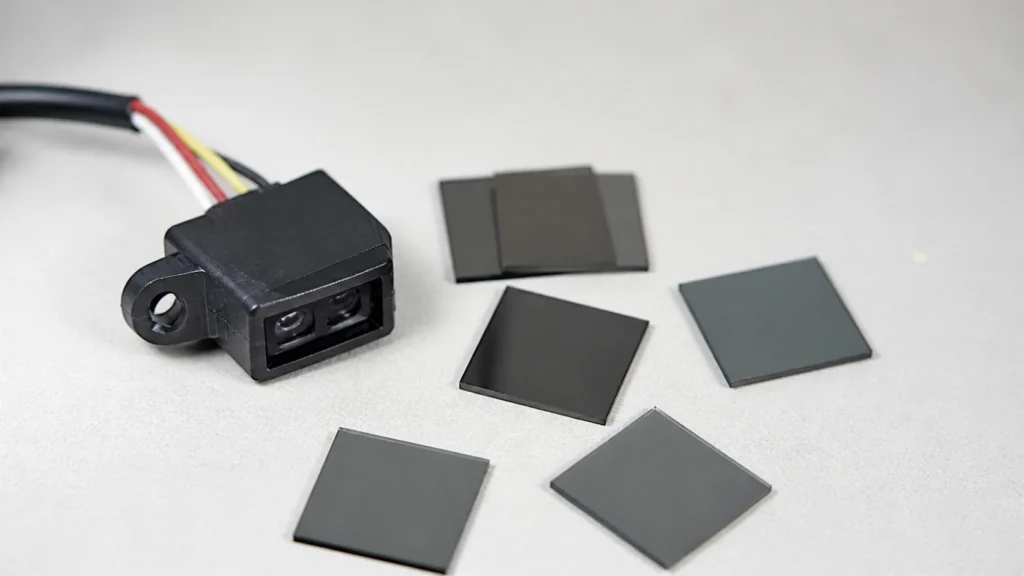
Key Takeaways
- Neutral density filter glass provides consistent optical attenuation for precise light measurement in appliance sensors.
- Material choice—borosilicate, fused silica, soda-lime, or sapphire—determines temperature stability and chemical durability inside demanding appliance environments.
- Precision specifications for flatness, surface quality, and coating uniformity are critical for sensor accuracy and long-term reliability.
- Custom sizing and coating capabilities align ND filter glass with specific appliance sensor shapes and wavelength requirements.
Sensing Accuracy in Thermal and Mechanical Stress Environments
Appliance optical sensors operate under demanding conditions. A smart oven must distinguish subtle surface browning while enduring temperatures exceeding 200°C near the viewing port. A washing machine turbidity sensor faces humidity, vibration, and detergent exposure. In every case, the sensor’s photodetector or image array must receive a controlled light level—neither saturating the pixels nor falling below the noise floor. The precision glass window that attenuates this light becomes a critical path component: it must deliver stable optical density (OD) across the sensor’s active wavelength band, resist environmental degradation, and maintain its flatness over the appliance’s rated lifetime.

Engineers sourcing these components quickly find that standard photographic ND filters cannot meet appliance-grade durability requirements. Instead, they need neutral density filter glass manufactured with robust substrates and durable coatings, designed for repeatable performance through thousands of thermal cycles. The filter must also avoid introducing spectral bias—attenuating all incoming wavelengths equally so the sensor’s color calibration or absorption measurement remains accurate.
ND Filter Glass: A Stable Attenuation Solution
In contrast to polymer films or thin coated plastics, glass-based ND filters offer superior flatness, resistance to scratching, and low thermal expansion. Typical substrates include borosilicate glass (for visible and near-infrared sensors in moderate-temperature environments) and fused silica (where UV transparency or extreme thermal shock resistance is required). A precisely controlled metallic or dielectric layer—deposited on one or both surfaces—provides the attenuation, often combined with an anti-reflection (AR) coating to suppress ghost images and maintain transmission efficiency.
For appliance applications, the substrate itself is as important as the coating. A flat, parallelism-controlled glass wafer ensures that the optical path length remains consistent, preventing focus shift in imaging sensors. Moreover, glass can be custom-shaped to fit compact sensor modules, including precise dicing into small rectangles or discs, edge grinding, and chamfering for safe automated assembly.
Selection Criteria for Appliance Sensor ND Filters
Selecting the right ND filter glass begins with a clear understanding of the sensor system:
- Optical Density and Tolerance: OD values commonly range from 0.3 to 4.0, with tighter tolerance (±0.05 or better) required for quantitative measurement applications. A filter with too high an OD starves the sensor; too low an OD leads to saturation and loss of dynamic range.
- Wavelength Region: Match the attenuation band to the sensor’s sensitivity. Visible-light sensors (e.g., color cameras) need flat response from 400 nm to 700 nm. Near-infrared sensors for food moisture analysis require consistent OD up to 1100 nm. Specify the substrate accordingly—fused silica for UV, borosilicate for cost-effective visible operation.
- Substrate Material and CTE: Coefficient of thermal expansion (CTE) must be compatible with the mounting frame or housing to prevent warping under temperature change. For applications adjacent to heating elements, a low-CTE material like fused silica may be necessary.
- Flatness and Surface Quality: Reflected wavefront error and scratch-dig specifications impact image sharpness. For camera-based sensors, typical flatness of λ/4 per 25 mm at 632.8 nm is adequate; for simpler photodiode sensors, commercial-grade polished glass may suffice.
- Environmental Durability: Specify tests such as thermal shock (−40°C to +85°C, multiple cycles), damp heat (85°C/85% RH), and chemical resistance to cleaning agents. Adhesion of the coating under these stresses is paramount.
- Regulatory Compliance: RoHS and REACH compliance are baseline. For components potentially in indirect food contact (e.g., an oven window’s inner filter), materials must meet applicable FDA or EU directives, and any outgassing of the coating must be negligible.
Integrating ND Glass into an Oven Camera System: A Walk-Through
Consider a manufacturer developing a smart wall oven with vision-based doneness recognition. The camera module sits behind a double-pane glass window, looking into the 250°C cavity. The interior halogen lamp, even when dimmed, saturates the CMOS sensor. The engineering team prototypes several filter configurations using ND filter glass samples with OD 0.8 to 1.2, cut to 12 mm × 12 mm squares. After testing, they select a borosilicate glass with a broadband metallic coating and an AR coating on the second surface. The OD tolerance of ±0.1 ensures consistent image brightness across production batches. The filter is mounted near the lens, so flatness (λ/2) prevents distortion. Thermal cycling tests (from room temperature to 250°C at the glass surface) confirm no delamination. The final material specification is approved and rolled into the bill of materials for pilot production.
Production Planning: Sizing, Coatings and Supply Logistics
Once the filter design is validated, attention turns to manufacturability and supply chain. Dicing to final dimensions with a tolerance of ±0.1 mm or ±0.05 mm is typical; edges may be ground or penciled to prevent chipping. Because coatings may be applied on large panels before dicing, or on individual parts, it is critical to align the coating pattern with the break lines. AR coatings are often included to maximize light throughput and minimize stray reflections, especially in multi-element optical stacks. Protective topcoats can enhance abrasion resistance.
Procurement teams must plan for lead times related to substrate fabrication, coating deposition, and quality inspection. Minimum order quantities (MOQs) may apply for custom sizes. Inventory strategies—such as vendor-managed buffers—can smooth production variability. International shipping of glass components requires robust packaging: individual part separation with acid-free paper or foam, moisture-barrier bags, and reinforced outer cartons.
Start Your Optical Component Specification Review
Every appliance sensor project brings unique optical, mechanical, and environmental requirements. Our application engineers can help you navigate substrate selection, coating trade-offs, and qualification testing. Share your target OD, wavelength range, sensor size, and any special environmental conditions to receive a detailed technical proposal and sample roadmap. Together, we can engineer an ND filter glass solution that ensures your sensor delivers accurate readings through the appliance’s entire service life.
Why Glass Substrate Choice Matters for ND Filter Longevity and Stability
The glass substrate in a neutral density filter glass fundamentally determines its optical stability, thermal resistance, and mechanical durability—directly impacting the consistency of your appliance’s optical sensor over time. For sensors exposed to oven heat, freezer cold, or dishwasher steam, borosilicate glass like Borofloat 33 delivers a low coefficient of thermal expansion (CTE) that resists warping during rapid temperature swings. When the application demands UV sensing or sensor calibration at short wavelengths, fused silica offers exceptional transmission down to 200 nm and a nearly zero thermal drift. For cost-driven designs with moderate environmental demands, soda-lime glass still provides reliable visible-light attenuation when coated appropriately. In extreme cases where the sensor window faces abrasion or aggressive chemicals, sapphire substrates provide Mohs 9 hardness and chemical inertness, though at a premium. Each substrate is lapped and polished to demanding flatness—often λ/4 or better—because even minor waviness can distort the light beam and falsify sensor readings. The substrate choice also influences the adhesion and durability of the metallic or dielectric coatings that define the filter’s optical density (OD).
Key Specifications for ND Filter Glass in Sensor Applications
When specifying ND filter glass for an optical sensor glass assembly, procurement teams evaluate a handful of critical parameters. The following list distills the attributes our engineering teams assess during feasibility studies:
- Optical Density (OD): Typically ranges from 0.1 to 5.0, selected according to the sensor’s dynamic range and ambient light conditions.
- Flatness: Surface accuracy of λ/4 or better at 632.8 nm prevents wavefront distortion that can shift sensor calibration.
- Surface Quality: A scratch-dig specification of 60-40 or finer minimizes stray light and ensures uniform coating thickness.
- Thickness Tolerance: Typically held to ±0.05 mm for consistent mechanical fit and predictable OD in reflection-based designs.
- Parallelism: Better than 3 arcminutes avoids beam deviation; critical in through-beam sensor configurations.
- Clear Aperture: Usually >90% of the part area, with edge chips and digs excluded from the active optical region.
Each attribute is verified with calibrated metrology equipment—interferometers for flatness, spectrophotometers for transmission—and documented in a lot-specific inspection report. Dimensional tolerances are confirmed with coordinate measuring machines (CMM) or optical comparators, ensuring every piece drops into the sensor housing without binding.
Material Processing and Coating Methods
Precision ND filter glass begins with CNC-machined blanks cut from sheet or rod stock. Double-side lapping and polishing achieve the required flatness and surface finish, while edge grinding can deliver a chamfer or a full bullnose to match assembly fixturing. The polished substrate then moves to a class 100 cleanroom for coating. Vacuum deposition—either electron-beam evaporation or ion-assisted deposition—applies thin-film layers of metal (e.g., Inconel, chromium) or dielectric stacks to create the neutral attenuation profile. For appliance sensors that must pass environmental cycling tests, adhesion layers and protective overcoats are often added. Our facilities can apply antireflective (AR) coatings to the rear surface, boosting transmission at the sensor’s peak wavelength and reducing ghost images. Every coated lot undergoes spectrophotometer verification across the full wavelength range of interest, with OD uniformity mapped across the part to guarantee sensor-to-sensor repeatability.
Quality Assurance and Certification for Appliance-Grade Optics
B2B buyers in the appliance sector increasingly require documentation that proves consistent quality across production runs. Look for suppliers that hold ISO 9001 certification as a baseline; many also maintain ISO 14001 for environmental management. RoHS compliance is standard for components shipped into the EU and many other global markets. When the appliance interfaces with potable water or food, NSF/ANSI 51 or similar certifications for material safety may apply to the glass and any exposed adhesives. Beyond formal certificates, a robust QA program will include in-process checks such as:
- 100% visual inspection under controlled lighting for subsurface damage and coating defects.
- Batch-level environmental stress screening (thermal shock, humidity, salt spray) for designs that face harsh appliance interiors.
- Lot traceability that ties each shipment back to raw material heats and coating chamber runs, simplifying root-cause analysis if field issues arise.
Integrating ND Filter Glass into Your Sensor Assembly
The filter glass rarely operates in isolation; its integration into the sensor module affects both optical performance and durability. Common mounting methods include mechanical retention with a compliant gasket, adhesive bonding with UV-curable epoxies, or even direct glass-to-metal sealing for hermetic sensor packages. The thermal expansion mismatch between the glass and the housing must be considered—borosilicate or fused silica, with their lower CTE, can reduce stress during soldering or over-molding processes. For sensors exposed to condensation, a hydrophobic coating or a perimeter seal can prevent moisture from creeping under the filter and fogging the optical path.
Designers should also plan for the filter’s orientation. The coated side typically faces the light source to prevent internal reflections from reaching the sensor, and an angular tolerance of ±0.1° is common when the filter is clocked into a precision bore. Sampling plans and incoming QC procedures should include OD measurement of first-article parts and a defined AQL for surface defects, ensuring that high-volume production maintains the same performance as the qualification units.
| Aspect | Details |
|---|---|
| Application Goal | Uniform light attenuation for accurate sensor readings across appliance duty cycles |
| Key Glass Materials | Borosilicate (Borofloat 33), Fused Silica, Soda-Lime, Sapphire |
| Typical Specifications | OD 0.1–5.0, Flatness λ/4, Surface Quality 60-40, Thickness ±0.05 mm, Parallelism <3 arcmin |
| Surface Preparation | Double-side lapping and polishing; optional AR coating on rear surface |
| Certifications | ISO 9001, RoHS, optional NSF/ANSI 51 for food-contact |
| MOQ / Lead Time | Custom MOQ may apply; lead times vary based on substrate and coating complexity |
Request Custom ND Filter Glass for Your Appliance Sensor Project
Every appliance optical sensor design presents a unique combination of wavelength, attenuation level, and mechanical envelope. Our engineering team starts with a review of your target OD, spectral range, sensor aperture size, and any special environmental conditions. We then propose a glass substrate, coating architecture, and edge treatment that align with your production processes. Please send your 2D drawings, tolerance expectations, and target annual volumes to receive a technical proposal with lead time and pricing guidance. We’ll include first-article samples and a qualification roadmap so your procurement team can move from prototype to full-rate production with confidence.
Frequently Asked Questions
What is the purpose of a neutral density filter in an appliance optical sensor?
A neutral density filter uniformly reduces light intensity without altering color, enabling the sensor to operate within its linear range and deliver accurate readings even when ambient light varies or the emitter is too bright.
What types of glass are used for ND filters in appliance applications?
Common substrates include borosilicate glass (e.g., Borofloat 33) for thermal stability, fused silica for UV-VIS transmission and low thermal expansion, and soda-lime for cost-effective visible-light attenuation. Sapphire may be chosen for extreme hardness or chemical exposure.
How does optical density specification affect sensor performance?
The optical density (OD) value determines the attenuation factor. An incorrect OD can saturate the sensor or let too little light through, leading to measurement errors. The OD must be matched to the sensor’s dynamic range and the expected illumination levels.
Can neutral density filter glass be customized for specific appliance sensor shapes?
Yes, precision glass manufacturers offer CNC cutting, edge grinding, and custom coatings to produce filters in round, square, or complex geometries that match the sensor aperture and mounting method.
What certifications should I look for in ND filter glass for home appliances?
Look for ISO 9001 for quality management, RoHS compliance for hazardous substances, and, depending on the application, NSF/ANSI 51 for food-zone safety or IEC standards for electrical safety. Many suppliers also provide lot-specific inspection reports.