
Key Takeaways
- A notch filter glass blocks a narrow laser wavelength while transmitting the measurement beam, restoring a sensor’s intended signal-to-noise ratio.
- Integrating a notch filter into a photodiode assembly eliminates false rejects, leading to higher uptime and less manual intervention.
- Operators can repurpose time previously spent on false alarms to optimize line performance and product quality.
- Choosing the right optical density, center wavelength, and mechanical fit ensures the filter delivers reliable blocking without attenuating the measurement signal.
- Partnering with a precision optical filter supplier early streamlines specification and validation, reducing integration risks.
The Real Cost of Sensor Interference in Appliance Production
Every appliance rolling off the line today carries dozens of optical sensors—from turbidity monitors in washing machines to laser alignment detectors in smart refrigerators. These sensors are meant to deliver fast, automated quality decisions. In practice, many manufacturers face a gnawing problem: false triggers and missed defects caused by stray light, ambient reflections, or tooling lasers that share the factory floor. A green laser guide from a nearby engraver or a bright overhead LED can easily overwhelm a detection photodiode, leading to a false “pass” or an unnecessary line stop. Each false reading triggers re-inspection, manual overrides, and potential scrap, slowly bleeding throughput and wearing down operator trust. Left unchecked, spectral noise quietly raises rework rates and undercuts the consistency that modern appliance brands demand.

How Notch Filter Glass Targets the Root Cause
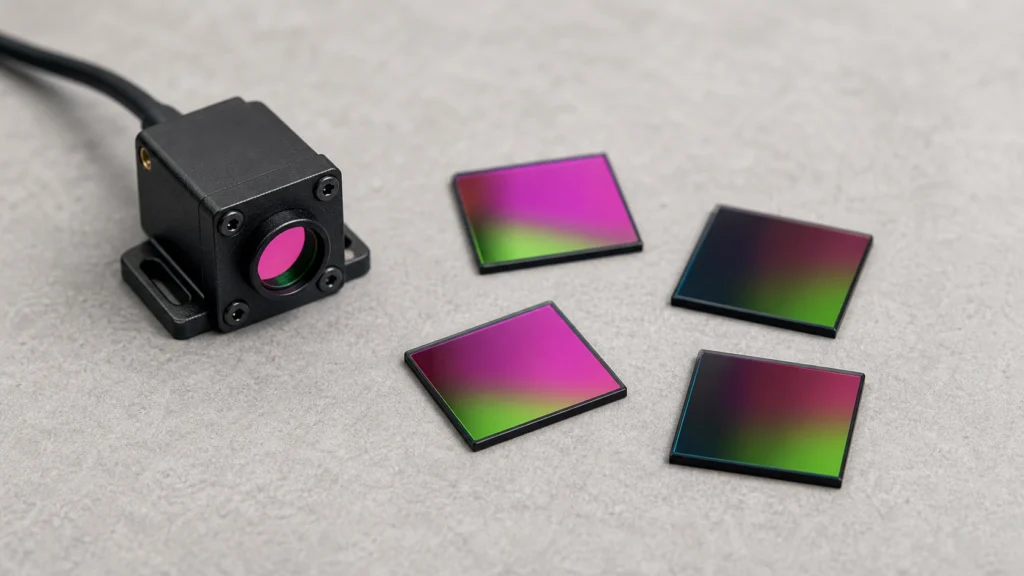
Notch filter glass solves this by introducing wavelength-selective blocking directly into the sensor path. Unlike a neutral density filter that dims everything, a notch filter is a precision optical element that attenuates only a narrow band of light—often a few nanometers wide—while letting all other wavelengths pass at high transmission. The glass substrate carries a multi-layer thin-film coating that achieves deep optical density (commonly OD4 or greater) right at the offending wavelength, whether that’s a 532 nm green laser, a 650 nm red pointer, or a bright near-IR glare. Outside that narrow notch, the filter maintains >90% average transmission, so the sensor’s intended measurement signal is barely affected.
For appliance detection systems, this means the interfering light is simply never seen by the detector. The result is a dramatic drop in false positives and negatives. Because notch filter glass blocks only the exact nuisance wavelength, it preserves the sensor’s full spectral sensitivity for the actual measurement—something a broadband bandpass filter cannot do. Tight wavelength control and steep edges ensure that even a laser line close to the signal band can be removed cleanly. The filters can be supplied in cut-to-size glass pieces, with anti-reflection coatings to boost transmission, and designed for specific angles of incidence. This flexibility makes them straightforward to integrate into existing detection stations without a major redesign.
A Day on the Line: Integrating Notch Filter Glass into an Appliance Inspection Station
Consider a home appliance plant assembling smart washing machines. A turbidity sensor checks rinse water clarity by shining a near-infrared LED through the drum and measuring scattered light. But the station sits near a laser engraver that fires 532 nm pulses to mark serial numbers. Every pulse creates a brief spike on the turbidity sensor, causing the system to falsely log clear water when the drum is still cloudy. After mapping the spectral interference, an engineer selects a 532 nm OD4 notch filter glass with AR coating on both faces, sized to seat directly into the sensor’s existing filter holder.
Installation is a two-step process: the glass is mounted in front of the photodiode, then a simple alignment check with a test target confirms no vignetting. When the line powers back on, the 532 nm pulses vanish from the sensor output. The background noise floor drops by more than an order of magnitude, and the system now responds exclusively to the turbidity measurement beam. Over the next shift, false rejects are eliminated, operator interventions decrease, and the line speed climbs noticeably. The filter rugged glass construction withstands the plant environment without any performance drift.
To explore how a custom notch filter could resolve interference in your own detection setups—and to pin down the exact wavelength, size, and durability requirements—consider sharing your sensor spectral data and operating conditions with an optical filter specialist or integrator.
Operational Gains That Stack Up
Eliminating the stray 532 nm pulses does more than clean up a sensor trace—it removes a persistent source of line interruptions. Every false reject that disappears is a stop the conveyor never makes. Operators no longer need to pull product to the side, inspect it manually, and then reset the system. Over a shift, those small interruptions erode throughput and inflate labor costs. With the interference blocked, the line maintains its intended pace. Skilled operators can shift their attention from reactive troubleshooting to proactive process monitoring, which often surfaces additional efficiency gains.
Product consistency tightens as well. When the photodiode stops reacting to an irrelevant laser signal, the turbidity reading becomes a true reflection of fluid clarity. That stability reduces measurement drift, so quality thresholds can be set more confidently. The result is fewer borderline readings that might otherwise trigger unnecessary alarms. For a beverage bottler tracking rinse water clarity, for instance, dependable readings mean fewer batches are flagged for recheck, and the whole-kernel rate of acceptable product stays high without eroding safety margins.
These improvements are logical outcomes of restoring the sensor’s intended signal-to-noise ratio. They do not require retuning algorithms or adding redundant hardware. The same optical channel and processing logic remain in place; the only change is that the sensor no longer sees the interfering wavelength. That simplicity is what makes the gain repeatable across shifts and seasons.
Integration Planning for Long-Term Reliability
Selecting the right notch filter glass goes beyond blocking a single wavelength. The filter must transmit the measurement wavelength with minimal attenuation and have an optical density deep enough to suppress the laser line to the sensor’s noise floor. Matching the center wavelength and bandwidth to the laser’s characteristics avoids attenuation of nearby signal bands. A filter with a narrow stopband centered exactly at 532 nm, for example, preserves all the information carried by the broader turbidity measurement beam.
Mechanical integration is equally important. The filter needs to fit the existing photodiode housing or a compact holder without vignetting the field of view. Dimensional tolerances and surface quality influence how much stray light is introduced. A precision optical component made from durable coated glass handles repeated cleaning cycles and moderate temperature swings without delaminating. This ruggedness is critical on food or pharmaceutical lines where washdowns are routine.
Working with a precision optical filter specialist early can shorten the specification cycle. Sharing the sensor’s spectral responsivity curve, the laser wavelength and power, and the mechanical constraints lets the supplier recommend a filter stack that meets blocking, transmission, and durability requirements in one assembly. Many integrators also offer pre-alignment testing with the actual sensor layout to verify performance before installation, reducing on-site debugging.
Charting the Path from Interference to Insight
When a single interfering beam is holding back the potential of an automated inspection station, the remedy can be as targeted as adding a coated glass element. The path forward starts with characterizing the noise source—identifying the exact wavelength, its intensity, and how it couples into the detector. From there, a filter design that blocks that line while preserving the measurement channel turns a noisy system into a decisive one. The same approach applies to other laser wavelengths, LED flicker, or even ambient light when the right optical filter material is chosen.
For teams ready to move beyond constant false alarms and manual resets, the next step is a technical conversation. Sharing a scope trace, the sensor model, and the line conditions with an optical filter engineer is the quickest way to determine filter feasibility and to receive a prototype that can be validated on the live system. There is no obligation—just the clarity that comes from knowing whether a notch can solve the noise.
| Aspect | Details |
|---|---|
| Problem | Stray laser pulses (e.g., 532 nm alignment laser) saturate photodiode in turbidity sensor, causing false rejects and line slowdowns |
| Solution | Notch filter glass blocks the narrow laser wavelength while passing the measurement signal, reducing noise by an order of magnitude |
| Integration | Mount filter in front of photodiode; check alignment to avoid vignetting; rugged glass withstands washdowns and temperature swings |
| Operational Benefits | Eliminates false rejects, cuts operator interventions, increases line speed, stabilizes measurements, and improves product consistency |
| Planning Factors | Center wavelength, optical density, bandwidth, physical size, coating durability, and compatibility with sensor housing and cleaning procedures |
| Next Step | Share sensor spectral data and operating conditions with an optical filter specialist for a tailored feasibility assessment |
Frequently Asked Questions
How does a notch filter glass improve appliance detection accuracy?
A notch filter glass blocks specific wavelengths that interfere with the sensor’s measurement signal. In appliance inspection, a stray laser line can trigger false signals, but the filter suppresses that wavelength while allowing the turbidity or other process beam to pass cleanly. This eliminates phantom readings and lets the system respond only to genuine product quality markers.
What are the key specifications when choosing a notch filter glass for an industrial sensor?
The most critical specifications are center wavelength (matching the interfering laser), optical density (how deeply it blocks that line), bandwidth (width of the blocked region), and transmission at the measurement wavelengths. Physical dimensions, surface quality, and coating durability against cleaning chemicals and temperature fluctuations also matter for long-term performance.
Can a notch filter be integrated into an existing photodiode assembly?
Yes, a notch filter can often be added to existing assemblies if there is room in front of the photodiode. A threaded holder or adhesive mount can secure the filter, and a quick alignment check ensures the filter does not vignette the beam. Mechanical compatibility and clearance are the main constraints, so consulting a filter supplier with the sensor’s dimensions is advisable.
What is the difference between a notch filter and a bandpass filter in sensor applications?
A notch filter blocks only a very narrow wavelength range (like a laser line) and transmits all other wavelengths, while a bandpass filter transmits only a narrow band and blocks everything else. In sensor cleanup, a notch filter is ideal when the interference is a single known wavelength, preserving more of the original signal bandwidth than a bandpass filter would.
What environmental factors should be considered when using notch filter glass in a production environment?
The filter must withstand the plant’s temperature range, humidity, and any cleaning agents used during sanitation cycles. Coatings should resist delamination from thermal cycling or chemical exposure. Rugged coated-glass substrates are typically chosen for food, beverage, or pharmaceutical lines where regular washdowns are routine.