
Key Takeaways
- Custom washing machine control panel glass is not a commodity; material, print, and tolerance choices directly impact appliance reliability and brand image.
- Total cost of ownership goes beyond unit price—factoring in assembly labor, field failures, and warranty claims reveals the true value of precision-engineered glass.
- Always verify environmental resistance, edge finish, and ink durability with test reports before committing to bulk production.
- For industrial buyers, the glass panel is an integral part of the assembly line; supplier consistency in delivery and color matching is as critical as the glass itself.
Who needs a custom glass plate and what problem does it solve?
If your appliance design demands a flawless, durable user interface that withstands constant touch, moisture, and thermal stress, you’re already facing the limitations of standard plastic or membrane overlays. Original equipment manufacturers, aftermarket service providers, and industrial appliance engineers all turn to custom glass plates for washing machine control panels when off-the-shelf covers fail to meet brand aesthetics, safety certifications, or long-term reliability. The right glass plate solves the twin challenges of physical resilience and design freedom: it protects sensitive electronics behind a sleek, easily cleaned surface while enabling capacitive touch zones, backlit icons, and full-color branding that plastic simply cannot match over a 10-year lifespan.

Key selection criteria that shape your buying decision
Choosing a supplier and a specification isn’t a commodity purchase—it’s a technical partnership. These seven factors directly affect the panel’s performance in the field and its integration into your production line.
Glass type and thickness. Tempered soda-lime glass is the workhorse of the industry, offering 3–5 times the impact resistance of annealed glass, often in 3mm or 4mm thicknesses. A 3mm toughened panel, for instance, balances strength with weight reduction, critical for large front-load door windows. If the control panel integrates a touch screen, verify the dielectric constant and clarity; aluminosilicate glass can deliver higher touch sensitivity and scratch resistance, though at a cost premium.
Surface treatments and printing. Silk-screen printing on the reverse side is standard for permanent logos, button halos, and circuit-hiding borders. Digital UV printing now enables photo-realistic graphics and smaller batches without tooling fees. Ask about ink durability under UV exposure and chemical compatibility with household cleaners. Edge finishing—flat polished, beveled, or pencil-ground—prevents chipping during assembly and improves the panel’s perceived quality.
Dimensional tolerance and footprint. The glass must fit precisely into a molded plastic or metal frame. A tolerance of ±0.5 mm is typical for CNC-cut panels, but complex shapes or cutouts for displays may require tighter control. Confirm that the supplier can maintain your specified footprint across high-volume runs, as cumulative variation can cause assembly-line slowdowns.
Production capacity and throughput. Whether you need 500 panels for a pilot run or 50,000 per month, the supplier’s capacity dictates lead times and your ability to scale. Throughput isn’t just speed—it’s the consistency of output. An automated cutting, tempering, and printing line reduces human error and ensures that the tenth-thousandth panel is identical to the first.
Automation level and machine sophistication. For glass processors, automation translates directly into fewer edge defects, repeatable ink registration, and safer handling. Look for evidence of CNC machining centers, automated silk-screen carousels, and inline optical inspection. This information gain is key: a highly automated line not only boosts output but also makes real-time quality data available, letting you trace any defect back to its source.
Build material and environmental compliance. Beyond the glass itself, consider the frits, coatings, and adhesives. Lead-free inks and RoHS-compliant materials are mandatory for many markets. If the panel is part of an induction cooktop or exposed to direct heat, verify thermal shock resistance and coefficient of expansion.
After-sales support and technical backup. A responsive partner will help troubleshoot adhesion failures, recommend alternative inks, or adjust the tempering profile if breakage rates rise. Pre-shipment sampling, installation guidelines, and a clear warranty against delamination or stress fractures save you from field recalls.
Typical configurations and which market they suit
Glass panels fall into two broad categories, each serving a different buyer profile. For small workshops or aftermarket specialists replacing a cracked lid, an off-the-shelf or semi-custom panel is often the fastest path. These are typically float glass pieces cut to common top-loader dimensions, with minimal printing—perhaps a power icon and a few temperature markings. A standard 3mm clear tempered sheet with flat ground edges can be shipped within days and installed by a local technician, answering the common question “Can you replace the glass on a washing machine?” with a practical, low-cost yes.
Industrial buyers, on the other hand, demand fully customized configurations. They order panels with intricate capacitive touch layouts, multi-color silk-screen layers, anti-glare coatings, and integrated mounting studs. These panels are designed alongside the appliance’s CAD model, often going through several DFM (Design for Manufacturing) iterations. The volume is high, and the relationship is long-term: the glass becomes part of the brand’s visual identity, so color consistency, print durability, and zero-defect delivery are non-negotiable. In these cases, the panel is not just a protective cover—it is the primary human-machine interface, so every selection criterion listed above must be evaluated with the rigor of a safety-critical component.
Total Cost of Ownership: Beyond the Per-Unit Price
A narrow focus on the initial quote can be misleading. While a standard tempered glass blank may seem economical, the total cost of ownership for a custom glass plate includes factors that significantly shift the financial equation over the appliance’s production life. The purchase price is only the entry point; running costs, labour efficiencies, and the payback from avoiding field failures all contribute to the true cost.
Running costs for a glass panel itself are negligible—there is no power consumption after installation. However, the panel’s quality directly influences the appliance’s field performance. A glass that resists scratching, chemical attack, and delamination maintains the product’s premium appearance, reducing warranty claims and brand damage. Conversely, a poorly printed panel that fades or peels under humidity can trigger costly service calls and reputation harm. So, paying more for proven durable inks and proper tempering processes often yields a lower lifetime cost.
Labour savings come from panels that are designed for fast, error-free assembly. Precision-cut glass with consistent dimensions and pre-applied adhesive pads or mounting holes allows assembly line workers to install the panel in seconds without adjustments. For high-volume lines, even a few seconds saved per unit translates into substantial output gains over a year. Additionally, panels that integrate touch functions directly onto the glass eliminate separate button assemblies, reducing part counts and assembly steps.
The payback logic is straightforward: an engineered custom panel that prevents even a small percentage of field failures or line stoppages can quickly recover its premium. For industrial buyers, the glass panel is a critical component; its reliability directly protects the brand’s bottom line.
Mistakes Buyers Make—and What to Verify Before Ordering
Several preventable errors repeat across procurement cycles. First, many buyers treat the glass panel as a commodity and under-specify requirements. Omitting tolerance details—flatness, hole diameters, edge finish—can result in panels that fit poorly into plastic housings, leading to rattles or water ingress. Always provide precise CAD files and agree on tolerance bands with the supplier.
Second, overlooking the end-use environment can be disastrous. Washing machines face high humidity, temperature swings, and detergent exposure. Standard silk-screen inks may not withstand long-term moisture, causing peeling or color shift. Buyers must request third-party test reports for ink adhesion, abrasion resistance (e.g., Taber abrasion), and environmental cycling. The same applies to glass strength: while tempered glass is robust, it is not invulnerable. Edge damage from improper handling or tight mounting can lead to spontaneous breakage. Verifying that the supplier performs proper edge finishing and provides strength certificates is essential.
Third, rushing into bulk production without prototypes is a classic trap. What looks perfect on a rendering may not meet tactile expectations or fit with other components. A small pre-production batch subjected to full assembly and functional testing reveals alignment problems, touch sensitivity inconsistencies, or print registration errors long before they become costly recalls.
Fourth, failing to discuss after-sales technical support can leave manufacturers stranded. Does the supplier offer on-site assistance for integration troubleshooting? How are design changes handled? Clarifying these points upfront builds a resilient supply chain.
How the Control Panel Glass Fits the Wider Production Line
The glass panel is never an isolated part; it sits at the intersection of mechanical assembly, electronic integration, and brand presentation. On the factory floor, its arrival time directly paces the appliance assembly line. A late shipment halts production, while a panel that fails inline testing stalls the station and forces rework. Therefore, a supplier’s delivery reliability and packaging quality—preventing transit damage—are as critical as the glass itself.
From a design standpoint, the panel is often the first thing a consumer sees and touches. It must harmonize with the machine’s color palette, user interface layout, and tactile feel. This demands close collaboration between the glass fabricator and the appliance’s industrial design team. For example, achieving a specific shade of metallic ink requires iterative sampling; the fabricator must maintain that color consistency across production runs spanning years. Integrating custom glass machining processes like precise cutouts for displays or illuminated icons ensures the final product meets both functional and aesthetic goals.
For aftermarket replacement operations, the glass panel’s design must facilitate one-to-one swapping. Mounting features that align perfectly with existing brackets mean that a technician can replace the glass without disassembling the entire door assembly—answering the common “Can you replace the glass on a washing machine?” question with a practical, low-cost solution already embedded in the panel’s design.
Ultimately, selecting the right glass partner is about de-risking the entire appliance launch. A supplier that can take a concept from DFM discussions to volume delivery, while managing production tolerances and print durability, becomes an extension of the buyer’s manufacturing arm.
| Aspect | Small Workshop / Aftermarket | Industrial OEM |
|---|---|---|
| Primary Use Case | Replacement panel for repair or retrofit | High-volume component for new appliance production |
| Customization Scope | Standard shapes, basic silk-screen, simple mounting holes | Fully customized capacitive touch layouts, multi-color prints, anti-glare, integrated studs |
| Critical Specification | Exact dimensions, glass thickness, edge finish to match original | Tight tolerances, flatness, print durability, color consistency, zero-defect delivery |
| Cost Priority | Low unit price, but risk of poor fit leads to customer callbacks | Total cost of ownership: payback through faster assembly, less rework, fewer field failures |
| Common Pitfall | Not verifying dimensions or environmental resistance of inks | Skipping prototype testing; under-specifying tolerances or ink adhesion |
| Supplier Requirement | Quick turnaround, reliable packaging, local technical support | Design-for-manufacturing collaboration, just-in-time delivery, strict quality control |
Frequently Asked Questions
Can you replace the glass on a washing machine?
Yes, the glass panel on a washing machine control interface can usually be replaced. For many models, a correctly sized replacement panel can be installed by a local technician, often without disassembling the entire door. This guide helps buyers source a custom panel that matches the original’s dimensions and mounting points.
Is washing machine glass strong?
Washing machine glass panels are typically made from tempered glass, which is three to five times stronger than ordinary annealed glass of the same thickness. However, tempered glass can shatter if the edges are damaged or if it is subjected to concentrated stress. Proper edge finishing and careful handling during installation are essential to maintain its strength.
What is a washing machine panel?
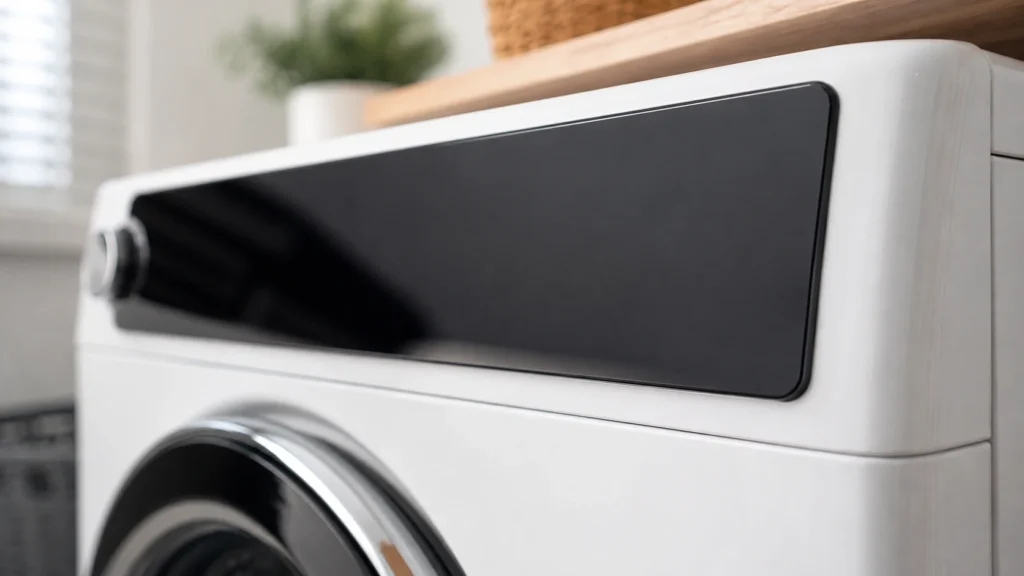
A washing machine panel is the glass interface located on the front or top of the machine that covers the control electronics and display. It often features touch-sensitive buttons, LED indicators, and printed graphics for program selection and status display.
What factors determine the lifespan of a washing machine glass panel?
The lifespan depends on the glass type (tempered vs. annealed), the durability of the screen-printing inks, resistance to moisture and chemicals, and the quality of installation. Panels that withstand humidity, temperature cycling, and detergent exposure without delamination or fading will last the lifetime of the appliance.
How can I ensure a custom glass panel fits my appliance model?
Provide exact dimensions, CAD files, and detailed mounting requirements to the glass supplier. Always request a pre-production prototype to verify fit, alignment of buttons and displays, and overall assembly compatibility before ordering the full production run.