
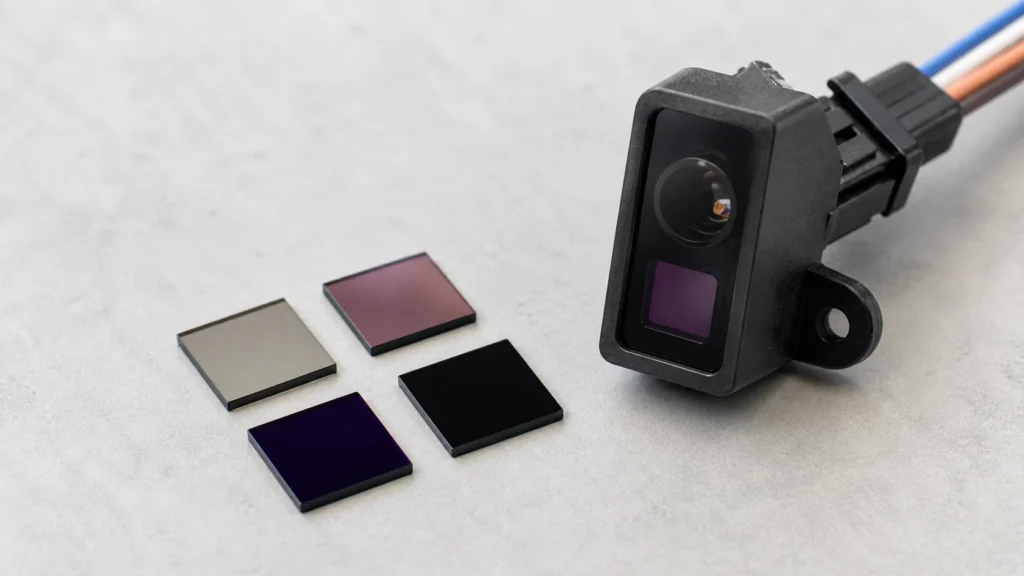
Key Takeaways
- Optical filter glass selects the exact wavelengths required for appliance sensor operation, rejecting ambient interference.
- Common substrate materials include borosilicate, fused silica, and aluminosilicate glass, each offering distinct thermal and chemical resistance properties.
- Custom filter designs can incorporate bandpass, longpass, shortpass, or notch coatings matched to emitter/detector pairs.
- Dimensional tolerances down to ±0.05mm and surface quality of 40-20 scratch-dig are routinely achievable.
- Lead times and MOQs depend on filter complexity and volume, with prototype quantities often available.
The Demands of Appliance Detection Sensors
For engineers integrating optical sensors into appliances—such as turbidity detectors in washing machines, gas sensors in ovens, or liquid-level monitors—the reliability and precision of the detection system start with the optical filter glass. These components must selectively transmit target wavelengths while rejecting interference from ambient light or internal heating elements, all while enduring thermal cycling, humidity, and chemical exposure. A poorly chosen filter leads to sensor drift, false readings, and early failure. This page outlines how precision optical filter glass meets these harsh environment demands and what to consider when specifying a custom optical filter for your appliance sensor application.
How Precision Optical Filter Glass Delivers Performance
Precision optical filter glass leverages colored glass substrates or multi-layer dielectric coatings to control spectral transmission. For appliance sensors, common requirements include blocking infrared heat while passing visible light (e.g., a heat-absorbing glass like Schott KG3) or isolating a narrow band for gas absorption measurements. High-quality substrates such as borosilicate or fused silica provide the thermal stability and chemical inertness needed for long-term use near heating elements or in detergent-laden water. Custom optical filter fabrication allows precise tailoring of the cut-on/cut-off wavelengths, out-of-band blocking, and incident angle tolerance. Anti-reflection (AR) coatings can be applied to both surfaces to maximize signal strength, while hardened coatings improve scratch resistance during assembly and operation. By matching the filter to the sensor’s LED and photodetector, you achieve consistent, high signal-to-noise ratios.
Key Selection Criteria for Appliance Sensor Filter Glass
When sourcing an appliance sensor filter, evaluate these factors:
- Spectral transmission requirements: Define the passband wavelength range and minimum transmission percentage, plus the desired blocking range and optical density. Standard filter glass catalogs offer starting points, but custom curves often optimize sensor accuracy.
- Thermal and mechanical stability: The coefficient of thermal expansion (CTE) must be compatible with mounting hardware to avoid stress fractures. Flatness and surface quality are critical for imaging or focused light paths.
- Chemical durability: The glass must resist degradation from detergents, steam, or food acids. Borosilicate and quartz-based glasses typically outperform soda-lime in these environments.
- Dimensional accuracy: Tolerances on diameter, thickness, and wedge affect sensor assembly and alignment. Specify your need for ±0.05 mm or tighter dimensions.
- Environmental compliance: Confirm RoHS, REACH, and other relevant regulations. Many appliance markets require full material declarations.
- Coating options: AR coatings improve light throughput; protective overcoats extend life in abrasive conditions.
Application Scenario: Turbidity Sensing in a Washing Machine
Consider a washing machine turbidity sensor that uses an 880 nm LED and a silicon photodiode. The sensor’s optical path includes a pair of precision filter glass windows that block ambient light and passing water, while transmitting the near-infrared signal. The design requires a custom optical filter with peak transmission >90% at 880 nm and strong blocking from 200 nm to 700 nm (OD ≥4) to eliminate crosstalk from visible light. The filter disk, 6 mm in diameter and 1.0 mm thick, is fabricated from boron float glass for cost-effective chemical durability. Each surface receives an AR coating for 880 nm. The glass withstands repeated 85°C hot water cycles and detergent exposure without delamination. By precisely controlling the transmission curve, the sensor reliably measures water turbidity, enabling the machine to adjust rinse cycles and conserve water. This scenario illustrates how a thoughtfully specified filter glass directly contributes to appliance performance and energy efficiency.
What to Plan For: Sizing, Tolerances, Integration, and Logistics
Early engagement with a precision glass manufacturer helps avoid integration pitfalls. Standard sheet glass can be cut to custom diameters down to a few millimeters with machined edges. Tolerances of ±0.05 mm on thickness and ±0.1 mm on diameter are typical, with finer levels available. Flatness of λ/2 or λ/4 is common for non-imaging optics. For optical filter glass integration, consider mounting: adhesive bonding requires clean, primed surfaces; mechanical retention calls for bevels or notches. Anti-reflection coatings must be designed for the intended angle of incidence. Plan for environmental testing to validate long-term coating adhesion and glass stability. On the supply side, confirm lead times for custom filter fabrication and arrange protected packaging to avoid scratches during transit. A collaborative partnership ensures that your optical filter glass supplier understands the end-use conditions and can recommend substrate, coating, and tolerance stacks that balance performance with cost.
Discuss Your Project Requirements
Every appliance detection sensor presents a unique set of optical and environmental challenges. Whether you are refining an existing design or developing a next-generation sensor, our team is ready to support you with custom optical filter solutions. Contact us to review your target transmission curve, mechanical dimensions, and environmental requirements. We’ll help you navigate the selection of substrate materials, coating designs, and tolerance specifications—without obligation. Let’s turn your sensor concept into a reliable, production-ready component.
The Critical Role of Optical Filter Glass in Appliance Sensors
Optical filter glass is the component that defines which wavelengths of light reach the detection element, directly influencing an appliance sensor’s accuracy and immunity to false triggers. In washing machines, dryers, dishwashers, and cooking appliances, sensors must reliably detect objects, turbidity, or flame under variable ambient conditions. The filter glass strips away interfering radiation—such as near-infrared from heating elements or visible room light—while transmitting only the intended signal band. This wavelength selectivity is what allows a simple photodiode to deliver consistent, repeatable readings without complex electronic compensation.
How Filtering Improves Sensor Performance
Appliance detection systems typically pair an LED or laser emitter with a photodetector. Without a filter, the detector sees all light, causing signal-to-noise collapse and false triggers. A properly specified optical filter glass blocks out-of-band radiation, matching the detector’s sensitivity curve to the emitter’s output. For example, a dishwasher turbidity sensor often uses a 940 nm bandpass filter to ignore visible kitchen light while monitoring scattered infrared from suspended particles. Custom coating designs can also include anti-reflection layers to boost transmission and hard oxide layers to withstand humidity and cleaning cycles.
Key Facts About Optical Filter Glass for Appliances
- Substrate versatility: Borosilicate (e.g., Borofloat 33), fused silica, aluminosilicate, and even chemically strengthened glasses are used depending on thermal and chemical demands.
- Coating types: Bandpass, longpass, shortpass, and notch filters are deposited via PVD or sputtering; AR coatings enhance throughput and durability.
- Environmental resilience: Filter stacks are designed to endure thermal cycling (−20°C to +85°C), humidity (up to 95% RH), and exposure to detergents, oils, and food acids.
- Custom geometries: CNC cutting, edge grinding, and polishing enable any shape required for sensor apertures, slots, or mounting features.
- Compliance: RoHS, REACH, and ISO 9001:2015 certification is standard; suppliers can provide additional documentation upon request.
Material and Specification Comparison
Choosing the right substrate means balancing optical transmission, thermal expansion, and mechanical robustness. Borosilicate glasses offer excellent thermal shock resistance and low autofluorescence, making them a cost-effective default for most appliance sensors. Fused silica provides high UV transmission and near-zero thermal expansion, but at a higher price point. Aluminosilicate glasses add chemical durability against alkaline cleaners. For extreme environments, sapphire delivers unmatched scratch resistance and broadband transmission. Coating durability is equally critical; hard dielectric layers applied via ion-assisted deposition withstand repeated thermal cycles and high-humidity storage without delamination.
Dimensional tolerances routinely achieved include thickness ±0.05 mm, flatness λ/4 to λ/10, and surface quality 40‑20 scratch-dig. These parameters ensure consistent optical performance and mechanical fit in automated assembly lines.
Customization and Supply Chain Considerations
Most appliance sensor filters are custom-designed for a specific OEM sensor module. Working from your sensor’s target transmission curve, an experienced fabricator can propose a substrate-coating combination that meets your spectral, environmental, and cost targets. Prototype and pilot volumes are typically available, with lead times quoted after drawing review. For production, MOQs vary with filter complexity and coating batch sizes; early collaboration helps balance tooling costs against unit price. Long-term supply agreements often include safety stock arrangements to support appliance production schedules.
| Aspect | Details |
|---|---|
| Substrate Materials | Borosilicate, fused silica, aluminosilicate, sapphire |
| Filter Coating Types | Bandpass, longpass, shortpass, notch, AR coatings |
| Environmental Resistance | Withstands thermal cycling, humidity, detergents, food acids |
| Dimensional Tolerances | Thickness ±0.05 mm; flatness λ/4–λ/10; scratch-dig 40‑20 |
| Certifications | RoHS, REACH, ISO 9001:2015 |
| Lead Time & MOQ | Defined after drawing review; prototype volumes available |
Specify Your Sensor Filter Requirements
Whether you are designing a new appliance or upgrading an existing detection system, your filter glass is a performance-critical component. Share your spectral target, mechanical outline, and environmental conditions, and our team will help you select the optimal substrate, coating, and tolerance stack. We support projects from prototyping through high-volume production. Custom optical filter solutions start with a conversation—contact us to turn your sensor concept into a reliable, cost-effective part.
Frequently Asked Questions
What type of optical filter is used in appliance sensors?
Most detection sensors in appliances use bandpass filters to isolate a specific wavelength range, such as near-infrared, from the emitter, while blocking visible light and thermal IR. Longpass and shortpass filter glasses are also common where only a cutoff is needed.
How do I choose the right optical filter glass material for my sensor?
Consider the operating wavelength, thermal conditions, chemical exposure, and mechanical strength needed. Borosilicate glasses like Borofloat 33 offer good thermal shock resistance; fused silica provides high UV transmission; aluminosilicates add chemical durability.
Can optical filter glass be customized for irregular sensor shapes?
Yes, precision glass suppliers routinely cut, edge-grind, and polish filter glass into custom shapes and sizes using CNC processes, waterjet cutting, or laser scribing, followed by coating.
What environmental factors affect optical filter glass in appliances?
Humidity, temperature cycling, vibration, and chemical exposure (e.g., detergents, food acids) all influence filter durability. Suitable substrate and coating selection ensures long-term reliability under these conditions.
How long does it take to receive custom optical filter glass samples?
Sample lead times vary with complexity and coating availability, but typically range from a few weeks to several weeks after drawing approval. Production volumes are quoted upon finalized specifications.