
Key Takeaways
- Quartz glass windows combine high optical transmission with thermal stability up to 1050°C, making them suitable for extreme appliance environments.
- Fused silica grades (JGS1, JGS2) offer tailored performance from deep UV to IR, while borosilicate serves lower-temperature applications.
- Custom CNC machining achieves tight tolerances and complex geometries, with coatings available to tune optical or protective properties.
- Uncoated quartz windows tolerate the highest temperatures; anti-reflection coatings improve transmission but require lower operating limits.
- Early collaboration with the fabricator on tolerances, coatings, and logistics prevents delays in custom quartz window projects.
High-temperature optical access: the core challenge
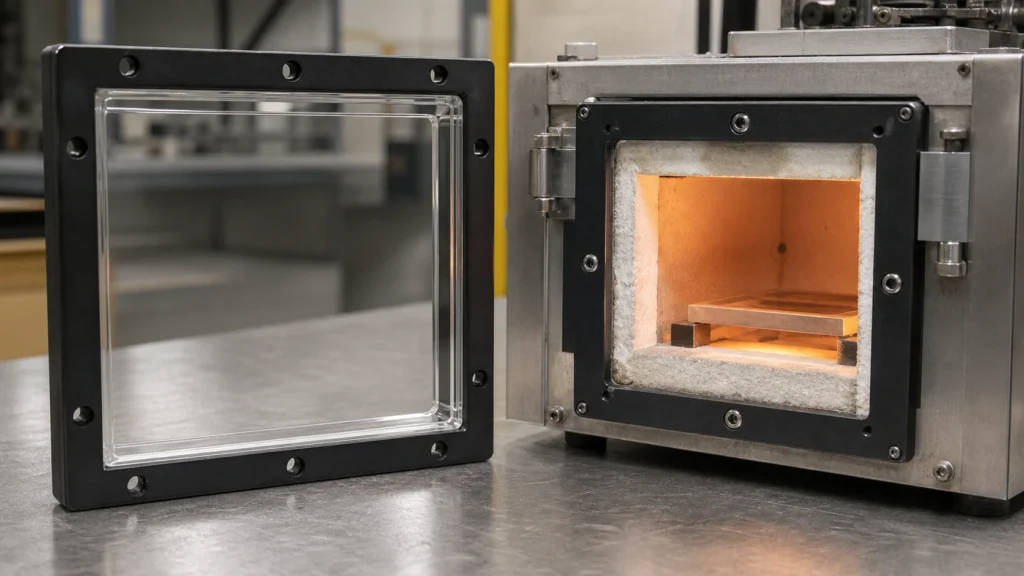
Many appliance modules—from industrial curing ovens to environmental test chambers—require a transparent barrier that maintains optical clarity while withstanding sustained high temperatures, rapid thermal cycling, and occasional chemical exposure. Engineers specify quartz glass windows when borosilicate or tempered soda-lime cannot meet the thermal budget or optical uniformity demands. The primary constraints are peak operating temperature (often 800–1050°C for fused quartz), minimal distortion under thermal load, and dimensional accuracy to ensure a reliable seal in the module housing.

Why fused quartz glass fits
Fused quartz (typically JGS2 grade) offers near-zero thermal expansion (CTE ~0.55×10⁻⁶/°C), exceptional thermal shock resistance, and high transmission from the UV through near-IR. These properties allow a single quartz window to serve as both a viewing port and a protective barrier for sensors, cameras, or light sources inside a heated enclosure. Unlike polymers or lower-grade glasses, quartz does not soften, craze, or outgas at appliance-level temperatures, ensuring long-term optical performance and safety. Custom quartz glass components can be cut, edged, and coated to match exact housing geometries and spectral requirements.
Selection criteria for appliance-grade quartz windows
When sourcing a quartz glass window for a high-temperature module, procurement teams should evaluate five critical parameters:
- Transmission range: Standard fused quartz transmits >80% from 260 nm to 2500 nm. UV-grade fused silica may be required for deep-UV applications.
- Thermal stability: Confirm the glass transition point (softening) and maximum continuous service temperature. Fused quartz typically serves up to 1050°C continuously; higher purity grades can handle brief excursions to 1200°C.
- Flatness and surface quality: Optical-grade windows demand λ/4 or better transmitted wavefront error and 40-20 scratch-dig to avoid imaging artifacts or scatter in sensor paths.
- Mechanical durability and edge finish: Seamed or polished edges prevent chipping during assembly and thermal cycling. Consider compressive mounting to allow for differential expansion between quartz and metal frames.
- Regulatory and industry compliance: Materials may need to meet REACH, RoHS, or specific flammability standards for the target appliance market.
Scenario: integrating a quartz window in an industrial baking module
Consider a manufacturer developing a conveyorized IR baking module for electronics curing. The module interior reaches 600°C, with frequent heating and cooling cycles. The design calls for a removable quartz window to allow visual inspection and IR thermography without opening the chamber. An engineer specifies a 150 mm diameter, 5 mm thick fused quartz disc with polished edges and a broadband anti-reflection coating for the 3–5 µm IR camera band. The window is mounted in a stainless-steel frame with a graphite gasket to accommodate thermal expansion. Because the quartz supplier provides tight thickness tolerance (±0.1 mm) and documented flatness, the integration team achieves a reliable seal with no shimming, and the module passes 10,000 thermal cycles without window failure or optical degradation.
Planning for sizing, coating, and integration logistics
Successful deployment of a quartz glass window begins with a detailed specification package. Define the clear aperture, overall dimensions, and thickness based on pressure differentials and mechanical mounting. Discuss tolerance stack-up: quartz can be machined to tight dimensional tolerances, but the mounting design should never create point loads. Consider anti-reflective, high-temperature, or electrically conductive coatings if required—but note that coatings may reduce the maximum service temperature. Factor in lead times for custom shapes and large diameters; while stock sizes exist, appliance-specific cuts often require CNC processing. Finally, engage with the glass fabricator early to align on packaging, shipping, and any secondary operations such as edge blackening or laser engraving for traceability.
Discuss your high-temperature window requirements
Every appliance module presents a unique combination of thermal, optical, and mechanical demands. Our applications team works with engineering and procurement groups to specify the right quartz glass window—whether a simple viewport or an optically coated sensor window. Share your operating temperature range, transmission needs, and dimensional envelope, and we will recommend a material grade, fabrication approach, and integration support to keep your project on schedule.
Quartz Windows Meet High-Temperature Appliance Demands
Quartz glass windows provide a proven optical interface for appliance modules that must endure extreme thermal cycling and harsh chemical exposure. By combining high transmission across ultraviolet, visible, and infrared wavelengths with thermal stability up to 1050°C, they enable precise sensor readings, visual monitoring, and process control in ovens, furnaces, and analytical instruments.
Material Grades and Fabrication Processes
Procurement teams typically specify optical quartz glass in grades such as JGS1 (UV-grade fused silica) and JGS2 (general-purpose fused quartz), with borosilicate glass offered as an economical alternative where temperature demands fall below 500°C. High-purity quartz glass material selection balances transmission requirements, thermal shock resistance, and chemical durability. Machining processes—including CNC grinding, lapping, and custom quartz glass cutting—achieve tight dimensional tolerances and surface finishes down to 40-20 scratch-dig or better. Edge blackening and laser engraving for traceability are often added as secondary operations.
Custom Quartz Window Attributes at a Glance
Engineers and buyers can specify the following parameters to match appliance-module requirements. Exact values are confirmed at the quoting stage.
- Material: Fused silica (JGS1, JGS2), borosilicate
- Dimensional tolerance: Typically ±0.1 mm; tighter accuracies possible for critical features
- Surface quality: 60-40 to 20-10 scratch-dig; Ra 0.5–2 nm after polishing
- Transmission range: 185 nm–2500 nm, grade-dependent
- Coating options: AR (single- or multi-layer), reflective, protective overcoats
- Maximum service temperature: Up to 1050°C (uncoated); coated windows often rated lower
- Certifications: RoHS, REACH compliance documentation available upon request
Key Facts for Procurement Teams
- Fused quartz windows sustain continuous operation above 1000°C without deformation.
- Thermal shock resistance prevents cracking during rapid heating or cooling cycles.
- UV-grade JGS2 quartz glass provides over 80% transmission at 185 nm, while IR grades transmit efficiently to 2500 nm.
- Anti-reflection coatings improve throughput but typically reduce the window’s maximum operating temperature; confirm the coating’s thermal limit early.
- Custom CNC processing enables complex shapes, holes, and edge profiles beyond standard round or rectangular blanks.
Consolidated Selection Overview
| Aspect | Typical Options | Considerations |
|---|---|---|
| Material | Fused silica (JGS1, JGS2), borosilicate | JGS1 for UV; JGS2 for IR and general high-temperature use |
| Transmission | UV (185 nm) to IR (2500 nm) | Select grade by target wavelength range |
| Max. Temperature | Up to 1050°C | Coatings lower maximum; verify with fabricator |
| Tolerance | Typically ±0.1 mm or tighter | Depends on part size and geometry |
| Coating | AR, reflective, protective | Specify coating type and required durability |
Start Your Quartz Window Project
Every high-temperature appliance module places unique demands on the optical window. Send your drawings and target specifications to our engineering team for a material and manufacturing review. Provide your operating temperature range, wavelength of interest, and dimensional envelope, and we will return a detailed proposal with lead time and cost estimates aligned to your production schedule.
Frequently Asked Questions
What is the maximum operating temperature of a quartz glass window?
Uncoated fused quartz glass windows can typically withstand continuous service temperatures up to 1050°C. The addition of optical coatings, especially anti-reflection layers, may reduce the maximum recommended temperature. Always verify the thermal rating with the supplier for the specific window configuration.
How does quartz glass compare to borosilicate glass for high-temperature appliances?
Quartz glass offers a much higher continuous-use temperature (above 1000°C vs. around 500°C for borosilicate) and better thermal shock resistance. Borosilicate is a cost-effective option for lower-temperature viewports and where UV transmission is not required. The choice depends on the appliance's thermal profile and optical needs.
Can quartz glass windows be coated for anti-reflection?
Yes, quartz glass windows can be coated with single- or multi-layer anti-reflection (AR) coatings to improve transmission in specific wavelength bands. However, AR coatings generally have a lower thermal tolerance than the bare quartz substrate. Specify the operating temperature and wavelength range so the coating can be matched to both the optical and thermal requirements.
What surface quality is available for optical quartz windows?
Surface quality is typically specified by scratch-dig numbers (e.g., 60-40, 40-20, or 20-10) or by surface roughness averages (Ra 0.5–2 nm). The required level depends on the optical application: less critical for protective viewports, more stringent for sensor windows and imaging paths.
What factors affect the lead time for custom quartz glass windows?
Lead time depends on material grade availability, part complexity, tolerances, and coating requirements. Simple circular cutouts from stock material may ship within weeks, while CNC-processed parts with tight flatness and custom coatings can take longer. Early engagement with the fabricator helps plan for sampling and production ramp-up.