
Key Takeaways
- Advanced coatings including AR, AF, and anti-fog treatments are essential for maintaining display clarity and touch functionality in kitchen conditions.
- Material CTE must align with frame and adhesive selections to prevent stress failures during thermal cycling.
- Custom glass fabrication with tight tolerances supports high-yield lamination and precise sensor integration.
- Collaborating with the glass supplier from the design phase optimizes cost, lead time, and certification compliance.
Defining the Application: Display Performance Under Refrigeration Conditions
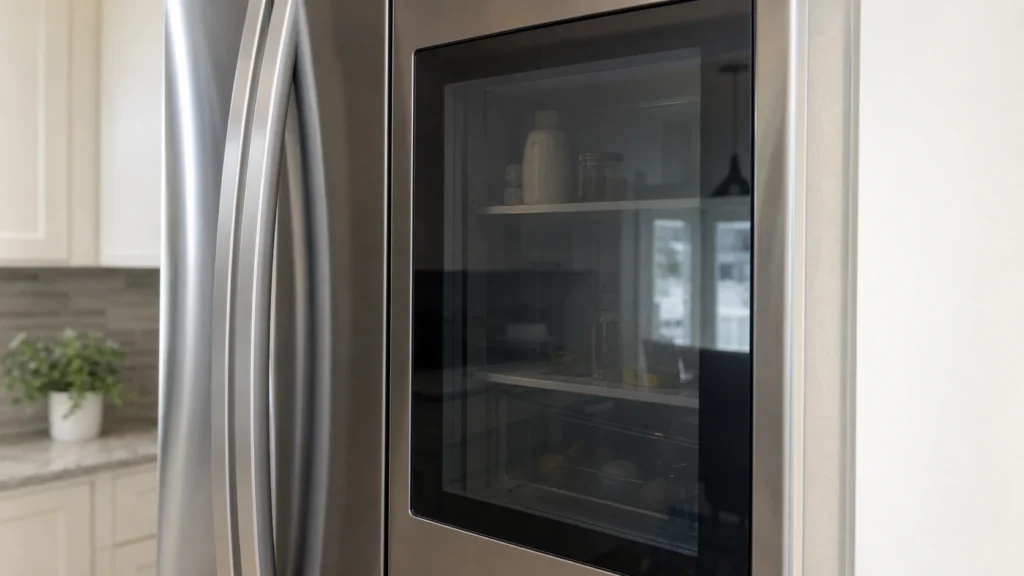
The engineering team flips through test reports, tracking the same failure mode across three different cover glass samples: condensation fogging the capacitive touch layer after only 200 door cycles. In a smart refrigerator, the display cover glass is more than a protective window — it is the primary human-machine interface in a harsh microclimate. The application demands consistent optical clarity, reliable touch response through the glass, and long-term resistance to thermal shock, humidity, and daily chemical exposure from cleaning agents. For procurement and design engineers, the essential requirements include high visible-light transmission to keep the LCD or OLED display vivid, a coefficient of thermal expansion (CTE) that matches the adjacent frame materials to prevent stress fractures, and dimensional accuracy that ensures seamless integration with the appliance bezel. Refrigerator touch panel glass must also withstand repetitive mechanical impacts, resist scratching from accidental cookware contact, and endure temperature swings from sub-zero to room ambient without warping or delamination.

Matching Glass Specifications to the Smart Refrigerator Environment
Custom cover glass engineered for smart appliances bridges the gap between fragile electronic displays and the demands of a working kitchen. Precision glass manufacturers offer aluminosilicate or borosilicate compositions that are chemically strengthened to achieve high surface compressive stress, providing the impact and scratch resistance needed for appliance display cover glass. Optional anti-reflective (AR) coatings improve readability under bright kitchen lights, while oleophobic and anti-fingerprint (AF) treatments keep the interface clean with minimal wiping. Anti-fog nano-coatings address the condensation challenge directly, maintaining touch sensitivity and optical transparency even when the refrigerator door is opened in humid environments. For design flexibility, custom glass panels can be fabricated with printed borders, IR-transparent apertures for proximity sensors, and precisely machined cutouts for microphones or cameras, supporting features like internal-view cameras and video calling without compromising the aesthetic of the appliance.
Critical Selection Criteria for Appliance Display Cover Glass
When sourcing glass for a smart refrigerator interface, B2B buyers should evaluate these technical characteristics:
- Optical Transmission and Haze: High transmission (typically >90% in the visible spectrum) and low haze ensure the display brightness is not compromised. For anti-glare finishes, balance the haze level to diffuse reflections without sacrificing crispness.
- Thermal Expansion Matching: The CTE of the glass should be compatible with the display module and plastic or metal frame. Mismatch can lead to delamination or cracking under thermal cycling.
- Flatness and Thickness Tolerance: Tight total thickness variation (TTV) and bow/warp specifications are critical for lamination and optical bonding processes. Flatness directly affects touch sensitivity uniformity.
- Durability and Surface Hardness: A pencil hardness rating of 7H or higher (or equivalent Vickers hardness) guards against scratches from everyday use. Impact resistance can be verified through ball-drop or IK rating tests.
- Regulatory and Environmental Compliance: Materials should meet RoHS, REACH, and FDA requirements where incidental food contact might occur. For global distribution, compliance with appliance-specific standards like UL or IEC is often necessary.
From Concept to Production: A Typical Project Walk-Through
Consider a North American appliance brand developing a new connected refrigerator with a 21.5-inch diagonal touchscreen. The engineering team initially prototypes with off-the-shelf cover glass but encounters frequent false touches due to condensation. After defining the specification — 3 mm thick chemically strengthened glass with anti-fog and anti-glare coatings — the manufacturer enters a sampling phase. First-article samples undergo accelerated life testing: 10,000 door open/close cycles in a 40°C, 95% RH chamber, and thermal shock from −20°C to 60°C. Optical characteristics are measured after each 1,000-cycle block. Once the design is validated, the supplier transfers the process to production-scale equipment, maintaining the same furnace profiles and coating parameters. Statistical process control (SPC) is applied to thickness, flatness, and optical transmission, with regular destructive testing of the chemical strengthening layer. This systematic approach prevents the field failures that would otherwise escalate warranty costs and damage the brand’s reputation.
Pre-Production Planning: Tolerances, Coatings, and Logistics
Before releasing a purchase order, procurement teams must address several manufacturing and supply chain factors:
- Tolerance Stack-Up: Coordinate with the display integrator to define the gap between the glass edge and bezel, considering expansion and mounting adhesive thickness. Dimensional tolerances of ±0.1 mm or better are typical for custom appliance display cover glass.
- Coating Uniformity and Durability: Specify coating adhesion levels (e.g., cross-hatch test) and abrasion resistance (e.g., Taber or steel wool test cycles) to ensure the anti-fingerprint and anti-fog functions survive the product lifetime.
- Integration with Touch Sensors: If using projected capacitive touch (PCT), the cover glass may need to be laminated to a touch sensor film or have ITO directly deposited. The glass supplier should coordinate with the sensor manufacturer to optimize stack-up and lamination parameters.
- Packaging and Logistics: Large-format, thin cover glass requires robust packaging with foam inserts and moisture barrier bags to prevent damage during ocean or air freight. Just-in-time delivery schedules can minimize inventory of coated glass, which may have limited shelf life before lamination.
Start Your Project Discussion
Bring your smart refrigerator display requirements to a precision glass manufacturer that understands the balance between optical performance, mechanical resilience, and producibility. Early collaboration on material selection, coating development, and tolerance analysis reduces development cycles and avoids costly redesigns. Contact our engineering support team to discuss your specific application, volume targets, and certification needs.
Engineering Display Cover Glass for Smart Refrigerator Applications
Selecting the right cover glass for a refrigerator display starts with defining the optical, mechanical, and environmental demands of the end application. The glass must maintain high clarity for crisp OLED or LCD screens, resist scratches and impacts from daily use, and withstand temperature swings from cold compartments to hot kitchen surfaces without warping or delamination.
Common glass materials for appliance display covers include chemically strengthened soda-lime, borosilicate such as Borofloat 33, and aluminosilicate compositions. Each offers a distinct balance of cost, scratch resistance, and thermal shock tolerance. custom glass plate options allow OEMs to specify exact dimensions, edge profiles, and hole patterns for mounting sensors or indicator LEDs.
Optical coatings are critical for performance. Anti-reflective (AR) coatings boost visible light transmission above 90%, reducing glare from kitchen lighting. Anti-fingerprint (AF) and oleophobic coatings minimize smudging on touch-enabled panels. Some designs also benefit from anti-fog treatments to prevent condensation in humid environments. These coatings are typically applied via magnetron sputtering or sol-gel processes, with durability tested to withstand tens of thousands of touch cycles.
Key Facts for Procurement Teams
- Typical cover glass thickness ranges from 0.7 mm to 3.0 mm, depending on strength requirements and display size.
- Surface quality is often specified as 60-40 scratch-dig per MIL-PRF-13830B for cosmetic areas, with tighter tolerances for active display regions.
- Thermal resistance must accommodate temperatures from −20°C to +60°C in storage and operation.
- Chemically strengthened glass reaches surface compressive stress levels above 400 MPa, enhancing impact resistance.
- Custom CNC machining can achieve dimensional tolerances of ±0.05 mm for length and width, with edge chamfering options to prevent chipping.
- Anti-reflective coatings can reduce surface reflection to less than 1% across the visible spectrum.
Customization and Supply Chain Considerations
Procurement teams should prepare for minimum order quantities (MOQs) that vary by glass type, processing complexity, and coating requirements. Standard sheet sizes and CNC cutting processes enable efficient nesting, but custom shapes or extra-large formats may increase lead times. A typical lead time for a first article run ranges from several weeks to a couple of months, depending on the availability of coated glass inventory and the need for new tooling.
When integrating cover glass into a refrigerator assembly, factor in the coefficient of thermal expansion (CTE) of the glass relative to surrounding plastics or metals. For example, borosilicate glass has a CTE around 3.3 × 10⁻⁶ /°C, which aligns well with many metal frames. Soda-lime glass, with a CTE near 9 × 10⁻⁶ /°C, may require more flexible adhesive bonding to avoid stress cracks during thermal cycling. display glass material selection should account for these mechanical compatibility factors alongside optical performance.
Packaging and logistics for large-format, thin glass panels often involve custom foam inserts and vapor-barrier bags to protect against humidity and mechanical shock during shipping. Just-in-time delivery schedules can be arranged for high-volume production.
Compliance and Quality Assurance
Suppliers must adhere to international standards such as RoHS (Restriction of Hazardous Substances) and REACH (Registration, Evaluation, Authorization and Restriction of Chemicals) for materials used in coatings and substrates. For applications where the display could contact food indirectly (e.g., door-mounted panels), compliance with FDA 21 CFR or EU 10/2011 for food contact may be required by the appliance OEM.
Reliability testing validates the cover glass under conditions mimicking years of household use. Typical tests include thermal shock (−40°C to +85°C rapid transition), damp heat (85°C / 85% RH for extended periods), and abrasion resistance using steel wool or eraser rub tests. Optical performance is verified with spectrophotometers to ensure transmission and color uniformity before and after environmental stress.
Summary of Selection Parameters
| Parameter | Common Options or Ranges | Notes |
|---|---|---|
| Glass Material | Soda-lime, borosilicate (e.g., Borofloat 33), aluminosilicate | Choice affects strength, CTE, cost, and chemical durability. |
| Optical Transmission | ≥90% with AR coating (single-side or dual-side) | Higher transmission improves display brightness and color accuracy. |
| Surface Flatness | ≤0.1 mm over 100 mm span | Ensures uniform optical bonding and lamination yield. |
| Thickness Tolerance | ±0.05 mm | Critical for capacitive touch sensitivity and mechanical fit. |
| Environmental Stability | Operational: -20°C to +60°C; storage: -40°C to +85°C | Tests include thermal shock and damp heat per IEC standards. |
| Surface Durability | Chemically strengthened to ≥400 MPa CS, abrasion-resistant coatings | Coating life typically exceeds 100,000 touch cycles. |
To start the specification process, send your dimensional drawings, target optical specs, and volume forecast to the engineering team. Early supplier engagement helps align glass selection, coating development, and integration methods, reducing design risk and speeding time to market.
Frequently Asked Questions
What are the typical material choices for smart refrigerator display cover glass?
Common materials include chemically strengthened soda-lime, borosilicate, and aluminosilicate glasses. Each offers different trade-offs in cost, impact resistance, and thermal expansion compatibility with appliance frames.
How do anti-reflective coatings improve refrigerator display performance?
AR coatings reduce surface reflections to below 1%, enhancing screen readability under bright kitchen lighting. They also improve transmission, making the display appear brighter and more color-accurate.
What are the key testing standards for appliance cover glass?
Reliability tests typically follow IEC 60068 for thermal shock and damp heat, while surface quality is assessed per MIL-PRF-13830B or ISO 10110. Compliance with RoHS and REACH is standard for global markets.
How do I specify tolerances for a custom cover glass with holes and cutouts?
Dimensional tolerances of ±0.05 mm can be achieved with CNC machining. For holes, position tolerance and edge chipping limits should be detailed. Collaboration on CAD models ensures manufacturability.
What is the typical lead time for custom cover glass prototypes?
Prototypes usually ship within 3 to 8 weeks, depending on substrate availability, coating requirements, and tooling complexity. Volume production lead times are established after process qualification.