
Key Takeaways
- Sandblasting borosilicate glass uses high-velocity abrasive particles to create a uniform, non-reflective matte finish without altering the bulk chemical properties.
- The process is suitable for Borofloat 33 and other borosilicate glass grades, commonly used in labware, optics, and microfluidics.
- Critical parameters include abrasive type (e.g., silicon carbide), particle size, air pressure, and nozzle distance to achieve target surface roughness.
- In-line quality checks measure gloss units, surface roughness (Ra), and visual uniformity to ensure batch-to-batch consistency.
- Scalable sandblasting lines can process hundreds of parts per hour, supporting both prototype and high-volume production orders.
How Is Borosilicate Glass Sandblasted to Achieve a Uniform Matte Finish?
Sandblasting borosilicate glass produces a consistent, non-reflective matte surface by propelling fine abrasive particles against the glass under controlled pressure. This mechanical etching technique is widely used for industrial components, labware, and optical elements where precise surface roughness and durability are critical.
Key Facts at a Glance
- Process: High-velocity abrasive particles etch the glass surface, creating a uniform matte texture without altering the bulk material’s thermal or chemical properties.
- Materials: Commonly applied to borosilicate glass grades such as Borofloat 33, as well as other low-expansion borosilicate variants used in optics and microfluidics.
- Abrasives: Silicon carbide or aluminum oxide, typically 100–220 grit, selected based on target surface roughness.
- Quality Metrics: Surface roughness (Ra), gloss units, and visual uniformity are monitored inline to ensure batch-to-batch consistency.
- Scalability: Automated sandblasting lines handle prototypes to high-volume orders while maintaining tight tolerances.
Base Materials and Inputs for Sandblasting Borosilicate Glass
The sandblasting process begins with precision-cut borosilicate glass blanks. Borosilicate glass, known for its low thermal expansion and high chemical resistance, is available in several grades. Borofloat 33 is a floated borosilicate glass with exceptional flatness and surface quality, making it ideal for applications requiring uniform matte finishes. Other inputs include the abrasive media—typically silicon carbide or aluminum oxide—selected for hardness and particle size distribution. The choice of abrasive directly influences the resulting surface roughness and etch pattern. Masking materials, such as UV-curable or rubberized resist films, are also critical to protect designated clear areas during blasting.
Step-by-Step Manufacturing Stages in Sandblasting Glass
Cutting and Pre-Shaping
Glass blanks are first cut to size using CNC scribing or diamond sawing. Edges may be ground or chamfered to remove sharp corners, ensuring safe handling and precise fit in assemblies. For components like BF33 microfluidic glass chip, laser cutting or waterjet cutting is often used to create intricate features before sandblasting.
Cleaning and Masking
After cutting, the glass undergoes rigorous cleaning to remove contaminants, oils, and particles that could interfere with mask adhesion. A protective mask—either self-adhesive film or liquid photoresist—is applied to areas that must remain clear. The mask pattern is designed using CAD files, guiding automated plotter cutters or UV exposure units for precise registration.
Abrasive Blasting Process
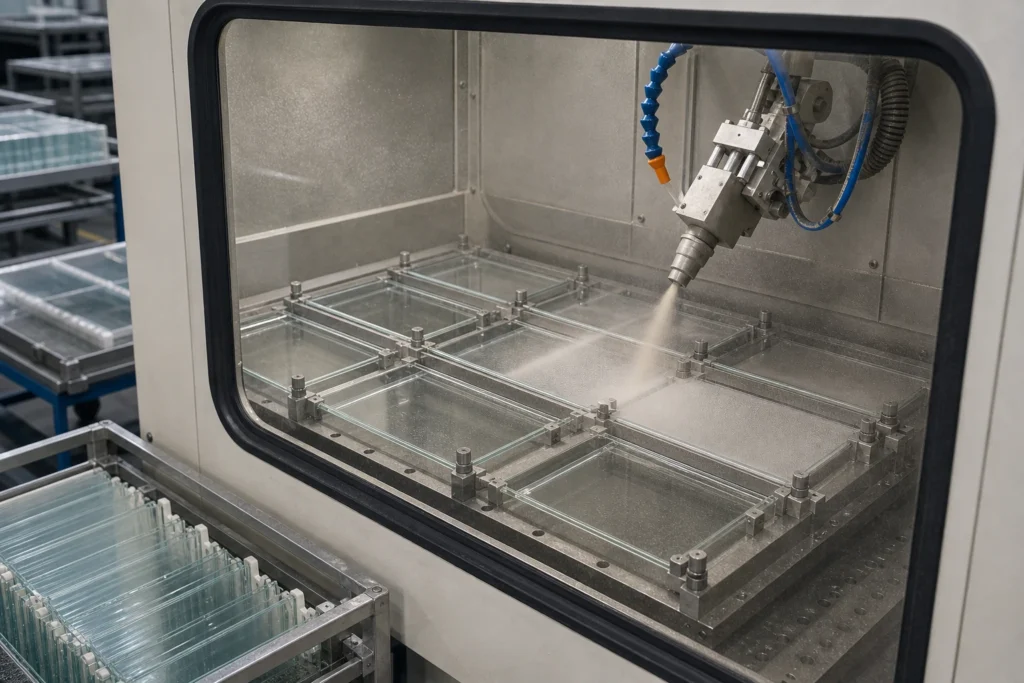
The masked glass is loaded into a sandblasting cabinet or automated blast system. Compressed air, typically pressurized between 30 and 90 psi, mixes with abrasive media in a pressurized pot or siphon system. The mixture accelerates through a tungsten carbide or ceramic nozzle, striking the exposed glass surface. Nozzle distance, angle, and traverse speed are precisely controlled to achieve uniform etching. The process removes a microscopic surface layer, creating a matte texture with consistent roughness.
Post-Blast Cleaning and Inspection
After blasting, residual abrasive and mask debris are removed through ultrasonic cleaning or high-pressure DI water rinsing. The components are then dried in a cleanroom environment to prevent water spots. Initial visual inspection under controlled lighting identifies any defects or mask bleeding before the parts proceed to final quality checks.
Equipment and Techniques That Influence Sandblasting Quality
Sandblasting Cabinet and Nozzle Technology
The design of the blast cabinet—whether a manual glove-box unit or a fully automated conveyor system—determines the throughput and consistency. Precision nozzles, typically 5–10 mm in diameter, focus the abrasive stream for tight tolerance control. Dual-chamber pressure vessels enable continuous operation without refilling, while media reclamation systems filter and recycle usable abrasive, reducing material waste.
Pressure and Media Control
Maintaining stable air pressure is critical: fluctuations can cause uneven etching. Digital pressure regulators and mass flow controllers ensure repeatable abrasive flow rates. For borosilicate glass, lower pressures are often preferred to avoid micro-cracking, while finer grit sizes produce smoother matte finishes. Automated systems store and recall process recipes for different part numbers, ensuring quick changeover.
In-Line Quality Checkpoints During Sandblasting
Surface Roughness and Gloss Measurement
Inline profilometers or confocal sensors measure surface roughness (Ra) in real time. Typical matte finishes range from Ra 0.5 to 2.0 µm, depending on application requirements. Gloss meters quantify the reduction in specular reflection, with values below 10 GU confirming a true matte appearance. These metrics are checked at multiple locations on each part to verify uniformity.
Visual and Dimensional Inspection
Automated optical inspection (AOI) systems scan for scratches, pits, or mask misalignment. Critical dimensions are verified with coordinate measuring machines (CMM) or laser micrometers. For high-precision optics, interferometry may be used to confirm that sandblasting has not induced stress or warp.
Capacity, Consistency and Scalability for Bulk Orders
Manufacturers specializing in sandblasted borosilicate glass maintain multiple blast stations to accommodate batch sizes from a few prototypes to tens of thousands of units per month. Process consistency is achieved through standardized work instructions, regular media replenishment schedules, and preventive maintenance on blast equipment. Suppliers often provide statistical process control (SPC) data and capability analysis (Cpk) to demonstrate long-term repeatability. For export orders, documentation such as certificates of conformance and surface quality reports accompanies the shipment.
| Aspect | Details |
|---|---|
| Glass Material | Borosilicate glass (e.g., Borofloat 33, other low-expansion grades) |
| Abrasive Media | Silicon carbide or aluminum oxide, 100–220 grit |
| Blasting Parameters | Air pressure 30–90 psi, nozzle distance 50–150 mm, traverse speed regulated |
| Surface Finish | Matte; typical Ra 0.5–2.0 µm, gloss <10 GU |
| Quality Checks | Inline roughness measurement, gloss meter, AOI, dimensional CMM |
| Scalability | Manual cabinets for prototypes; automated lines for high-volume production (1,000–100,000+ pcs/month) |
Request a Detailed Process Overview for Your Borosilicate Glass Sandblasting Project
If you need uniform matte finishes on borosilicate glass components, our factory can provide a custom process flow and sample parts for your evaluation. Send your specifications or drawings to our engineering team to discuss project feasibility, lead times, and quality benchmarks.
Frequently Asked Questions
What is the process of sandblasting glass?
Sandblasting glass involves propelling fine abrasive particles at high speed onto the glass surface using compressed air. A stencil or mask protects areas meant to remain clear, while exposed glass becomes etched with a matte finish. The depth and texture are controlled by adjusting air pressure, abrasive type, and exposure time.
How is sandblasted glass different from frosted glass?
Sandblasted glass is mechanically etched with abrasive media, resulting in a deeper, more durable matte texture than chemically frosted glass. Frosted glass typically uses acid etching for a lighter surface effect, while sandblasting can create varying depths and even 3D patterns. Sandblasted finishes are often preferred for industrial components requiring precise surface roughness.
What abrasives are used for sandblasting borosilicate glass?
Common abrasives include silicon carbide, aluminum oxide, and sometimes glass beads. Silicon carbide is widely used for its hardness and ability to produce a consistent matte finish on borosilicate glass without excessive chipping. Particle size, typically between 100 and 220 grit, is selected based on the desired surface roughness and application.
Can sandblasting damage borosilicate glass components?
When performed with controlled parameters, sandblasting does not damage borosilicate glass's structural integrity. The process only removes a microscopic surface layer, leaving the glass’s thermal resistance and chemical durability intact. However, excessive pressure or coarse abrasive can cause micro-cracks, so process validation is essential for precision applications.
What are the typical applications for sandblasted borosilicate glass?
Sandblasted borosilicate glass is used in laboratory equipment, optical diffusers, microfluidic chips, and semiconductor processing components. The matte surface reduces glare and provides better adhesion for coatings or bonding. It's also common in architectural glass and high-temperature view ports where a non-reflective finish is needed.