
Key Takeaways
- Precision glass cutting encompasses multiple stages including scribing, grinding, lapping, and polishing to achieve tight tolerances.
- CNC machining enables complex geometries and repeatable production of custom glass components.
- In-line quality checks for dimensions, flatness, and surface quality ensure components meet demanding specifications.
- Materials like fused silica, borosilicate, and optical glass are selected based on application requirements.
- Scalable processes support both prototype and high-volume orders with consistent quality.
Precision glass cutting transforms raw stock into high-tolerance custom components through a sequence of controlled subtractive and finishing operations
The manufacturing of custom glass components begins with selecting the right base material and proceeds through multiple stages—cutting, grinding, lapping, polishing, and coating—to deliver parts with micron-level precision. For B2B buyers, understanding this process is essential to evaluate supplier capability, ensure repeatability, and confirm that components will meet application-specific requirements such as flatness, surface quality, and dimensional accuracy.

Base materials and inputs
Glass component fabrication starts with the selection of raw stock, chosen for its optical, thermal, and mechanical properties. Common base materials include:
- Fused silica – low thermal expansion, high UV transmission; often specified for laser and semiconductor parts. When supplied as Custom High-Purity Quartz Glass, it offers exceptional purity.
- Borosilicate glass – excellent thermal shock resistance and chemical durability; widely used in laboratory and industrial equipment.
- Soda-lime glass – cost-effective for applications where moderate thermal and mechanical performance is acceptable.
- Optical glass – precisely controlled refractive index and dispersion; critical for lenses and prisms.
- Sapphire – extremely hard and scratch-resistant; used in demanding optical windows and wear components.
Each material arrives in sheet, rod, or boule form, requiring different handling and machining approaches.
Step-by-step manufacturing stages
Custom glass machining follows a logical progression to achieve the final shape, edge quality, and surface finish. The exact sequence varies with the component design, but typical stages include:
Cutting and Scribing
The first shaping step removes bulk material from the raw glass pane. Methods range from diamond scribing and breaking for straight cuts to waterjet or laser cutting for complex profiles. Waterjet cutting uses a high-pressure abrasive slurry to erode glass without heat-affected zones, while CO₂ or ultrafast lasers apply localized thermal stress to trace the desired contour. This stage defines the part’s outer boundary.
Grinding
After cutting, the edges and surfaces are rough-ground with diamond-impregnated wheels to achieve approximate dimensions and remove subsurface damage. A coolant is continuously applied to prevent thermal cracking. Grinding sets the stage for finer finishing.
Lapping
Lapping uses a slurry of loose abrasive between the glass and a rotating plate to produce a flat, parallel surface with minimal surface roughness. Double-side lapping processes both faces simultaneously, ensuring uniform thickness and parallelism.
Polishing
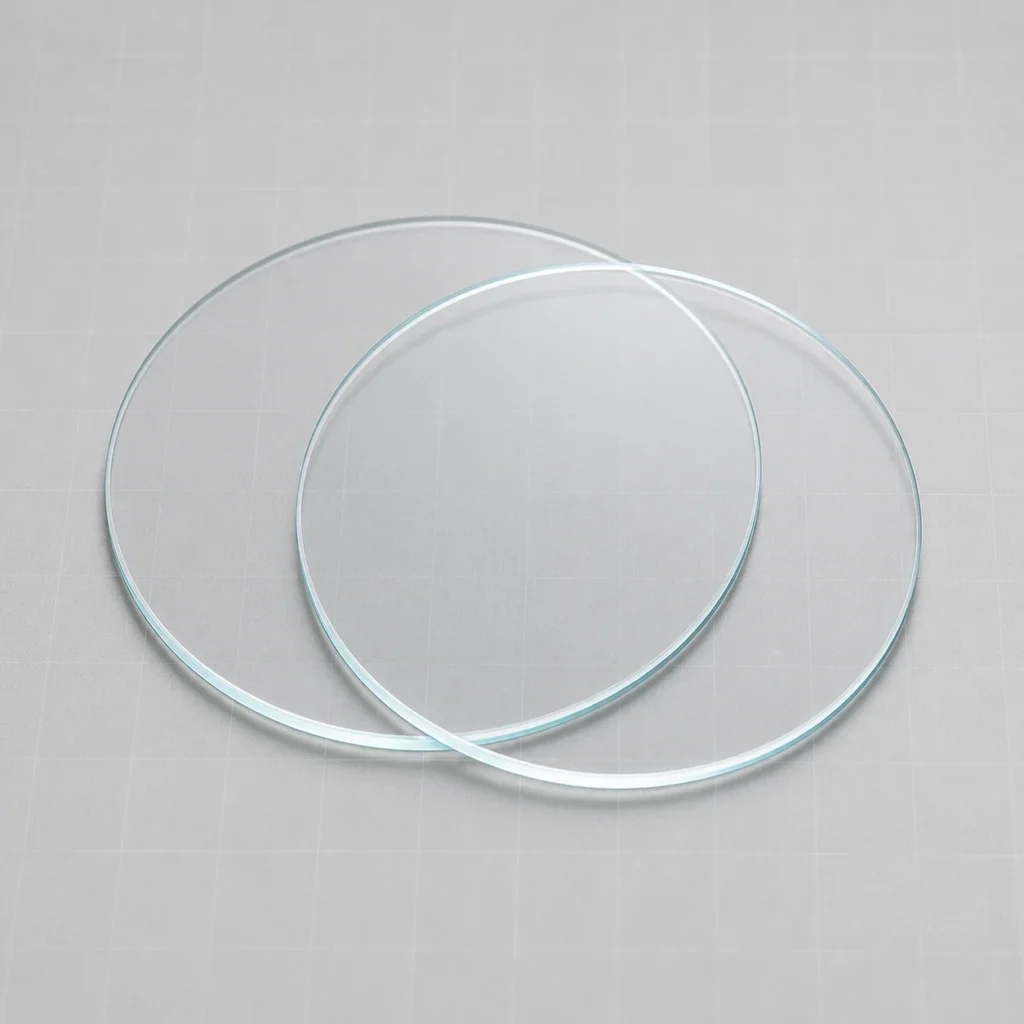
Polishing removes the last micron-scale layer of material to achieve optical clarity and low surface roughness. Cerium oxide or diamond slurries on polyurethane pads create surfaces with Ra values below 1 nm for demanding optical applications. For components like ultra-thin discs, the polishing parameters must be tightly controlled to avoid edge roll-off.
Edging
Edging creates the final perimeter geometry, whether round, oval, or a custom contour. CNC edge grinding machines follow a programmed path to produce a clean, chip-free edge with precise bevels or chamfers.
Drilling and CNC Machining
For features such as holes, slots, and pockets, CNC machining centers with diamond tooling remove material. Multi-axis CNC enables drilling, milling, and grooving, even on hardened glasses. Non-standard outlines like a Custom Special-Shaped Glass Plate are produced by combining CNC cutting with grinding routines.
Coating
After shaping, many components receive thin-film coatings to enhance performance. Magnetron sputtering or ion-beam-assisted deposition applies anti-reflective, reflective, conductive, or protective layers. The coating uniformity is critical and is verified with spectrophotometers.
Tempering and Strengthening
Heat tempering or chemical strengthening can increase the glass’s resistance to mechanical and thermal stress. The component is heated and rapidly cooled or immersed in a salt bath to induce surface compressive stress. This step is performed before final inspection if dimensional stability permits.
Cleaning
Final cleaning removes all residues and particles. Ultrasonic baths with detergents, followed by deionized water rinsing and drying in a cleanroom environment, ensure components meet cleanliness specifications for assembly or coating.
Equipment and techniques that drive quality
The precision of custom glass components depends on the capability of the machinery and the environment. Key equipment and practices include:
- CNC machining centers – multi-axis machines with diamond tooling enable repeatable fabrication of complex geometries. They maintain tolerances within ±0.05 mm or tighter on features like holes and edges.
- Double-side polishing machines – simultaneously process both faces of a workpiece, delivering parallelism under 2 arc seconds and flatness to λ/4.
- Magnetron sputtering systems – deposit uniform dielectric or metallic coatings over large areas with thickness variations under ±3%.
- Cleanroom assembly and inspection – ISO Class 7 or better environments prevent contamination during coating and final handling, essential for optical and life-science components.
These techniques allow a supplier to scale from prototype to production while maintaining consistent output.
In-line quality checkpoints during production
Quality is verified throughout the process, not just at the end. Checkpoints typically include:
- Dimensional measurement – coordinate measuring machines (CMM) or vision systems check length, width, hole position, and diameter after cutting and machining.
- Flatness and parallelism – laser interferometers or optical flats assess surface flatness after lapping and polishing. Common flatness specifications range from 1λ to λ/10 per inch depending on the application.
- Surface quality – scratch/dig inspections per MIL-PRF-13830 or ISO 10110 standards are performed under controlled lighting.
- Transmission and coating performance – spectrophotometers measure transmittance, reflectance, or sheet resistance on coated parts to confirm functional performance.
These in-line gates catch deviations early and allow process adjustments before continuing to the next stage.
Capacity, consistency and scalability for bulk orders
For B2B buyers placing volume orders, the production line must balance precision with throughput. Process control is achieved through:
- Validated work instructions – every operation follows a documented standard, ensuring repeatability across operators and shifts.
- Tool life management – diamond wheels and polishing pads are monitored and replaced based on wear patterns, not just cycle count.
- Batch processing – lapping and polishing fixtures hold multiple parts per run, while CNC machines with pallet systems reduce changeover time.
- Flexible MOQs – lines designed for both R&D quantities and full-scale production can accommodate orders from a few hundred to hundreds of thousands of pieces annually.
This scalability ensures that prototypes and high-volume orders receive the same rigorous process control.
| Process Stage | Key Techniques | Typical Quality Checks |
|---|---|---|
| Cutting & Scribing | Diamond scribing, waterjet, laser | Overall dimensions, edge profile |
| Grinding | Diamond wheel, coolant | Thickness, surface roughness (Ra) |
| Lapping & Polishing | Double-side lapping, CMP | Flatness, parallelism, scratch/dig |
| Edging & CNC Machining | CNC grinding, drilling, milling | Hole diameter, chamfer, position |
| Coating | Magnetron sputtering, IAD | Transmission, reflectance, adhesion |
| Final Inspection | CMM, interferometer, microscopy | All critical-to-function specifications |
Request a factory process overview
Understanding a supplier’s manufacturing sequence, in-line controls, and capacity helps you qualify them with confidence. Contact our team with your component drawings and we will provide a detailed process flow summary—from material selection to final packaging—including quality assurance documentation and estimated lead times based on your order quantity.
Frequently Asked Questions
What is the process for custom glass cutting?
Custom glass cutting begins with material selection and proceeds through a sequence of shaping operations including scribing or laser cutting to trim the blank, grinding to approach final dimensions, lapping for flatness, polishing for optical surface quality, and edging or CNC machining for features. Each stage is followed by inspection before the part moves on to optional coating or strengthening. The process is tailored to the material and component specifications.
How does CNC glass cutting work?
CNC glass cutting uses computer-controlled machines with diamond tooling to remove material from glass. Multi-axis mills can drill, slot, and contour complex shapes with high repeatability. Coolant is applied continuously to manage heat and prevent cracking. CNC is ideal for creating holes, pockets, and irregular outlines that are difficult to achieve with manual methods.
What tolerances are achievable in precision glass cutting?
Achievable tolerances depend on the feature and process. CNC machining can hold dimensions within ±0.05 mm for features like hole diameter and edge position. Polishing can achieve flatness of λ/4 or better and surface roughness under 1 nm Ra. Parallelism can be controlled within a few arc seconds using double-side lapping. Tighter tolerances are possible with additional processing steps and part-specific fixturing.
What is the difference between grinding and lapping glass?
Grinding uses fixed diamond abrasives to rapidly remove material and establish near-net shape, leaving a relatively coarse surface. Lapping employs a slurry of loose abrasive between the glass and a rotating plate, producing much flatter surfaces and finer finishes. Grinding is often a prerequisite for lapping, and together they achieve the parallelism and flatness required for optical components.
Can you cut complex shapes in borosilicate glass?
Yes, borosilicate glass can be cut into complex shapes using waterjet, laser, or CNC machining. Waterjet cutting is versatile and works for thermal-sensitive glasses without inducing stress. CNC machining allows intricate internal features and edge profiles. The specific method is selected based on shape complexity, required precision, and production volume.