
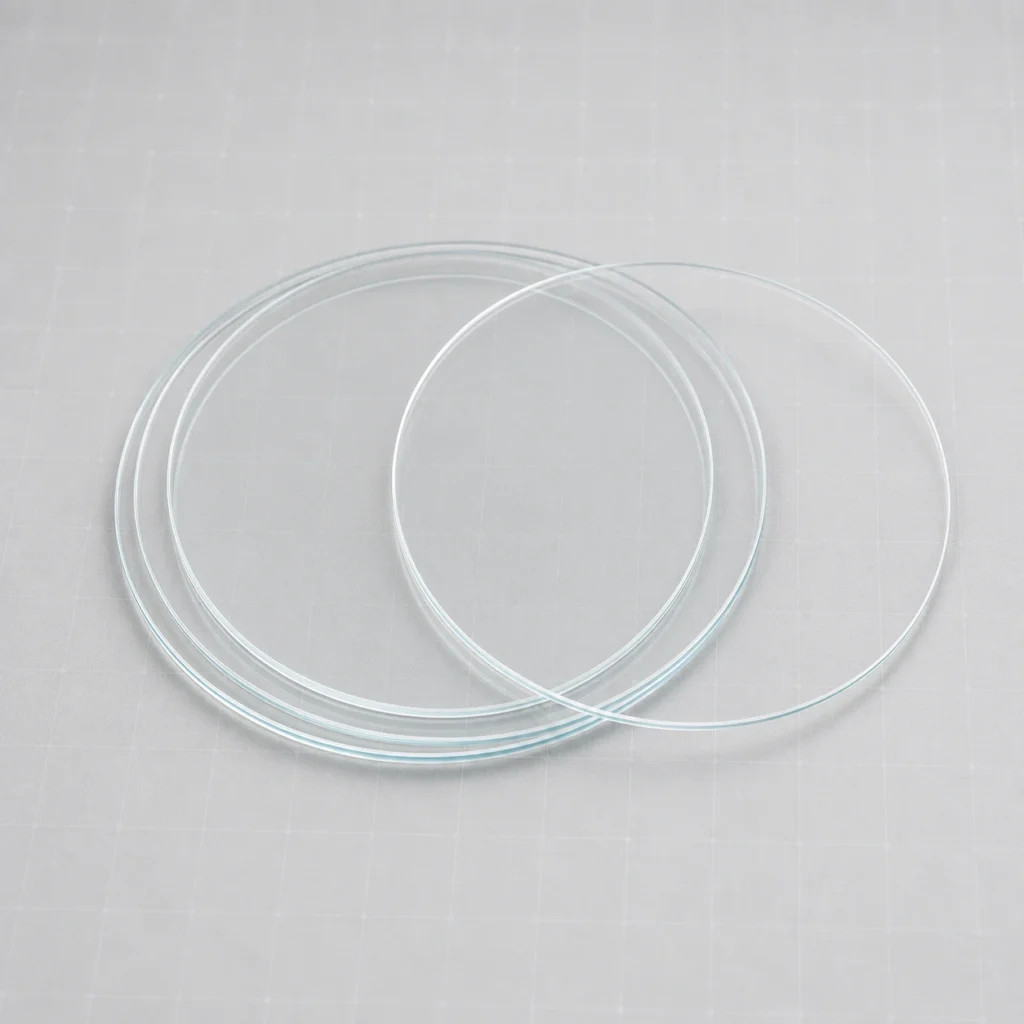
Alkali-Free Glass for Industrial Displays: Alkali-Free Glass (CTE 3.2 x 10^-6 /K, 350 nm – 2.0 um). Single-piece prototypes to production volumes, quoted from your drawing.
alkali-free glass for industrial displays programs need strengthened, printed cover glass for HMI panels. Alkali-Free Glass is the fit here because it offers no alkali ion migration into TFT or sensor layers. Typical parts: touch covers, gauge windows, printed bezels.
Specification envelope
| Material | Alkali-Free Glass (AF32 / EAGLE-class display glass) |
|---|---|
| Thermal expansion (CTE) | 3.2 x 10^-6 /K |
| Service temperature | 600 C (Tg 717 C) |
| Transmission range | 350 nm – 2.0 um |
| Density | 2.43 g/cm3 |
| Knoop hardness | 590 kg/mm2 |
| Refractive index | 1.51 @ 587 nm |
| Stock thickness | 0.10 – 1.1 mm |
| Maximum blank size | 400 x 300 mm |
| RFQ inputs | PDF/DXF/STEP drawing, quantity brackets, surface and edge spec |
Process window
Beyond this page, Alkali-Free Glass routinely runs through double-side polishing, drilling, cnc machining, etching in our shop – most real parts combine two or three of these steps.
Specification advice
The shop-floor rules that matter here:
- Material note: thin sheets below 0.3 mm demand carrier-supported handling through every step.
- Over-specification is the quiet budget killer: a 20/10 scratch-dig face costs roughly three times an 80/50 face, so grade each surface individually.
For the complete framework, see the tolerance design guide and the holes and edges design guide.
Application context
alkali-free glass for industrial displays shows up across industrial displays (touch covers, gauge windows, printed bezels); oled packaging (cover lids, frit-seal frames, fill-port plates); ccd inspection equipment (CCD cover plates, reference grids, stage glass). Background reading on the underlying material science: SCHOTT AF 32 eco.
The fastest route to a quote is geometry: use the 3D builder below, draw a dimensioned 2D drawing from it, or open the site-wide custom glass machining 3D + 2D builder for fully custom parts.
Engineers scoping this work usually also review alkali-free display glass, alkali-free glass wafers, special-shaped glass plates.
Frequently asked questions
How does Alkali-Free Glass behave under heat?
CTE is 3.2 x 10^-6 /K and continuous service reaches 600 C (Tg 717 C), which is what drives its use where no alkali ion migration into TFT or sensor layers matters.
What do industrial displays programs usually order?
Touch covers, gauge windows, printed bezels. Typical spec: chemically strengthened, OD4 black print.
Is there a minimum order for alkali-free glass for industrial displays?
No. Single prototypes are accepted, and pricing steps down at 10, 100 and 1,000 pieces.
How fast can prototypes ship?
Machined prototypes ship in 5 – 10 working days. Coated or bonded parts add 1 – 2 weeks depending on queue slots.
What files do you need for a quote?
A dimensioned PDF plus DXF or STEP geometry. If only a sketch exists, our drawing review service formalizes it before quoting.
Specifications on this page were last reviewed by our engineering team in August 2026.