
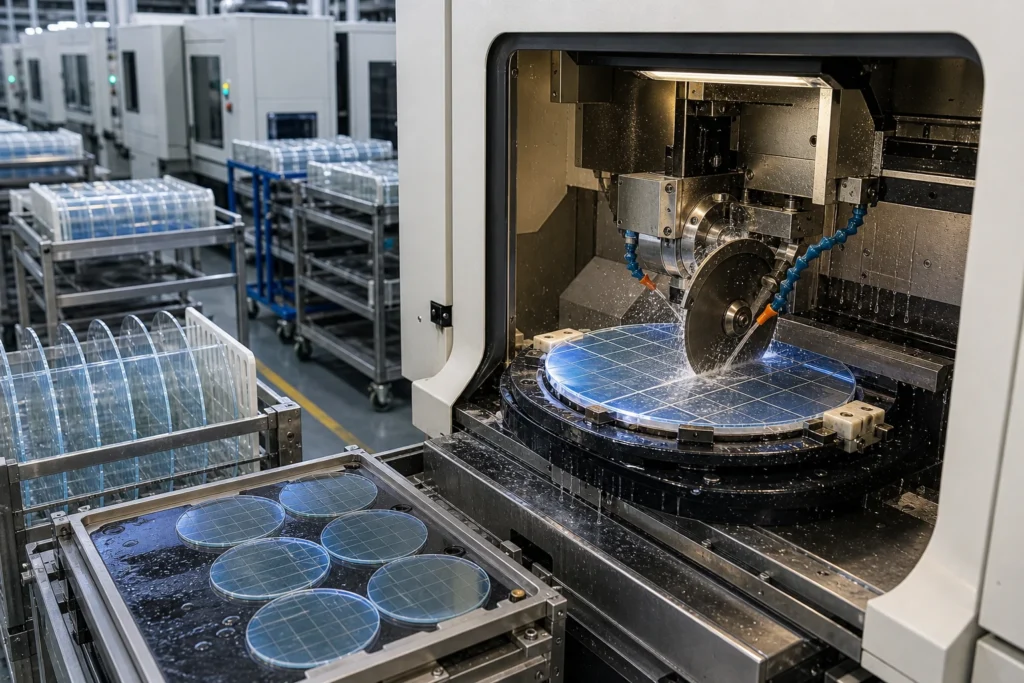
Dicing Soda-Lime Glass: Soda-Lime Glass (CTE 9.0 x 10^-6 /K, 360 nm – 2.0 um); Dicing to +/-0.01 mm index accuracy. Single-piece prototypes to production volumes, quoted from your drawing.
dicing soda-lime glass is a materials problem before it is a machining problem. Soda-Lime Glass has lowest cost per square meter and a Knoop hardness of 585 kg/mm2, so the dicing recipe – feeds, coolant, tooling – differs from what works on ordinary float glass. The line runs automatic dicing saws with resin and metal-bond blades and holds +/-0.01 mm index accuracy.
Key parameters
| Material | Soda-Lime Glass (Float per ASTM C1036, low-iron option) |
|---|---|
| Thermal expansion (CTE) | 9.0 x 10^-6 /K |
| Service temperature | 350 C continuous |
| Transmission range | 360 nm – 2.0 um |
| Density | 2.50 g/cm3 |
| Knoop hardness | 585 kg/mm2 |
| Refractive index | 1.52 @ 587 nm |
| Stock thickness | 0.40 – 19 mm |
| Maximum blank size | 1,000 x 800 mm |
| Process | Dicing |
| Working tolerance | +/-0.01 mm index accuracy |
| Minimum feature | 30 um kerf |
| Surface finish | edge chipping under 15 um |
| Thickness window | 0.05 – 3 mm |
| Edge condition | saw edge, optional etch relief |
| RFQ inputs | PDF/DXF/STEP drawing, quantity brackets, surface and edge spec |
Getting the drawing right
The shop-floor rules that matter here:
- Material note: higher CTE means edge chips propagate under thermal load, so edge finishing quality drives reliability.
- Process boundary: straight-line cuts only; contours route to laser cutting instead.
- Over-specification is the quiet budget killer: a 20/10 scratch-dig face costs roughly three times an 80/50 face, so grade each surface individually.
For the complete framework, see the tolerance design guide and the holes and edges design guide.
Manufacturing capability
The core strength of Dicing is singulating wafers into dies with tight index accuracy and low chipping. The honest limit: straight-line cuts only; contours route to laser cutting instead. Both belong on the drawing before quoting, not after.
One material, many routes: on Soda-Lime Glass we also quote sandblasting, ultrasonic machining, polishing, laser cutting, and multi-step drawings are the norm rather than the exception.
Typical applications
dicing soda-lime glass shows up across led packaging (groove covers, phosphor carriers, package windows); industrial displays (touch covers, gauge windows, printed bezels). Background reading on the underlying material science: ASTM C1036 flat glass standard.
Dimensions still moving? Configure this part live in the 3D + 2D builder below, or open the full custom glass machining 3D + 2D builder to start from a blank canvas.
For adjacent specifications, see ultra-thin glass materials, wafer dicing process, perforated quartz plates.
Common questions
What equipment runs the dicing work?
Automatic dicing saws with resin and metal-bond blades.
Is there a minimum order for dicing soda-lime glass?
No. Single prototypes are accepted, and pricing steps down at 10, 100 and 1,000 pieces.
How fast can prototypes ship?
Machined prototypes ship in 5 – 10 working days. Coated or bonded parts add 1 – 2 weeks depending on queue slots.
What files do you need for a quote?
A dimensioned PDF plus DXF or STEP geometry. If only a sketch exists, our drawing review service formalizes it before quoting.
Do parts ship with inspection data?
Dimensional reports, surface certificates and material certs per melt are available; specify the level on the RFQ.
Specifications on this page were last reviewed by our engineering team in September 2026.