
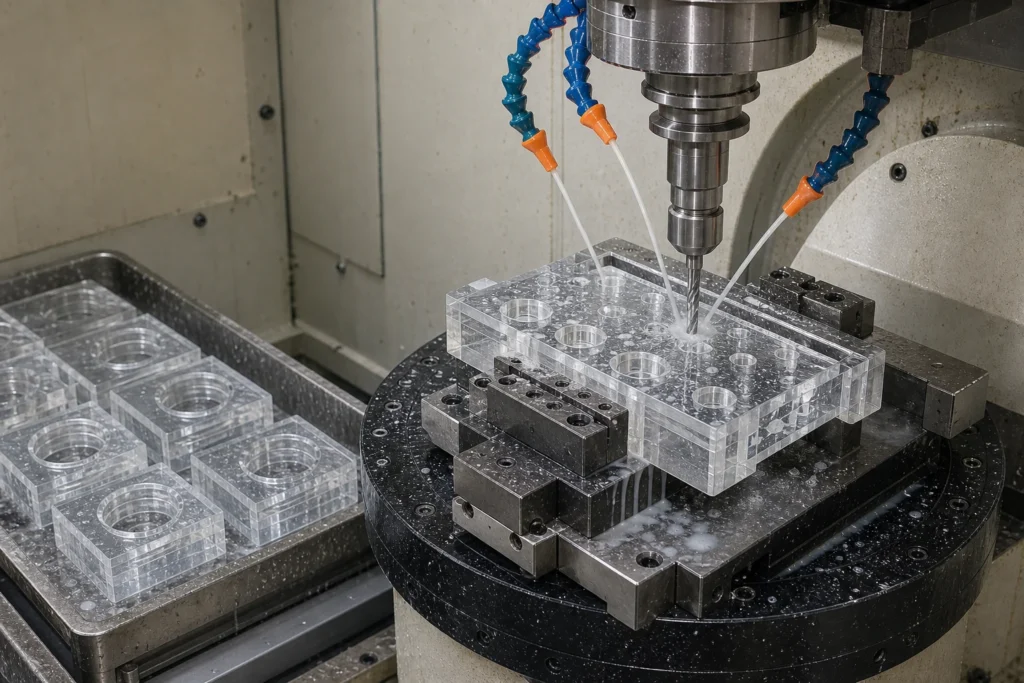
Drilling JGS1 Quartz Glass – JGS1 Quartz Glass (CTE 0.55 x 10^-6 /K, 185 nm – 2.5 um (UV grade)); Drilling to +/-0.02 mm hole position. No minimum order; DFM review included with every RFQ.
The combination of JGS1 Quartz Glass and Drilling comes up constantly in RFQs for a reason – the material offers no bubbles or inclusions in the uv path, and Drilling is the right way to get accurate geometry into it. Expect +/-0.02 mm hole position and exit-chip controlled below 0.1 mm.
The numbers
| Material | JGS1 Quartz Glass (UV-grade synthetic, bubble class 0) |
|---|---|
| Thermal expansion (CTE) | 0.55 x 10^-6 /K |
| Service temperature | 1,100 C continuous |
| Transmission range | 185 nm – 2.5 um (UV grade) |
| Density | 2.20 g/cm3 |
| Knoop hardness | 500 kg/mm2 |
| Refractive index | 1.458 @ 587 nm |
| Stock thickness | 0.10 – 30 mm |
| Maximum blank size | 300 mm diameter |
| Process | Drilling |
| Working tolerance | +/-0.02 mm hole position |
| Minimum feature | 0.15 mm laser / 0.5 mm mechanical |
| Surface finish | exit-chip controlled below 0.1 mm |
| Thickness window | 0.1 – 30 mm |
| Edge condition | optional chamfered hole entry |
| RFQ inputs | PDF/DXF/STEP drawing, quantity brackets, surface and edge spec |
Getting the drawing right
Three items decide most of the cost and lead time on this work:
- Material note: UV-grade surfaces must be polished without subsurface damage that scatters below 250 nm.
- Process boundary: hole-to-edge distance should stay above 1.5x thickness to protect strength.
- Over-specification is the quiet budget killer: a 20/10 scratch-dig face costs roughly three times an 80/50 face, so grade each surface individually.
For the complete framework, see the tolerance design guide and the holes and edges design guide.
Capabilities and limits
The core strength of Drilling is through-holes, blind holes and countersinks at densities beyond 1,000 holes per part. The honest limit: hole-to-edge distance should stay above 1.5x thickness to protect strength. Both belong on the drawing before quoting, not after.
One material, many routes: on JGS1 Quartz Glass we also quote sandblasting, cnc machining, dicing, grinding, and multi-step drawings are the norm rather than the exception.
Typical applications
drilling jgs1 quartz glass shows up across laser systems (windows, beam splitters, debris shields); aerospace optics (sensor windows, star-tracker flats, radiation-tolerant ports). Background reading on the underlying material science: RP Photonics: fused silica.
The fastest route to a quote is geometry: use the 3D configurator below, or the site-wide custom glass machining 3D builder for fully custom parts.
Related reading on this site: fused silica wafers 2-12 inch, precision glass drilling, CCD screening plates.
Frequently asked questions
What tolerances are achievable on JGS1 Quartz Glass parts?
Ground features hold +/-0.01 mm and lapped thickness reaches +/-0.003 mm. UV-grade surfaces must be polished without subsurface damage that scatters below 250 nm.
What thickness range do you stock for JGS1 Quartz Glass?
Standard stock spans 0.10 – 30 mm, with blanks up to 300 mm diameter. Other formats are sourced per order.
How does JGS1 Quartz Glass behave under heat?
CTE is 0.55 x 10^-6 /K and continuous service reaches 1,100 C continuous, which is what drives its use where deep-UV transmission to 185 nm matters.
What accuracy does drilling hold?
+/-0.02 mm hole position with minimum features of 0.15 mm laser / 0.5 mm mechanical. Hole-to-edge distance should stay above 1.5x thickness to protect strength.
What equipment runs the drilling work?
Diamond core drills, ultrasonic assist and laser percussion heads.
Specifications on this page were last reviewed by our engineering team in July 2026.