
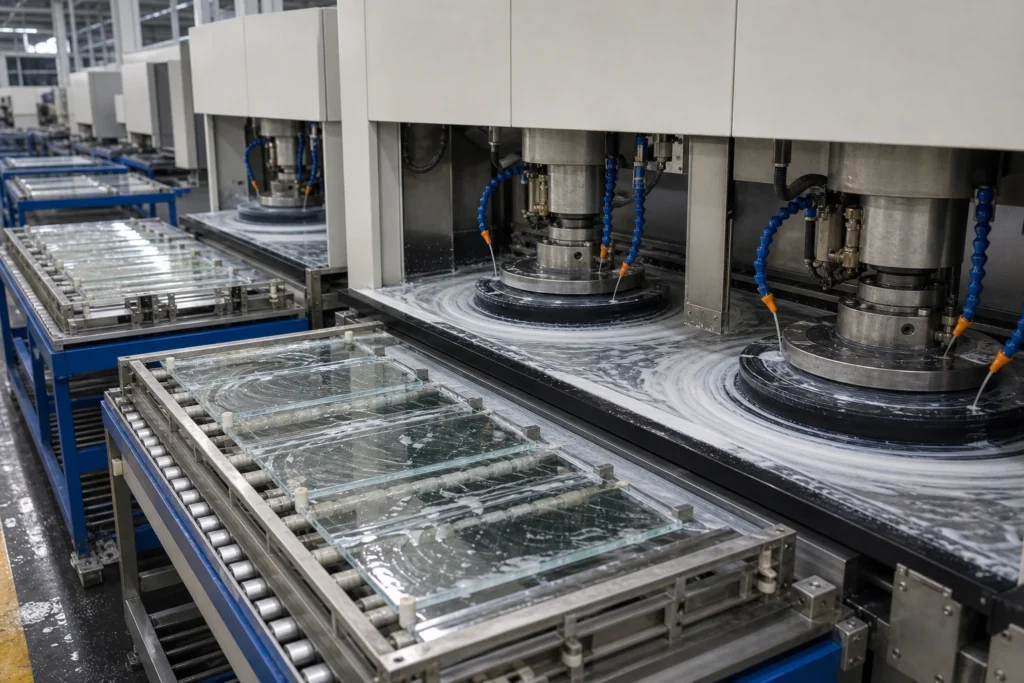
Polishing Fused Silica: Fused Silica (CTE 0.55 x 10^-6 /K, 185 nm – 2.5 um); Polishing to flatness to lambda/4 per 25 mm. Single-piece prototypes to production volumes, quoted from your drawing.
The combination of Fused Silica and Polishing comes up constantly in RFQs for a reason – the material offers deep-uv transmission, and Polishing is the right way to get accurate geometry into it. Expect flatness to lambda/4 per 25 mm and scratch-dig 40/20 to 20/10.
The numbers
| Material | Fused Silica (JGS1 (UV), JGS2 (standard), JGS3 (IR)) |
|---|---|
| Thermal expansion (CTE) | 0.55 x 10^-6 /K |
| Service temperature | 1,100 C continuous |
| Transmission range | 185 nm – 2.5 um |
| Density | 2.20 g/cm3 |
| Knoop hardness | 500 kg/mm2 |
| Refractive index | 1.458 @ 587 nm |
| Stock thickness | 0.10 – 50 mm |
| Maximum blank size | 450 x 450 mm |
| Process | Polishing |
| Working tolerance | flatness to lambda/4 per 25 mm |
| Minimum feature | Ra below 1 nm |
| Surface finish | scratch-dig 40/20 to 20/10 |
| Thickness window | 0.2 – 50 mm |
| Edge condition | polished bevels available |
| RFQ inputs | PDF/DXF/STEP drawing, quantity brackets, surface and edge spec |
Specification advice
The shop-floor rules that matter here:
- Material note: its hardness and brittleness demand diamond tooling and controlled feeds.
- Process boundary: steep aspect parts and deep pockets polish unevenly; those faces are specified as fine-ground.
- Over-specification is the quiet budget killer: a 20/10 scratch-dig face costs roughly three times an 80/50 face, so grade each surface individually.
For the complete framework, see the tolerance design guide and the holes and edges design guide.
Capabilities and limits
The core strength of Polishing is optical-grade faces with certified scratch-dig and interferometer-verified flatness. The honest limit: steep aspect parts and deep pockets polish unevenly; those faces are specified as fine-ground. Both belong on the drawing before quoting, not after.
One material, many routes: on Fused Silica we also quote drilling, ultrasonic machining, dicing, coring, and multi-step drawings are the norm rather than the exception.
Application context
The recurring buyers of polishing fused silica: ccd inspection equipment (CCD cover plates, reference grids, stage glass); optical sensors (sensor windows, filter caps, lens covers); microfluidic devices (chips, manifolds, via plates, bonded stacks). Background reading on the underlying material science: RP Photonics: fused silica.
Dimensions still moving? Configure this part live in the 3D + 2D builder below, or open the full custom glass machining 3D + 2D builder to start from a blank canvas.
Useful companion pages: CNC machining capability, optical polishing capability, ultra-thin glass materials.
Buyer questions, answered
What equipment runs the polishing work?
Pitch and polyurethane pad polishers with cerium oxide slurry.
Is there a minimum order for polishing fused silica?
No. Single prototypes are accepted, and pricing steps down at 10, 100 and 1,000 pieces.
How fast can prototypes ship?
Machined prototypes ship in 5 – 10 working days. Coated or bonded parts add 1 – 2 weeks depending on queue slots.
What files do you need for a quote?
A dimensioned PDF plus DXF or STEP geometry. If only a sketch exists, our drawing review service formalizes it before quoting.
Do parts ship with inspection data?
Dimensional reports, surface certificates and material certs per melt are available; specify the level on the RFQ.
Specifications on this page were last reviewed by our engineering team in September 2026.