
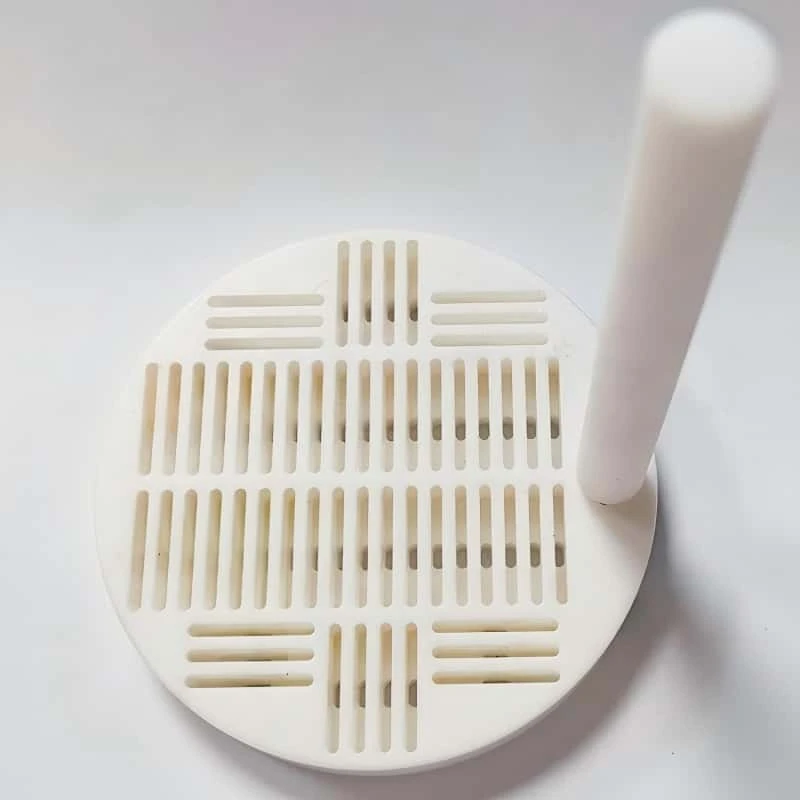
Model: costom.
Overview
The CNC Non-Scratch PTFE Cleaning Carrier for Wafer and Glass Substrates is supplied as a glass wafer made from Stainless Steel. Dimensions, material grade, coating and finish can be quoted to your drawing; the values above are the listed starting point.
Specifications
| Material | Stainless Steel |
|---|---|
| Standard | Customized Non-Standard Precision Optical Componen |
| Tolerance | +/-0.005mm |
| Model NO. | costom |
| Surface Treatment | Gold/Silver Plating, Nickel/Tin Plating,PVD |
| Machining Method | Laser Cutting |
| Other Processing Method | Chemical Etching, Stamping |
| Production Type | OEM Custom Manufacturing |
| Material Options | Stainless Steel, Copper, Brass,Nickel |
| Material Thickness | 0.03mm to 1.5mm (Ultra-Thin Foil Specialists) |
| Min. Hole Diameter | 0.05mm ( Thickness,Ratio up to 1:1) |
| Min. Slot/Line Width | 0.03mm |
| Edge Quality | Burr-Free, No Stress, No Heat-Affected Zones |
| Service Scope | OEM & ODM Supported |
| File Formats | CAD (.Dwg, .Dxf), Gerber, Pdf, STP/Step |
| Home Appliances | Precision filters for coffee machines, atomizers, faucets, and small kitchen devices. |
| Industrial & Medical | High-precision filters for micro pumps, infusion devices, and protective meshes for automotive sensors. |
| Applications | Used in wafer cleaning, glass substrate handling, optical glass processing, ITO glass cleaning, semiconductor laboratories, cleanroom production, and precision substrate washing. |
| Supplier | Shenzhen Xintu Precision Hardware Co., Ltd. |
Technical data
| Parameter | Specification Range / Options |
|---|---|
| Product Type | CNC Machined Parts / Components / Blocks / Plates / Fixtures |
| Material | Aluminum (6061 / 6063 / 7075) / Stainless Steel (303 / 304 / 316) / Carbon Steel / Brass / Copper |
| Manufacturing Process | CNC Milling / CNC Turning / Drilling / Tapping |
| Size Range | Custom (based on drawing) |
| Structure Type | Block / Plate / Bracket / Housing / Fixture / Frame |
| Tolerance | ±0.01 – ±0.05 mm (depending on part complexity) |
| Surface Roughness | Ra 0.8 – 3.2 μm |
| Flatness | ≤0.05 mm |
| Parallelism | ≤0.02 mm |
| Hole Accuracy | H7 / H8 (customizable) |
| Thread Standard | Metric / UNC / UNF / BSP |
| Surface Treatment | Anodizing / Sandblasting / Polishing / Brushing / Plating |
| Heat Treatment | Available (for steel parts) |
| Edge Condition | Deburred / Smooth edge |
| Color Option | Natural / Black / Silver / Custom anodized colors |
| Assembly Capability | Threading / Press-fit / Assembly support |
| Drawing Format | CAD / STEP / IGES / PDF |
| Inspection Method | Caliper / Micrometer / CMM |
| Quality Control | Full inspection / Sampling inspection |
| OEM Service | Supported (custom design & production) |
| Prototype | Supported (small batch / sample) |
| Sample Time | 3 – 7 days |
| Production Lead Time | 7 – 20 days |
| Item | Electrophoretic Coating (E-coating) | Powder Coating | Electroplating |
| Process Principle | Paint particles are deposited on the metal surface through an electric field to form a uniform coating layer. | Dry powder is sprayed onto the metal surface and cured at high temperature to form a protective layer. | A metal layer is deposited on the surface through an electrochemical reaction in an electrolyte solution. |
| Coating Material | Resin-based paint coating | Polymer powder coating | Metal layer (nickel, chrome, copper, gold, etc.) |
| Surface Appearance | Smooth matte or semi-gloss finish | Matte or textured coating | Metallic glossy finish |
| Coating Uniformity | Excellent uniform coating, even on complex shapes | Good coverage but may be thicker on edges | May vary depending on part geometry |
| Thickness Range | 10–30 μm | 40–120 μm | 5–25 μm (typical) |
| Corrosion Resistance | Very good corrosion protection | Excellent corrosion resistance | Depends on plating material |
| Wear Resistance | Good mechanical durability | Very strong impact and wear resistance | High hardness depending on plating type |
| Environmental Impact | Environmentally friendly with high coating efficiency | Eco-friendly with minimal solvent emissions | May involve chemical waste or heavy metals |
| Typical Applications | Automotive parts, electronic components, speaker grilles | Outdoor equipment, appliances, metal housings | Decorative parts, connectors, conductive components |
What to specify when you request a quote
- Diameter and flat / notch — listed as “0.05mm ( Thickness,Ratio up to 1:1)”; state diameter, flat or notch and their tolerances.
- Thickness and TTV — listed as “0.03mm to 1.5mm (Ultra-Thin Foil Specialists)”; give thickness, its tolerance and total thickness variation.
- Polish and roughness — listed as “Gold/Silver Plating, Nickel/Tin Plating,PVD”; specify single- or double-side polish and roughness.
- Flatness, bow and warp — quote flatness, bow and warp limits.
- Material grade — listed as “Stainless Steel”; name the grade (JGS1/JGS2, Borofloat 33, alkali-free, sapphire orientation).
Engineering guides for this part
For material grades and coating options, see BOROFLOAT 33 & Alkali-Free Glass Wafers: Material Guide. How parts like this are machined and finished is covered in Precision Glass Hole Machining for MEMS and Wafer Parts. For an application example, read Alkali-Free Glass Wafers for Appliance Display Substrates. Before sending a drawing, check Choosing Glass Materials for Optical & Industrial Components. A related standard product is Alkali-Free Glass Wafers.
FAQ
What is the CNC Non-Scratch PTFE Cleaning Carrier for Wafer and Glass Substrates made of? expand_more
It is listed as Stainless Steel. Other grades can be quoted if your application needs different transmission, thermal or chemical properties.
What should I include in a quote request? expand_more
Include diameter and flat / notch, thickness and ttv, polish and roughness, flatness, bow and warp and material grade, plus quantity and a drawing if the part is custom.


