
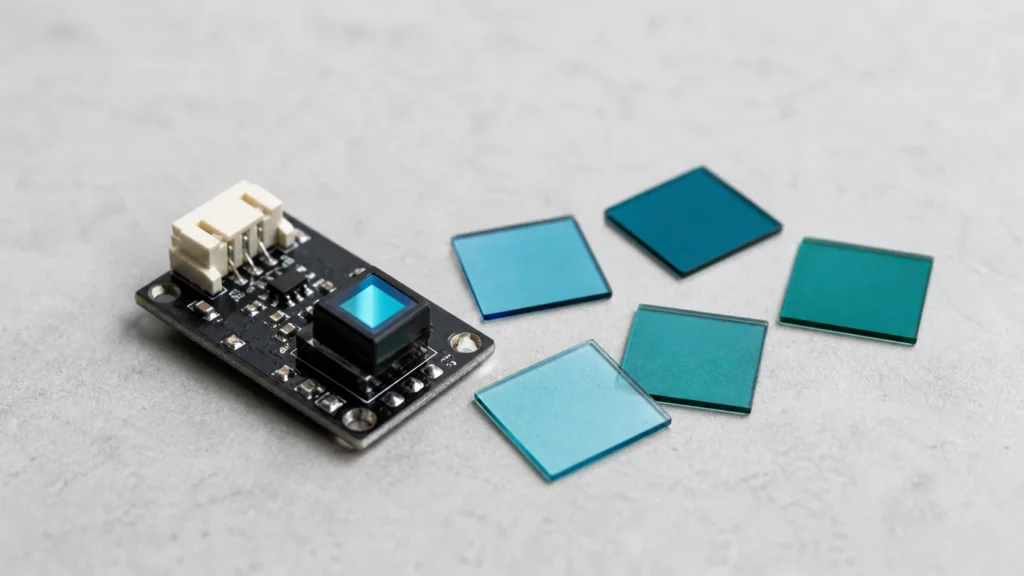
Key Takeaways
- Bandpass filter glass for appliance sensors must balance optical precision with cost-effective mass production.
- Substrate choice (borosilicate, fused silica, sapphire) determines thermal stability and transmission range.
- Custom coatings and dimensional control enable integration into compact, sealed sensor housings.
- Environmental testing per appliance standards ensures long-term reliability in kitchen, laundry, and outdoor devices.
- Partnering early with a filter manufacturer streamlines design and reduces development cycles.
Application Need: Reliable Light Detection in Appliance Environments
Consider a design engineer troubleshooting a false trigger in a washing machine’s turbidity sensor. The module must accurately measure water clarity by detecting scattered light from suspended particles, yet ambient light leaking through the chassis or reflections from wet surfaces cause erratic readings. The sensor’s photodiode sees a broad spectrum, but only a narrow band around a 940 nm IR LED carries the useful signal. A precision glass bandpass filter solves this by isolating the emitter’s wavelength and blocking everything else—daylight, fluorescent spikes, and even the appliance’s own status LEDs.

Appliance light detection modules—found in smart ovens, dryers, dishwashers, and air purifiers—share a common set of demands. Optical performance must be consistent despite temperature swings from room ambient to 85°C and humidity near saturation. Filters must withstand vibration, thermal shock, and occasional exposure to cleaning agents or condensing steam. Dimensional accuracy matters too: a filter that shifts its center wavelength by a few nanometers over temperature, or one that deforms under stress, can compromise the entire sensor’s calibration. A robust bandpass filter glass engineered for these conditions turns a fragile concept into a repeatable, production-ready subassembly.
How Precision Glass Bandpass Filters Fulfill These Requirements
A glass bandpass filter selectively transmits light within a specific wavelength interval while attenuating all others. In most appliance sensors, this is achieved either by interference coatings deposited on a polished glass substrate or by using intrinsically absorptive colored glass. Interference filters offer steep cut-on and cut-off slopes, high peak transmission (often exceeding 90%), and a blocking level specified as optical density (OD). An OD4 filter reduces out-of-band light to 0.01% of its original intensity; OD6 is common for high-stray-light environments. The glass substrate provides a stable, dimensionally precise platform that can be diced to small rectangles or circles—often as compact as 3 mm on a side—for integration into tight module housings.
Unlike plastic filters, glass does not creep under mechanical load and maintains its form over the appliance’s lifetime. Manufacturers can fine-tune the coating design to match the exact LED emission peak and detector responsivity curve, while putting blocking bands where environmental light sources are strongest. For instance, a flame detection module in a gas oven might require a narrow passband at 4.3 µm—a wavelength where glass is still viable with chalcogenide substrates—while blocking the oven’s visible glow and room light. By combining material know-how with coating expertise, a supplier delivers a filter that behaves as a predictable optical component, not a variable.
Key Selection Criteria for Appliance Detection Modules
Choosing the right bandpass filter glass involves evaluating spectral, mechanical, and environmental parameters together. The following points are critical for appliance-grade modules:
- Spectral specifications: Center wavelength (CWL) tolerance, full width at half maximum (FWHM), peak transmittance, and out-of-band blocking from UV through NIR. A typical turbidity sensor filter might be centered at 940 ± 5 nm with a 50 nm FWHM and OD4 from 200–1100 nm.
- Thermal behavior: The coefficient of thermal expansion (CTE) of the glass affects dimensional stability, while the temperature dependence of the coating layers causes a small but predictable shift in CWL—often on the order of 0.01 nm/°C. For an appliance cycling between 0 °C and 85 °C, the passband must remain within the detector’s acceptance window.
- Durability: Hard oxide coatings withstand humidity, thermal cycling, and occasional contact with mild detergents far better than soft coatings. Filters destined for damp environments should pass 85 °C/85% RH testing and meet adhesion standards per MIL-C-48497 or similar.
- Flatness and surface quality: In imaging-based sensors, transmitted wavefront error can degrade contrast. A flatness of λ/4 per 25 mm and a scratch-dig of 40-20 are typical for non-imaging detector optics; tighter specs add cost.
- Regulatory compliance: RoHS and REACH are baseline. In some markets, UL recognition of the filter as a component in an overall appliance certification streamlines the approval process.
Real-World Scenario: From Prototype to Volume Production
A manufacturer of smart ovens was developing a flame detection module that would trigger a safety shutdown if ignition failed. Their initial prototype used an off-the-shelf IR filter, but the unit gave false positives when the broiler element glowed red. After an inquiry, an optical engineer at the glass filter supplier reviewed the detector’s spectral response and the flame’s characteristic emission bands. Together they specified a custom bandpass filter glass centered at 4.26 µm (CO₂ emission), with a passband just 120 nm wide and deep blocking across visible and near-IR. The supplier fabricated first-article samples on a 0.5 mm thick chalcogenide glass substrate, measuring 8 × 8 mm. The customer tested these in a thermal chamber and confirmed reliable discrimination. With parameters locked, the supplier scaled to thousands of units per month, maintaining lot-to-lot CWL uniformity within ±5 nm and providing spectral trace data with every shipment.
Integration and Logistics Planning
When moving from design to production, several practical factors ensure smooth integration of the bandpass filter glass into the light detection module:
- Sizing and form factor: Filters are typically supplied as unmounted glass pieces—rounds from 3 to 50 mm diameter, squares, or custom shapes with tolerances as fine as ±0.05 mm. Some teams prefer a filter already mounted in a blackened metal ring to simplify handling and assembly.
- Tolerance stack-up: Thickness variation and wedge can alter the optical path and cause beam deviation. For proximity sensors using a dual-aperture setup, a wedge of less than 1 arc minute may be critical. The mechanical drawing should define parallelism, thickness, and flatness explicitly.
- Hard coating option: Specifying a hard, sputtered coating ensures the filter survives automated assembly processes and long-term exposure without delamination. A coated glass filter can often withstand soldering reflow temperatures if bonded into the housing beforehand.
- Packaging and transport: Glass filters deserve proper handling: waffle trays, gel packs, or tape-and-reel options for automated pick-and-place. Cleanroom packaging prevents contamination that could degrade adhesion or optical quality.
- Lead time and scalability: Custom coatings typically carry longer lead times for initial lots, but once qualified, production capacity can ramp quickly. Discuss volume forecasts early so the filter manufacturer can reserve coating chambers and glass stock.
Discuss Your Project Requirements
Every appliance sensor brings a unique combination of optical target, physical envelope, and environmental stress. Rather than adapting to a catalog filter, you can define a bandpass filter glass that fits your module from the outset. Reach out with your detector data, housing constraints, and applicable test standards. Our engineering team will help map the spectral requirements, suggest substrate materials, and provide first-article samples for your verification. From a single prototype to high-volume production, the right filter partner makes sure your light detection module performs consistently in the real world.
Material and Coating Options for Appliance Light Sensor Bandpass Filters
Choosing the right bandpass filter glass substrate directly influences an appliance sensor’s signal-to-noise ratio, temperature stability, and long-term durability. Manufacturers typically select from borosilicate glass, fused silica, or optical-grade sapphire, each offering distinct cost, thermal expansion, and transmission profiles. Borosilicate glass provides a cost-effective foundation for visible and near-infrared bands in moderate-temperature appliances. Fused silica excels in UV-sensing applications where low autofluorescence and minimal thermal expansion are critical. Sapphire, with exceptional hardness and thermal conductivity, is preferred for appliances exposed to frequent thermal cycling or abrasive cleaning agents.
Dielectric thin-film coatings, often combined with broadband anti-reflection layers, define the filter’s spectral shape. Hard-coated designs withstand humidity and temperature changes required by appliance test standards, while absorptive colored glass substrates can simplify construction for broad-band detection tasks. Unlike generic optical filter glass, appliance-grade filters must maintain consistent transmission during repeated power cycles and exposure to steam, oils, or cleaning chemicals.
Key Facts About Bandpass Filter Glass for Appliance Light Detection
- Appliance bandpass filters must maintain transmission characteristics across a typical operating range of −20°C to +85°C.
- Surface quality of 60-40 scratch-dig or better reduces stray light that can cause false sensor triggers.
- Custom filter sizes down to a few millimeters accommodate compact sensor housings in modern appliances.
- RoHS and REACH compliance is standard for glass substrates and coatings used in consumer appliance applications.
- Lead times for prototype filters scale with the number of coating layers, but volume production can ramp quickly once the design is qualified.
| Aspect | Details |
|---|---|
| Primary Function | Selective transmission of a narrow wavelength band to match the appliance sensor’s detector response, while blocking ambient light. |
| Common Substrates | Borosilicate glass (visible/NIR), fused silica (UV/VIS), sapphire (durability/thermal). |
| Coating Technology | Hard dielectric coatings with AR layers; absorptive colored glass substrates for broadband blocking. |
| Typical Dimensional Tolerances | Thickness ±0.05 mm or tighter, flatness λ/4 per 25 mm area, depending on integration requirements. |
| Environmental Durability | Adhesion and spectral stability tested per temperature cycling, humidity, and appliance-specific standards. |
| Customization Options | Size, shape, spectral profile, mounting features; prototype and volume production available. |
| Compliance | RoHS, REACH; additional certifications by request. |
Next Steps: Share Your Filter Design Requirements
Every appliance sensor module has a unique combination of spectral target, footprint, and environmental exposure. Share your detector specifications, spectral profile requirements, and mechanical layout. Our engineering team will review feasibility and provide a quotation with first-article lead time estimates, helping you move from concept to qualified production with confidence.
Frequently Asked Questions
What types of glass are used for bandpass filters in appliance light sensors?
Borosilicate glass, fused silica, and optical-grade sapphire are the most common substrates. Borosilicate offers a good cost-performance balance for visible and near-infrared detection, while fused silica is chosen for UV sensing and low thermal expansion. Sapphire is specified for extreme durability and thermal stability in harsh appliance environments.
How do temperature changes affect bandpass filter performance in appliances?
Thermal expansion of the glass can shift the filter’s center wavelength slightly. Substrates with low coefficient of thermal expansion, such as fused silica or borosilicate, minimize this shift. Hard dielectric coatings are also designed to maintain spectral stability across the wide temperature ranges typical of kitchen and laundry appliances.
Can bandpass filter glass be custom sized for small sensor modules?
Yes, bandpass filter glass can be fabricated to custom dimensions, often as small as a few millimeters, to fit compact sensor housings. CNC machining, grinding, and edge polishing achieve precise geometries with tight tolerances, enabling seamless integration into appliance light detection modules.
What coatings improve the durability of optical filters in humid appliance environments?
Hard dielectric coatings and hydrophobic top layers provide resistance to moisture ingress and condensation. These coatings are deposited under tightly controlled conditions and tested for adhesion and spectral stability after environmental cycling, ensuring long-term reliability in dishwashers, washing machines, and outdoor appliances.
What is the typical lead time for custom bandpass filter glass prototypes?
Prototype lead times depend on substrate availability and coating complexity. Simple designs with standard substrates and few coating layers may be sampled in weeks, while multi-layer hard coatings on custom-shaped substrates typically extend the timeline. Volume production lead times shorten once the design is qualified and coating chambers are scheduled.