
Key Takeaways
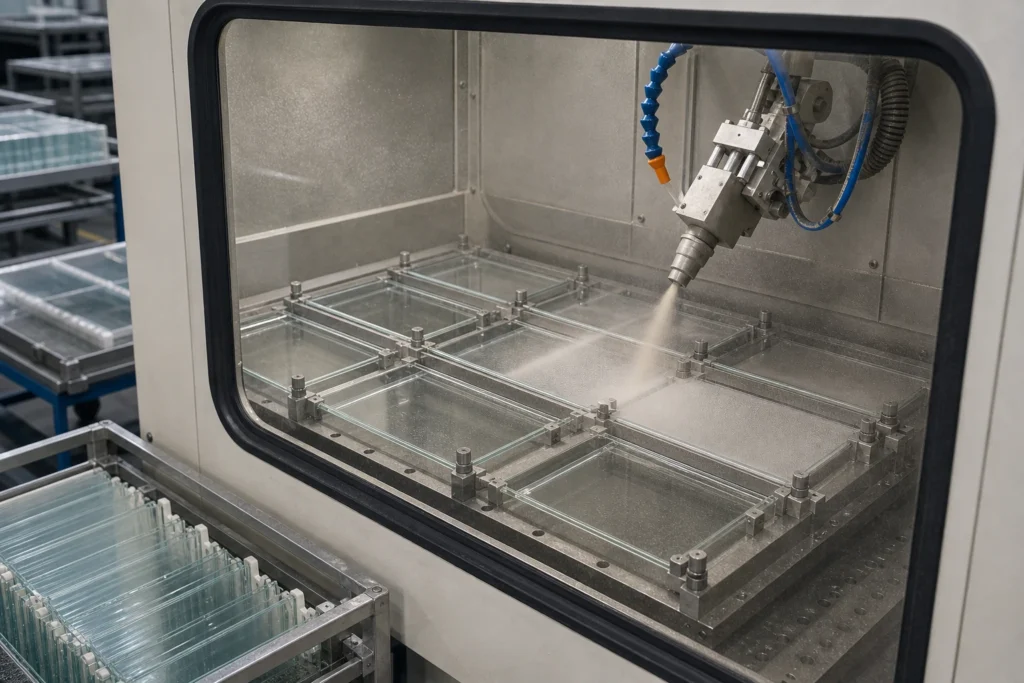
- Sandblasting uses compressed air and abrasive media to create a consistent micro-roughened surface on borosilicate glass, scattering light for a matte appearance.
- Borosilicate glasses like Borofloat 33 are selected for sandblasted components because of their thermal shock resistance and chemical inertness.
- Process parameters—air pressure, abrasive type and size, nozzle speed, and masking—directly control surface roughness and uniformity across production runs.
- In-line inspection typically includes visual uniformity checks, roughness measurement by profilometry, and optical transmission or haze testing, ensuring batch-to-batch consistency.
Borosilicate Glass Sandblasting: Achieving Uniform Matte Finishes
How can manufacturers consistently achieve a matte surface finish on borosilicate glass components? Sandblasting—a controlled high-pressure abrasive process—provides a repeatable method for creating uniform matte or frosted surfaces on borosilicate glass substrates. This overview explains the production workflow from material selection through final inspection, highlighting how precise sandblasting integrates into optical, microfluidic, and semiconductor component manufacturing.
- Process: High-velocity abrasive particles impact the glass surface, creating a micro-roughened texture that scatters light.
- Material: Borofloat 33 and other borosilicate glasses offer thermal stability and chemical durability ideal for demanding applications.
- Control: Pressure, abrasive type, nozzle distance, and masking determine surface roughness and pattern uniformity.
- Outcome: Repeatable matte finishes with reduced reflectivity and controlled light diffusion, suitable for precision optics, microfluidics, and protective windows.
Frequently Asked Questions
What is the typical surface roughness achieved by sandblasting borosilicate glass?
Surface roughness after sandblasting is tunable but typically falls in the range of a few micrometers Ra, depending on the abrasive media grain size and blasting pressure. Manufacturers can target specific roughness values for light diffusion or anti-glare requirements. Final roughness is verified with contact or non-contact profilometry.
How does sandblasting compare to acid etching for matte glass surfaces?
Sandblasting is a mechanical erosion process that creates a physically textured surface, while acid etching chemically dissolves glass to produce a matte finish. Sandblasting generally yields a coarser, more robust texture and can be easily masked for patterned areas, whereas acid etching provides a smoother surface with potentially higher optical uniformity. The choice depends on required finish, environmental regulations, and production scale.
What abrasive media are used for sandblasting borosilicate glass?
Common abrasives include aluminum oxide, silicon carbide, and sometimes glass beads, chosen based on desired surface roughness and aggressiveness. Aluminum oxide is popular for its hardness and reusability, while silicon carbide offers a sharper cutting action. The grit size is selected to balance material removal rate with surface finish quality.
Can sandblasting be applied to borosilicate glass without causing micro-cracks?
Yes, with proper parameter control—moderate pressure, appropriate abrasive size, and uniform nozzle movement—sandblasting induces only surface pitting without compromising bulk glass strength. Post-process inspection, including microscopy or dye penetrant testing, ensures no stress-concentrating cracks are present. When parts require higher mechanical reliability, a post-sandblasting thermal treatment (heating to annealing point) can relieve residual surface stresses.
What are common industrial applications of sandblasted borosilicate glass?
Sandblasted borosilicate is widely used in microfluidic chips for uniform fluid wetting, optical windows and diffusers for lighting systems, protective covers for sensors, and laboratory glassware requiring semi-transparent marking. It also finds use in semiconductor equipment components where a non-reflective, chemically durable surface is needed.