
Key Takeaways
- Industrial laser etching achieves permanent, sub‑micron features on glass without mechanical stress or tool wear, ideal for high‑volume optical and microfluidic components.
- UV and femtosecond lasers deliver the highest precision by minimizing heat‑affected zones, ensuring sharp edges and repeatable depth control.
- The process integrates seamlessly with upstream shaping and polishing steps, and is scalable from prototypes to full production through automation and multi‑head systems.
- In‑line metrology—profilometry, confocal microscopy, and transmission testing—provides real‑time verification of dimensional and optical quality.
- A well‑characterized laser etching machine for glass enables consistent output across bulk orders, with the flexibility to handle multiple substrate types and feature geometries.
How the Precision Glass Laser Etching Process Delivers Fine Features
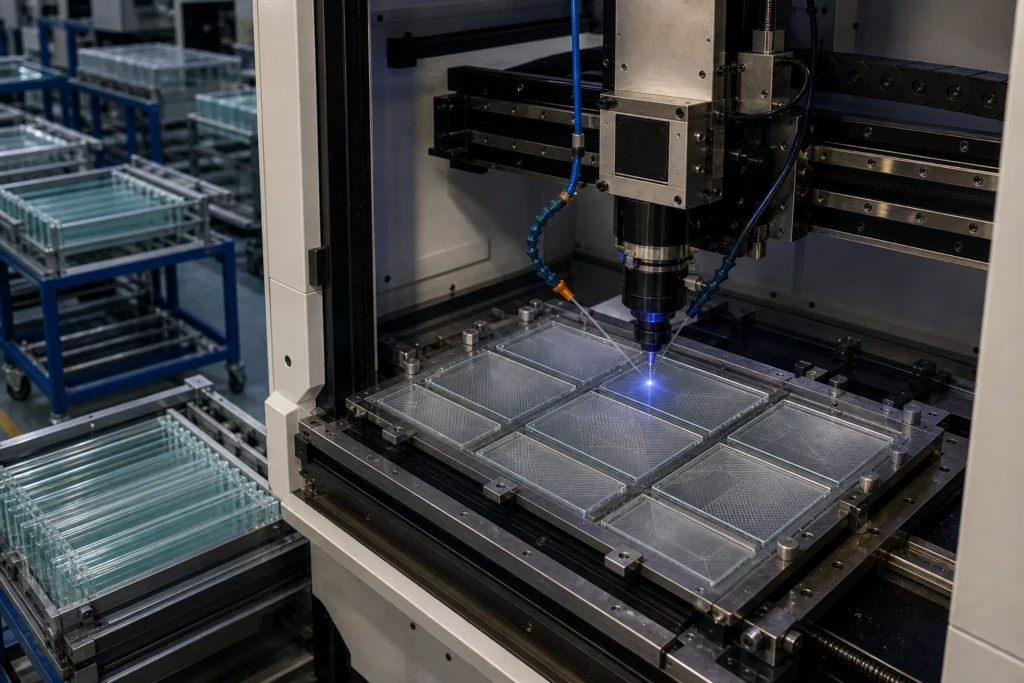
How do you achieve micron-level permanent markings on glass without inducing micro‑cracks or compromising surface integrity? Industrial laser etching answers this need by using tightly focused, wavelength‑tuned laser beams to selectively ablate or modify a glass surface. This non‑contact method produces permanent, high‑contrast features—logos, barcodes, alignment marks, microfluidic channels—on components destined for medical devices, lab‑on‑a‑chip systems, optical encoders, and semiconductor equipment. Unlike mechanical engraving, the process avoids tool wear and stress‑induced subsurface damage, making it the preferred choice for precision optics and bio‑compatible consumables. When a buyer evaluates a supplier’s laser glass etching machine capability, the critical questions center on material compatibility, achievable line widths, edge quality, and scalability—all answered by a well‑designed glass etching process.
Frequently Asked Questions
What is the smallest feature size achievable with industrial laser glass etching?
Typical industrial systems can produce feature widths and spacing down to a few microns, with depth control on the order of hundreds of nanometers. The exact minimum depends on the laser wavelength, pulse duration, and glass composition; femtosecond lasers enable sub‑micron resolution with virtually no thermal damage.
Which laser type is best for fine marking on fused silica?
UV lasers (355 nm) and femtosecond lasers are most effective for fused silica due to their high photon energy and short pulse widths. These sources initiate cold ablation, which preserves surface integrity and avoids micro‑cracking, making them ideal for optical components where transmission and wavefront accuracy are critical.
How does laser etching compare to chemical etching for glass microstructures?
Laser etching is a dry, mask‑less process, while chemical etching requires photolithography and hazardous chemicals. Laser methods offer faster prototyping, greater geometric flexibility, and the ability to create tapered or 3D profiles, though chemical etching can sometimes deliver smoother sidewalls at lower cost for very high volumes.
Can laser etching create depth‑controlled features for microfluidics?
Yes. By precisely tuning laser power, scan speed, and pulse overlap, manufacturers can produce channels and reservoirs with controlled depths ranging from a few microns to hundreds of microns. This capability is widely used for glass microfluidic chips where channel depth uniformity is essential for fluidic performance.
What are the typical lead times for laser‑etched glass components in production quantities?
Lead times depend on order volume, feature complexity, and required post‑processing. For a new project, after design approval and process optimization, sample batches may ship within a few weeks. Production runs benefit from automated laser cells and can achieve accelerated turnaround through parallel processing and dedicated in‑line quality gates.