
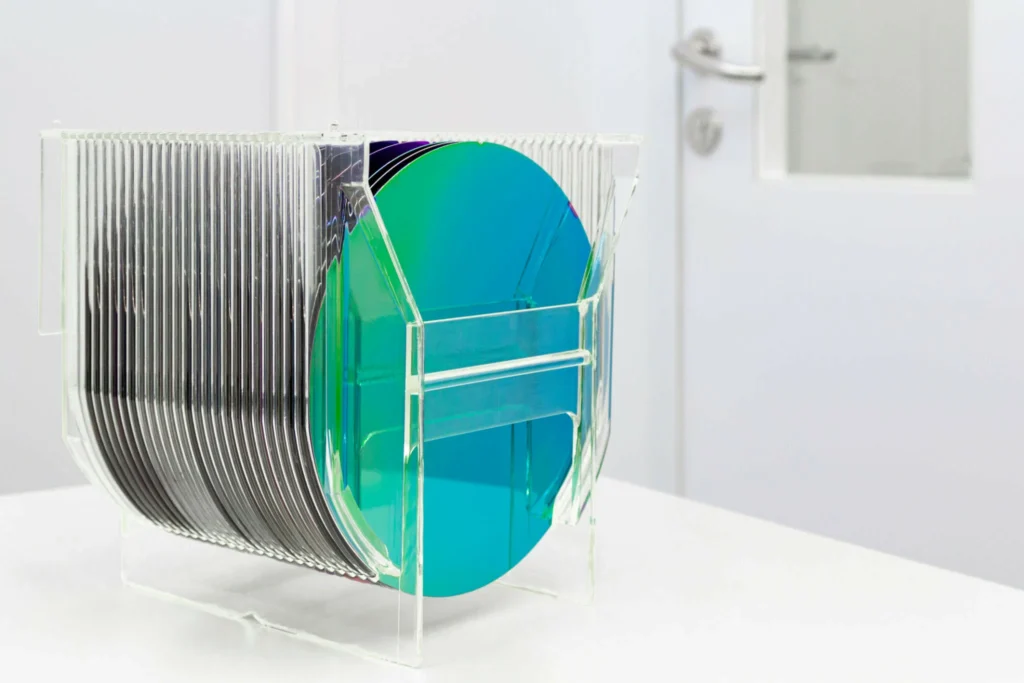
Borofloat 33 With Precision Holes – Borofloat 33 (CTE 3.25 x 10^-6 /K, 350 nm – 2.0 um); position +/-0.02 mm, diameter from 0.15 mm. No minimum order; DFM review included with every RFQ.
When a drawing calls out Borofloat 33, three numbers matter before any machining starts: CTE of 3.25 x 10^-6 /K, service temperature to 450 C continuous, and a transmission window of 350 nm – 2.0 um. borofloat 33 with precision holes here begin with those numbers and end with dimensional reports.
Key parameters
| Material | Borofloat 33 (SCHOTT float production, wafer grade) |
|---|---|
| Thermal expansion (CTE) | 3.25 x 10^-6 /K |
| Service temperature | 450 C continuous |
| Transmission range | 350 nm – 2.0 um |
| Density | 2.23 g/cm3 |
| Knoop hardness | 480 kg/mm2 |
| Refractive index | 1.471 @ 587 nm |
| Stock thickness | 0.70 – 25.4 mm |
| Maximum blank size | 500 x 500 mm |
| Feature | Precision Holes |
| Capability | position +/-0.02 mm, diameter from 0.15 mm |
| RFQ inputs | PDF/DXF/STEP drawing, quantity brackets, surface and edge spec |
Design guidance
The shop-floor rules that matter here:
- Material note: float tin side must be tracked when parts see coating or bonding steps.
- Feature rule: keep hole-to-edge distance above 1.5x thickness.
- Over-specification is the quiet budget killer: a 20/10 scratch-dig face costs roughly three times an 80/50 face, so grade each surface individually.
The full rules live in our tolerance design guide and holes and edges design guide.
Process window
Beyond this page, Borofloat 33 routinely runs through dicing, grinding, double-side polishing, coring in our shop – most real parts combine two or three of these steps.
These features are produced by drilling or laser cutting. Capability: position +/-0.02 mm, diameter from 0.15 mm. Design rule worth copying onto the drawing: keep hole-to-edge distance above 1.5x thickness.
Application context
Orders for borofloat 33 with precision holes cluster in machine vision (camera windows, ring-light diffusers, calibration plates); microfluidic devices (chips, manifolds, via plates, bonded stacks); led packaging (groove covers, phosphor carriers, package windows). Background reading on the underlying material science: SCHOTT BOROFLOAT product page.
Dimensions still moving? Configure this part live in the 3D + 2D builder below, or open the full custom glass machining 3D + 2D builder to start from a blank canvas.
For adjacent specifications, see 4 inch Borofloat wafers, wafer dicing process, surface quality guide.
Frequently asked questions
Is there a minimum order for borofloat 33 with precision holes?
No. Single prototypes are accepted, and pricing steps down at 10, 100 and 1,000 pieces.
How fast can prototypes ship?
Machined prototypes ship in 5 – 10 working days. Coated or bonded parts add 1 – 2 weeks depending on queue slots.
What files do you need for a quote?
A dimensioned PDF plus DXF or STEP geometry. If only a sketch exists, our drawing review service formalizes it before quoting.
Do parts ship with inspection data?
Dimensional reports, surface certificates and material certs per melt are available; specify the level on the RFQ.
What tolerances are achievable on Borofloat 33 parts?
Ground features hold +/-0.01 mm and lapped thickness reaches +/-0.003 mm. Float tin side must be tracked when parts see coating or bonding steps.
Specifications on this page were last reviewed by our engineering team in September 2026.