
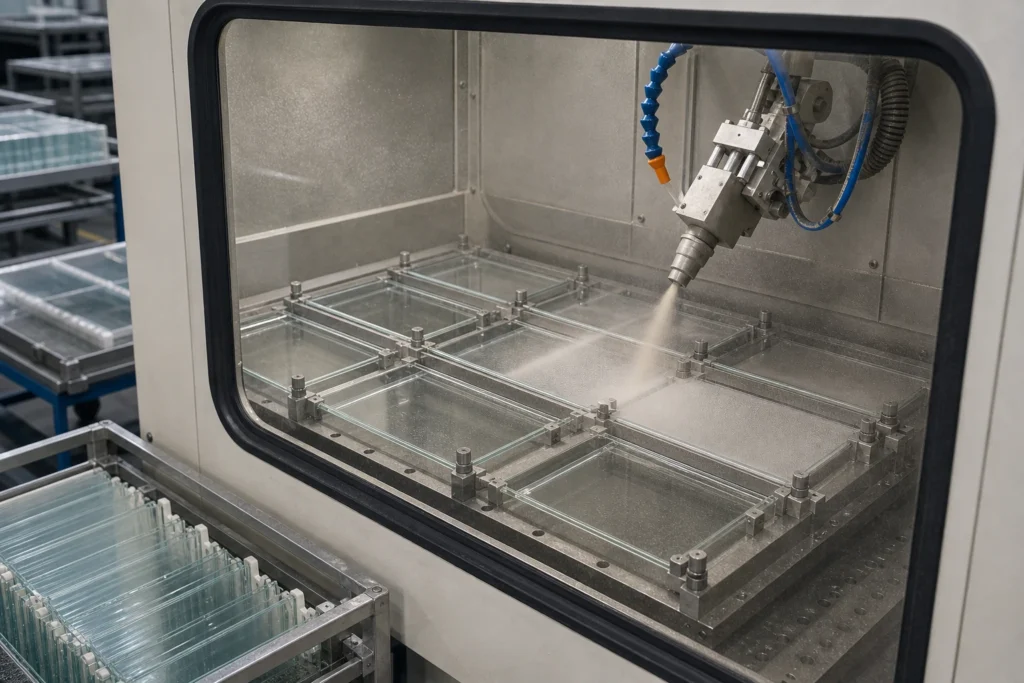
Sandblasting JGS1 Quartz Glass: JGS1 Quartz Glass (CTE 0.55 x 10^-6 /K, 185 nm – 2.5 um (UV grade)); Sandblasting to mask registration +/-0.1 mm. Single-piece prototypes to production volumes, quoted from your drawing.
sandblasting jgs1 quartz glass is a materials problem before it is a machining problem. JGS1 Quartz Glass has deep-uv transmission to 185 nm and a Knoop hardness of 500 kg/mm2, so the sandblasting recipe – feeds, coolant, tooling – differs from what works on ordinary float glass. The line runs automated cabinets with alumina media and photoresist masks and holds mask registration +/-0.1 mm.
Key parameters
| Material | JGS1 Quartz Glass (UV-grade synthetic, bubble class 0) |
|---|---|
| Thermal expansion (CTE) | 0.55 x 10^-6 /K |
| Service temperature | 1,100 C continuous |
| Transmission range | 185 nm – 2.5 um (UV grade) |
| Density | 2.20 g/cm3 |
| Knoop hardness | 500 kg/mm2 |
| Refractive index | 1.458 @ 587 nm |
| Stock thickness | 0.10 – 30 mm |
| Maximum blank size | 300 mm diameter |
| Process | Sandblasting |
| Working tolerance | mask registration +/-0.1 mm |
| Minimum feature | 1 mm masked window |
| Surface finish | uniform matte, gloss 4 – 8 GU |
| Thickness window | 0.7 – 25 mm |
| Edge condition | not applicable |
| RFQ inputs | PDF/DXF/STEP drawing, quantity brackets, surface and edge spec |
Design guidance
Before sending the RFQ, check these against your drawing:
- Material note: UV-grade surfaces must be polished without subsurface damage that scatters below 250 nm.
- Process boundary: blasted faces lose roughly 30% bend strength; safety-critical faces get a post-etch.
- Over-specification is the quiet budget killer: a 20/10 scratch-dig face costs roughly three times an 80/50 face, so grade each surface individually.
The full rules live in our tolerance design guide and holes and edges design guide.
Process window
Sandblasting earns its place through uniform diffusing texture and masked logos or windows at panel scale. Its boundary condition – blasted faces lose roughly 30% bend strength; safety-critical faces get a post-etch – is the first thing our DFM review checks.
Beyond this page, JGS1 Quartz Glass routinely runs through edge grinding, laser cutting, grinding, etching in our shop – most real parts combine two or three of these steps.
Application context
Orders for sandblasting jgs1 quartz glass cluster in laser systems (windows, beam splitters, debris shields); aerospace optics (sensor windows, star-tracker flats, radiation-tolerant ports). Background reading on the underlying material science: RP Photonics: fused silica.
Dimensions still moving? Configure this part live in the 3D builder below, or open the full custom glass machining 3D builder to start from a blank canvas.
Useful companion pages: glass sandblasting, fused silica wafers 2-12 inch, 4 inch Borofloat wafers.
Common questions
What tolerances are achievable on JGS1 Quartz Glass parts?
Ground features hold +/-0.01 mm and lapped thickness reaches +/-0.003 mm. UV-grade surfaces must be polished without subsurface damage that scatters below 250 nm.
What thickness range do you stock for JGS1 Quartz Glass?
Standard stock spans 0.10 – 30 mm, with blanks up to 300 mm diameter. Other formats are sourced per order.
How does JGS1 Quartz Glass behave under heat?
CTE is 0.55 x 10^-6 /K and continuous service reaches 1,100 C continuous, which is what drives its use where deep-UV transmission to 185 nm matters.
What accuracy does sandblasting hold?
Mask registration +/-0.1 mm with minimum features of 1 mm masked window. Blasted faces lose roughly 30% bend strength; safety-critical faces get a post-etch.
What equipment runs the sandblasting work?
Automated cabinets with alumina media and photoresist masks.
Specifications on this page were last reviewed by our engineering team in July 2026.