
Key Takeaways
- Define optical, mechanical, and thermal requirements before selecting a glass material.
- Fused silica and quartz excel in UV/thermal applications, while borosilicate balances cost and performance.
- Specify dimensions, tolerances, surface quality, and coatings in your drawing package for accurate quoting.
- Use the 3D Configurator to visualize geometry and prepare an RFQ, but confirm all specs with engineering review.
A process engineer studies a drawing for a microfluidic chip that must transmit deep-UV light while surviving repeated thermal bonding cycles. The material listed on the print will determine whether the wafer cracks during dicing or distorts after coating. Matching the glass to the application is not just a catalog lookup—it is the single decision that drives downstream machinability, yield, and long‑term stability.
Why Material Selection Defines the Part
For custom precision glass components, material choice reaches far beyond optical constants. The glass type controls how the part can be machined, what coatings it will accept, how it fails, and how it performs over temperature. Specify the wrong glass for a drilled CCD cover plate or an AR‑coated beam‑splitter and you may see edge chipping, coating delamination, or unexpected warpage that no spot‑tolerance on the drawing can catch.
Material Considerations for Optical and Industrial Components
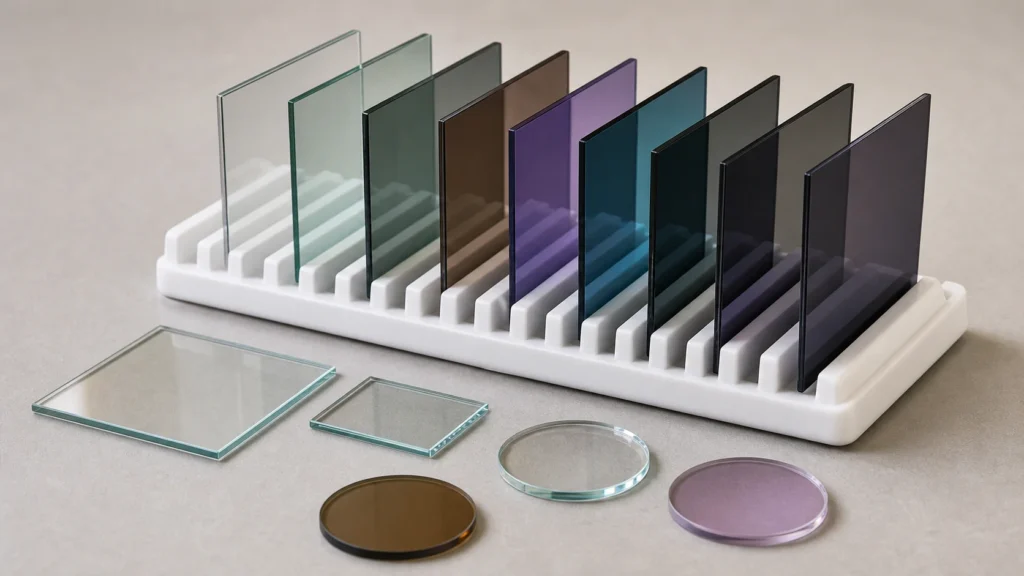
Select from a family of materials, each with a clear advantage. Fused silica and synthetic quartz glass deliver the highest UV transmittance, near‑zero thermal expansion, and excellent laser damage resistance—essential for excimer lasers and semiconductor optics. Borosilicate glasses, including Borofloat 33, offer a moderate CTE, good chemical durability, and flatness suited to glass wafers and microfluidic chips. Optical glasses (N‑BK7 and equivalents) provide high visible transmission and controlled refractive index for imaging windows and filters. Alkali‑free glasses prevent ion migration in electronic packaging and ITO‑coated sensors. Sapphire—though technically a crystal—brings extreme hardness, IR transparency, and thermal conductivity when the application demands it.
Geometry and Drawing Requirements
Define the finished shape clearly: outer dimensions, thickness, and any modifications such as through‑holes, slots, or edge chamfers. Edge distance around a hole should be at least the glass thickness to reduce breakage during drilling. Orientation features like a flat, notch, or D‑cut prevent assembly errors. For microfluidic chips, specify channel depth and cover‑bonding surfaces. A 3D preview helps avoid misinterpretation before the first cut.
Tolerance and Surface Requirements
List the functional tolerances. Dimensional tolerance is typically ±0.05 mm or finer on critical features. Flatness is stated in waves (e.g., λ/4 at 633 nm), while TTV (total thickness variation) and bow/warp control wafer‑level geometry. Parallelism of windows and beam‑splitters must hold arc‑minute levels. Surface quality uses scratch‑dig (80‑50, 60‑40, or better) and roughness Ra values. Edge finish—ground, polished, or seamed—prevents chips in handling.
Coating and Functional Requirements
Antireflection coatings, optical filter stacks, ITO/FTO conductive layers, and metallization all demand a substrate that is clean, flat, and compatible with the deposition temperature. Define whether coatings are applied before or after machining, the required spectral bands, and any edge deletion area. For microfluidic chips, note if etched cavities or channel geometries are needed, and whether hydrophilic or hydrophobic surface treatments are required.
Key Specification Points
- Material and grade – Fused silica, borosilicate, optical glass, sapphire, etc.
- Dimensions and thickness – With tolerances for each feature.
- Surface quality – Scratch‑dig, flatness (waves), TTV, parallelism.
- Edge finish – Seamed, ground, polished, or as‑cut.
- Coating details – Type, wavelength range, reflectance/transmittance targets, and conductive sheet resistance if ITO/FTO.
- Quantity and application – Prototype, pre‑production, or volume run.
Manufacturability Notes
Before production, the supplier will review material availability in the required size, machining risks (e.g., thin‑wall hole drilling, chipping on un‑chamfered edges), and the best sequence for coating—before or after scribing. Inspection methods (interferometry, microscopy, contact profilometry) are selected to match the stated tolerances. Final cleaning and packaging—vacuum sealed in a cleanroom for optical surfaces—protect the part until integration.
Previewing Your Part in 3D
When a custom geometry or drawing set is still taking shape, the Precision Glass 3D Configurator at https://machiningglass.com/3d-glass-builder/ can give you a visual starting point. Choose a product module—glass wafer, microfluidic chip, optical window, ITO‑coated sensor plate, or a custom blank—adjust dimensions, and then copy the RFQ summary. Attach your drawings and submit for an engineering review. It does not replace final drawing sign‑off, but it helps align the specification before formal quoting.
Ready for Review
Send your drawings, material requirements, tolerances, coating specs, target quantities, and a brief description of the application. Our team will assess manufacturability and return a technical proposal.
Choosing the Right Glass Material for Your Component
The optimal glass material balances optical transmission, thermal stability, mechanical strength, and cost for the specific application. Reviewing key properties against your requirements narrows the options. For deeper dives, refer to our detailed resources on optical glass material, bf33 glass material, and quartz glass material.
| Material | Transmission Range | Thermal Properties | Typical Applications |
|---|---|---|---|
| Fused Silica | UV to IR, high transmission | Very low CTE, high thermal shock resistance | High-power laser optics, semiconductor equipment |
| Quartz Glass (e.g., JGS1/JGS2) | UV to IR | Low CTE, good thermal stability | Optical windows, UV-transmissive components |
| Borosilicate (e.g., Borofloat 33) | Visible to near-IR | Moderate CTE, good thermal resistance | Microfluidic chips, display glass, general optics |
| Alkali-Free Glass | Visible | Low CTE, high thermal stability | TFT displays, flat panel substrates |
| Optical Glass (e.g., N-BK7) | Visible, high refractive index options | Moderate CTE, controlled thermal behavior | Lenses, prisms, beam splitters, filters |
| Sapphire | UV to MWIR, scratch-resistant | High thermal conductivity, high melting point | Extreme environment windows, scratch-proof covers |
Frequently Asked Questions
What is the best glass material for high-temperature optical windows?
Fused silica and quartz glass are often preferred for high-temperature environments due to their low thermal expansion and high thermal shock resistance. Borosilicate glass also offers good thermal resistance but to a lower maximum temperature. The exact choice depends on the temperature range and optical requirements.
How do I choose between fused silica and borosilicate glass?
Fused silica provides superior UV transmission and thermal stability, making it ideal for laser optics and semiconductor equipment. Borosilicate glass is more cost-effective for visible-range applications like microfluidic chips and display covers. Consider your spectral transmission needs and budget.
What surface quality is needed for imaging optics?
Imaging optics typically require high surface quality with scratch-dig specifications of 40-20 or better, and low wavefront distortion. Precision polishing to λ/4 or λ/10 flatness is common for lenses and windows. The exact specification depends on the optical system's resolution and wavelength.
Can optical glass components be custom machined to specific shapes?
Yes, experienced precision glass manufacturers can machine custom geometries such as holes, slots, grooves, and special contours in optical glass materials. Features like edge bevels, orientation flats, and chamfers are also achievable. Engineering review is necessary to ensure feature sizes and tolerances are manufacturable.
What information do I need to provide for a precision glass quote?
Provide material type, dimensions with tolerances, surface quality (scratch-dig, flatness), coating requirements, quantity, and application details. A full drawing set is essential. The Precision Glass 3D Configurator can help generate an initial RFQ summary.