
Laser System Precisely Positions 2,000 Rydberg Atoms for Quantum Computer
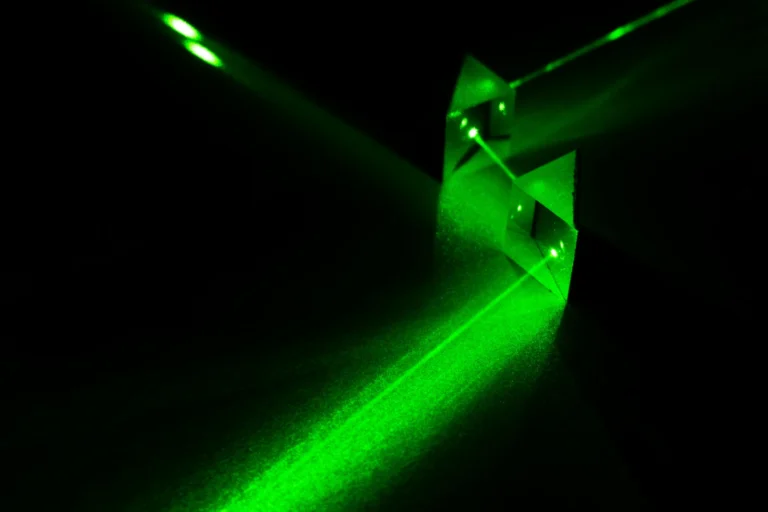
A new laser-optical system developed at Fraunhofer ILT can manipulate 2,000 trapped Rydberg atoms with submicrometer precision, marking a significant step for a next-generation quantum computer at the University of Stuttgart.
Precision Optics for Quantum Trapping
The system is designed to operate inside a highly compact vacuum chamber at the 5th Institute of Physics, where neutral Rydberg atoms serve as qubits. By using individually addressable laser beams, the optics create an array of optical tweezers that hold each atom in place. Achieving this level of control requires a complex interplay of beam shaping, stabilization, and alignment, all of which had to be integrated into a limited physical volume.
Engineers at Fraunhofer ILT leveraged their expertise in high-power laser optics and micro-optical components to meet the demanding specifications. The system projects a precisely patterned light field into the chamber, generating thousands of potential wells that can be filled with single atoms. Real-time feedback mechanisms adjust the beam positions to correct for any drift, ensuring long-term stability during quantum operations.
Overcoming Scaling Hurdles
Quantum computers based on neutral atoms have attracted attention because they can be scaled to hundreds or thousands of qubits using reconfigurable optical traps. Achieving precise control over every single atom, however, demands an exceptionally stable and high-resolution laser-optical system. The Fraunhofer ILT solution reportedly positions atoms with accuracy better than one micrometer, a requirement for reliable gate operations. Such precision reduces crosstalk between neighboring qubits and improves the fidelity of two-qubit interactions, which are essential for error correction.
Comparing this achievement with earlier systems that managed only a few dozen atoms underscores the progress in optical engineering. Every additional qubit increases the computational overhead for maintaining coherence, making the compact design and thermal management of the laser system critical. The team’s ability to fit these capabilities into a vacuum chamber suitable for university-scale research paves the way for broader adoption of Rydberg quantum processors.
From Bench-top to Compact Vacuum Chamber
Integrating such a complex optical setup into the compact vacuum environment of the Stuttgart prototype presents engineering challenges. The laser system must align with the chamber’s strict spatial constraints while maintaining beam pointing stability and low drift. Traditional optical tables with bulky mounts are impossible to use; instead, miniaturized holders and precision-adjustable mirrors had to be developed. This approach also reduces the system’s sensitivity to acoustic vibrations and temperature fluctuations, which can displace trapped atoms.
Fraunhofer ILT’s experience in industrial laser manufacturing proved valuable in creating robust, maintenance-friendly components. The system’s modular design allows for iterative upgrades, meaning that the same platform could eventually handle more than 2,000 qubits. Integration with the ultra-high vacuum environment and the atom source is now the next major step, requiring careful alignment of the optical path with the magnetic and cooling infrastructure.
Implications for Quantum Computing Industry
The ability to control 2,000 qubits is seen as an important milestone on the path toward fault-tolerant quantum computing. This laser-optical system provides the foundational hardware to explore quantum error correction and algorithm demonstrations at a scale that begins to outperform classical simulation. Procurement of high-precision optical components for quantum systems is likely to increase as more research groups target atom counts above 1,000. Specialized coatings, beam splitters, and aspheric lenses already form a growing niche market, with suppliers adapting products originally developed for semiconductor lithography to meet the lower-loss requirements of quantum optics.
International research efforts, such as those at other European and North American institutions, have highlighted the need for standardized optical assemblies that can be rapidly deployed in different quantum testbeds. The Stuttgart project, supported by German funding agencies, illustrates how close collaboration between a Fraunhofer institute and a university can accelerate the transition from laboratory demonstrations to practical quantum processors. Component suppliers are now under pressure to deliver optics with sub-nanometer surface roughness and extreme thermal stability, characteristics that the Fraunhofer system already demands.
Key System Specifications
| Aspect | Detail |
|---|---|
| Number of atoms controlled | 2,000 |
| Positioning accuracy | Submicrometer |
| Atom type | Rydberg atoms |
| Developer | Fraunhofer ILT |
| Host institution | University of Stuttgart, 5th Institute of Physics |
With the laser system completed, attention turns to its integration with the vacuum chamber and the subsequent cooling stage. The full quantum computer is expected to undergo initial testing once the assembly and alignment are finalized.
Key Figures
This story includes concrete figures such as 2,000. The points below pull out the key numbers so the reporting is easier to scan and verify.
- Atom count: 2,000 Rydberg atoms positioned in the vacuum chamber
Why This Matters
Precise optical control of 2,000 Rydberg atoms is a tangible step toward scalable quantum computing architectures that can tackle problems beyond the reach of classical computers. This milestone signals that industrial-grade laser systems are now ready to support quantum processors in the transition from small-scale lab experiments to larger, more capable quantum testbeds.
FAQ
Who developed the laser system?
The system was developed by Fraunhofer ILT based in Aachen, Germany, in collaboration with the University of Stuttgart. Their combined expertise in laser optics and quantum physics enabled the construction of this highly complex apparatus.
What is the purpose of the laser-optical system?
It traps and precisely positions 2,000 Rydberg atoms to serve as qubits in a quantum computer. By using focused laser beams, the system creates an array of optical tweezers that hold each atom in place with submicrometer accuracy.
Why are Rydberg atoms used for quantum computing?
Rydberg atoms exhibit strong, controllable interactions, making them suitable for high-fidelity quantum gate operations. Their large size and long coherence times allow for robust entanglement between qubits, which is essential for practical quantum computation.
When will the quantum computer be operational?
The system is currently under construction, with integration and testing expected to follow once all components are assembled. Exact timelines have not been disclosed, but successful demonstration of the laser system is a critical milestone toward full operation.
Sources
- Fraunhofer ILT (ilt.fraunhofer.de)
- University of Stuttgart (uni-stuttgart.de)
Source: Optics & Photonics News – Optics, Photonics, Physics News