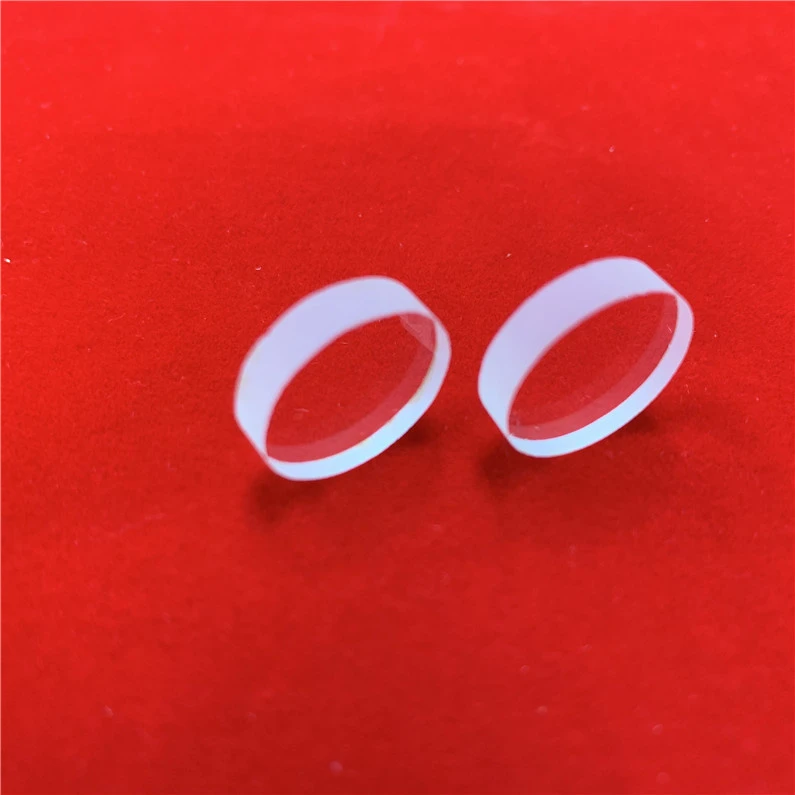
Optical Small Round Quartz Glass Windows Jgs1 Jgs2 Clear Fused Silica Wafers: a fused silica / quartz wafer. Temperature 1100°C. Typical applications: Chemical, Construction, Metallurgy and Quartz Plate. Dimensions, material grade, coating and finish can be quoted to your drawing; the values above are the listed starting point.
Specifications
Type
Quartz Plate
Application
Chemical, Construction, Metallurgy, Quartz Plate
Model NO.
HB-QP
Color
Clear
Keyword
Clear Quartz Wafers
Design Tensile Strength
4.8X10⁷ PA (N/M2) (7000 Psi)
Softening Point
1683c
Annealing Point
1215c
Working temperature
1100°C
surface
polishing
Support customization
Their size can designed according your need and can be grinded and polishing the sides according your need!
Supplier
LIANYUNGANG BAIBO NEW MATERIAL CO., LTD.
Technical data
Properties
Density
Elastic modulus
Tensile strength
Hardness
2.2g/cm3
700*103kg/cm3
.-500kg/cm3
5.5-6.5
Technical Data of GE Clear Quartz Glass plate
Property Content
Unit
Property Index
Density
kg/cm³
2.2×10³
Tensile Strength
Pa(N/m2)
4.9×10⁷
Compression Strength
Pa
>1.1×10⁹
Coefficient of Thermal Expansion(20ºC-300ºC)
cm/cmºC
5.5×10⁻⁷
Thermal Conductivity(20ºC)
W/mºC
1.4
Specific Heat(20ºC)
J/kgºC
670
Softening Point
ºC
1680
Annealing Point
ºC
1215
1. High-quality products
2. Optimal price
3.SafeTransportation
4. Sample service
5. Customized size
6. Compensate for broken goods
7. Safe package
8. Transportation safety
9. Low procurement risk
What to specify when you request a quote
Diameter and flat / notch — state diameter, flat or notch and their tolerances.
Thickness and TTV — give thickness, its tolerance and total thickness variation.
Polish and roughness — listed as “polishing”; specify single- or double-side polish and roughness.
Flatness, bow and warp — quote flatness, bow and warp limits.
Material grade — name the grade (JGS1/JGS2, Borofloat 33, alkali-free, sapphire orientation).
Where is this fused silica / quartz wafer used? expand_more
Listed applications: Chemical, Construction, Metallurgy and Quartz Plate.
What should I include in a quote request? expand_more
Include diameter and flat / notch, thickness and ttv, polish and roughness, flatness, bow and warp and material grade, plus quantity and a drawing if the part is custom.
Configure in 3D, draw in 2D
3D Model & 2D Drawing Builder
PRECISION GLASS3D
3D Precision Glass ConfiguratorBuild a visual 3D preview for custom precision glass parts, including wafers, microfluidic chips, coated glass, optical filters, and machined quartz plates.This tool is for visual configuration only. Final dimensions, tolerances, materials, coatings, and manufacturability will be reviewed from your drawing or specification.
Paste a configuration JSON (from Export) or a copied RFQ summary. The product and all recognized parameters are applied automatically; unknown parameters are listed and skipped.
Answer the choices below step by step — every value comes from the real option list, so it always renders.
Save the current configuration under a name and recall it any time on this device.
2D PreviewYour browser is showing a simplified engineering preview because WebGL is unavailable.
Glass Wafer Builder
Interactive visual preview for custom precision glass configuration.
CMD
Import Code (One-Click Recall)
Save this code before you leave — it is the only way to recall this exact model. If you lose it, your configuration cannot be restored.
SUBMIT RFQ — ENGINEERING REVIEWYour current 3D configuration and specification summary are attached automatically. Attach a drawing if you have one.
FREQUENTLY ASKED QUESTIONSWhich fused silica grade should I choose — JGS1, JGS2 or JGS3?
JGS1 offers deep-UV transmission from about 185 nm (best for DUV lithography and UV laser optics). JGS2 transmits well from about 220 nm for standard UV-visible use at lower cost. JGS3 is optimized for visible-to-infrared and high-power laser work. The builder exposes a transmission-band requirement so you can specify the grade by application.
What wafer diameters and thicknesses are supported?
Common diameters are 2, 3, 4 and 6 inch (note 1 inch = 25.0 mm for quartz wafers, so a 4 inch wafer is 100 mm). Typical thicknesses are 200, 500, 700 and 1000 µm, with tighter thickness tolerance and TTV specifiable for polished optical grades.
Can I specify TTV, surface quality and a flat or notch?
Yes. You can set total thickness variation, scratch-dig surface quality (down to 40/20 or 20/10 for optical grade), single- or double-side polish, and a primary flat or notch for orientation.
This website uses only necessary and functional cookies to operate, secure, and improve basic website performance.
We do not use advertising cookies, Google Analytics, or cross-site tracking technologies.
Privacy Policy