
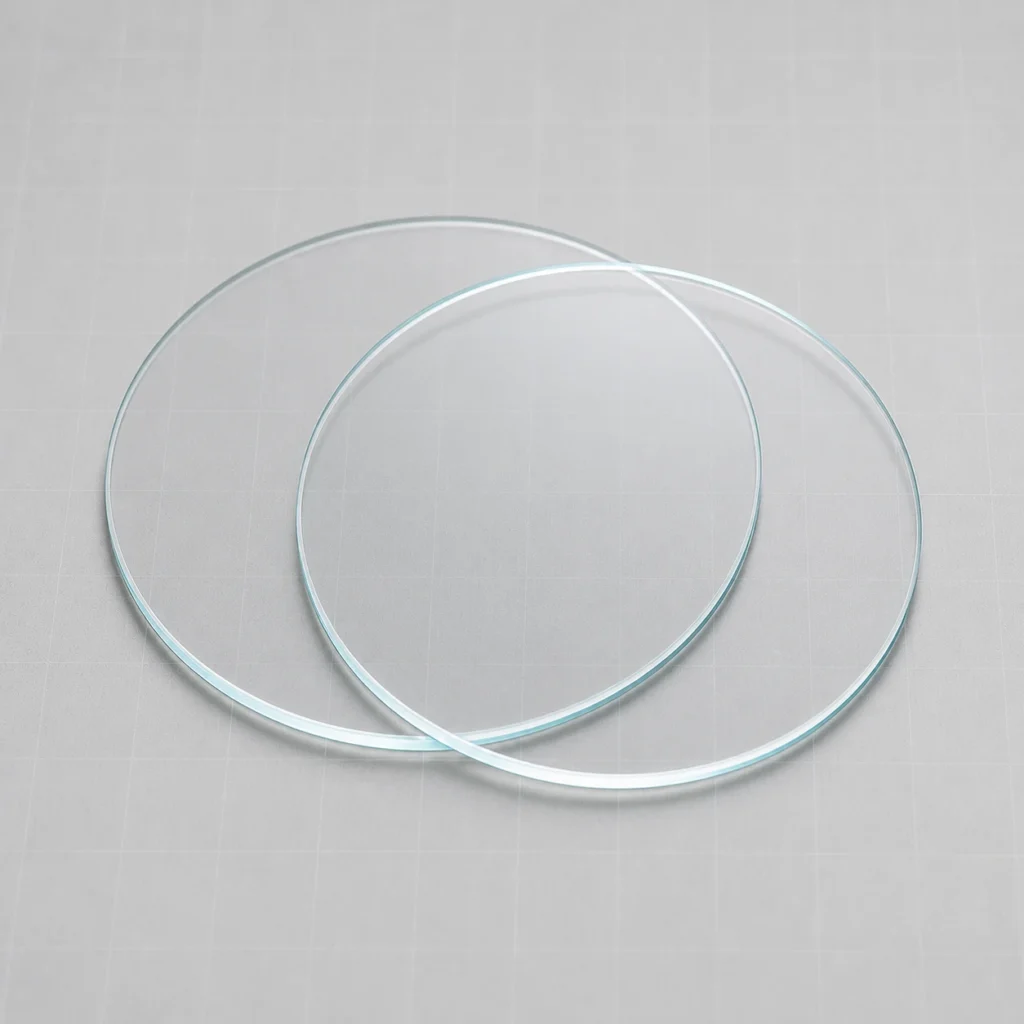
Borofloat 33 With Slots: Borofloat 33 (CTE 3.25 x 10^-6 /K, 350 nm – 2.0 um); width from 0.4 mm, length any, ends R0.2 mm min. Single-piece prototypes to production volumes, quoted from your drawing.
Buyers come to borofloat 33 with slots with two kinds of parts: catalog-adjacent blanks that need accurate finishing, and genuinely custom geometry. We quote both from the same dataset – SCHOTT float production, wafer grade stock in 0.70 – 25.4 mm, blanks to 500 x 500 mm.
Key parameters
| Material | Borofloat 33 (SCHOTT float production, wafer grade) |
|---|---|
| Thermal expansion (CTE) | 3.25 x 10^-6 /K |
| Service temperature | 450 C continuous |
| Transmission range | 350 nm – 2.0 um |
| Density | 2.23 g/cm3 |
| Knoop hardness | 480 kg/mm2 |
| Refractive index | 1.471 @ 587 nm |
| Stock thickness | 0.70 – 25.4 mm |
| Maximum blank size | 500 x 500 mm |
| Feature | Slots |
| Capability | width from 0.4 mm, length any, ends R0.2 mm min |
| RFQ inputs | PDF/DXF/STEP drawing, quantity brackets, surface and edge spec |
Specification advice
The shop-floor rules that matter here:
- Material note: float tin side must be tracked when parts see coating or bonding steps.
- Feature rule: slot web between features at least 1x thickness.
- Over-specification is the quiet budget killer: a 20/10 scratch-dig face costs roughly three times an 80/50 face, so grade each surface individually.
For the complete framework, see the tolerance design guide and the holes and edges design guide.
Process window
Beyond this page, Borofloat 33 routinely runs through cnc machining, dicing, polishing, etching in our shop – most real parts combine two or three of these steps.
These features are produced by cnc machining or laser cutting. Capability: width from 0.4 mm, length any, ends R0.2 mm min. Design rule worth copying onto the drawing: slot web between features at least 1x thickness.
Typical applications
The recurring buyers of borofloat 33 with slots: optical sensors (sensor windows, filter caps, lens covers); machine vision (camera windows, ring-light diffusers, calibration plates); mems devices (cap wafers, TGV substrates, motion-sensor lids). Background reading on the underlying material science: SCHOTT BOROFLOAT product page.
The fastest route to a quote is geometry: use the 3D builder below, draw a dimensioned 2D drawing from it, or open the site-wide custom glass machining 3D + 2D builder for fully custom parts.
Engineers scoping this work usually also review wafer dicing process, Borofloat 33 selection guide, alkali-free display glass.
Buyer questions, answered
What files do you need for a quote?
A dimensioned PDF plus DXF or STEP geometry. If only a sketch exists, our drawing review service formalizes it before quoting.
Do parts ship with inspection data?
Dimensional reports, surface certificates and material certs per melt are available; specify the level on the RFQ.
What tolerances are achievable on Borofloat 33 parts?
Ground features hold +/-0.01 mm and lapped thickness reaches +/-0.003 mm. Float tin side must be tracked when parts see coating or bonding steps.
What thickness range do you stock for Borofloat 33?
Standard stock spans 0.70 – 25.4 mm, with blanks up to 500 x 500 mm. Other formats are sourced per order.
How does Borofloat 33 behave under heat?
CTE is 3.25 x 10^-6 /K and continuous service reaches 450 C continuous, which is what drives its use where float-glass flatness off the line matters.
Specifications on this page were last reviewed by our engineering team in October 2026.