
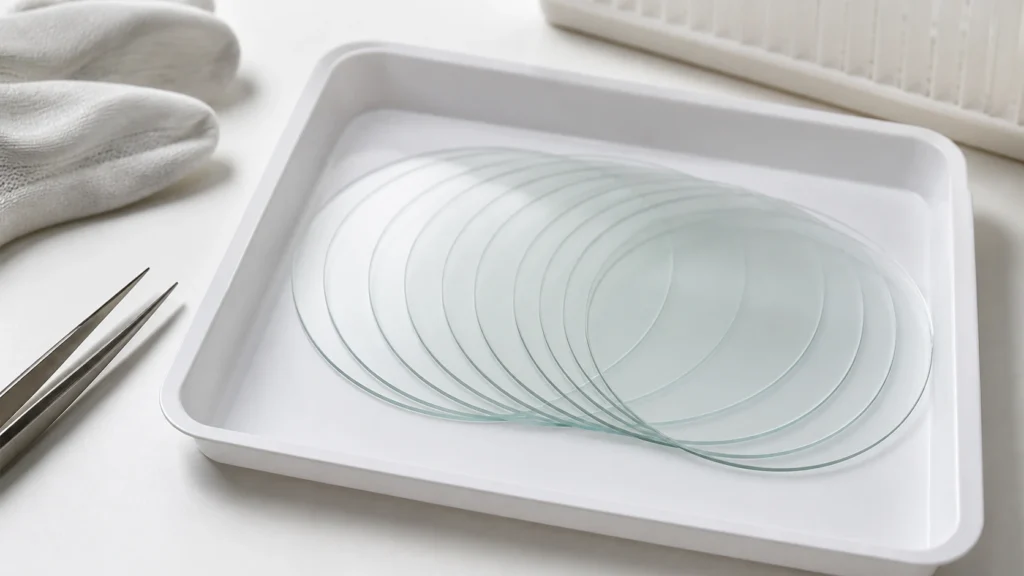
Borosilicate Glass Perforated Glass Plates – Borosilicate Glass (CTE 3.3 x 10^-6 /K, 360 nm – 2.0 um); Hole grids from 0.15 mm diameter, pitch from 0.5 mm. No minimum order; DFM review included with every RFQ.
borosilicate glass perforated glass plates are ordered for airflow sensors, filtration and vacuum chucks. The geometry envelope is Hole grids from 0.15 mm diameter, pitch from 0.5 mm, held to hole position +/-0.02 mm, in Borosilicate Glass.
Specification envelope
| Material | Borosilicate Glass (3.3 expansion group per ISO 3585) |
|---|---|
| Thermal expansion (CTE) | 3.3 x 10^-6 /K |
| Service temperature | 450 C continuous |
| Transmission range | 360 nm – 2.0 um |
| Density | 2.23 g/cm3 |
| Knoop hardness | 480 kg/mm2 |
| Refractive index | 1.473 @ 587 nm |
| Stock thickness | 0.50 – 30 mm |
| Maximum blank size | 600 x 400 mm |
| Geometry | Perforated Glass Plates |
| Size envelope | Hole grids from 0.15 mm diameter, pitch from 0.5 mm |
| Key tolerance | hole position +/-0.02 mm |
| RFQ inputs | PDF/DXF/STEP drawing, quantity brackets, surface and edge spec |
Manufacturing capability
One material, many routes: on Borosilicate Glass we also quote polishing, laser cutting, lapping, etching, and multi-step drawings are the norm rather than the exception.
Production route: drilling, laser cutting, ultrasonic machining – selected per geometry and volume. Edge condition: optional chamfered hole entry.
DFM notes from the shop floor
The shop-floor rules that matter here:
- Material note: sheet stock carries more thickness variation than float wafer stock, so lapping is often the first step.
- Hold the controlling dimension (hole position +/-0.02 mm) and let secondary dimensions carry standard tolerance – it is the single biggest cost lever.
- Over-specification is the quiet budget killer: a 20/10 scratch-dig face costs roughly three times an 80/50 face, so grade each surface individually.
The full rules live in our tolerance design guide and holes and edges design guide.
Where these parts end up
borosilicate glass perforated glass plates shows up across medical diagnostics (flow cells, slides, microplate bottoms, cuvette windows); scientific instruments (reference flats, cells, prism mounts, stage inserts); laboratory instruments (cuvettes, sight glasses, stir-cell windows). Background reading on the underlying material science: ISO 3585 borosilicate glass 3.3.
Dimensions still moving? Configure this part live in the 3D + 2D builder below, or open the full custom glass machining 3D + 2D builder to start from a blank canvas.
Useful companion pages: material selection guide, perforated quartz plates, ultra-thin quartz discs.
Frequently asked questions
What files do you need for a quote?
A dimensioned PDF plus DXF or STEP geometry. If only a sketch exists, our drawing review service formalizes it before quoting.
Do parts ship with inspection data?
Dimensional reports, surface certificates and material certs per melt are available; specify the level on the RFQ.
What tolerances are achievable on Borosilicate Glass parts?
Ground features hold +/-0.01 mm and lapped thickness reaches +/-0.003 mm. Sheet stock carries more thickness variation than float wafer stock, so lapping is often the first step.
What thickness range do you stock for Borosilicate Glass?
Standard stock spans 0.50 – 30 mm, with blanks up to 600 x 400 mm. Other formats are sourced per order.
Specifications on this page were last reviewed by our engineering team in October 2026.