
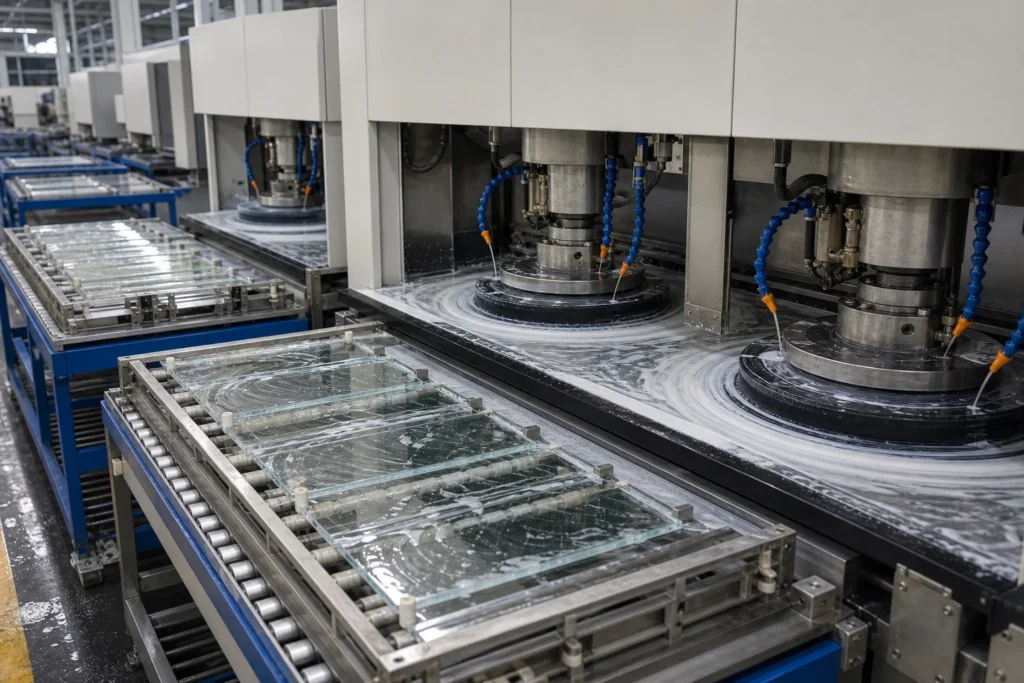
Polishing Alkali-Free Glass – Alkali-Free Glass (CTE 3.2 x 10^-6 /K, 350 nm – 2.0 um); Polishing to flatness to lambda/4 per 25 mm. No minimum order; DFM review included with every RFQ.
The combination of Alkali-Free Glass and Polishing comes up constantly in RFQs for a reason – the material offers display-grade surface quality, and Polishing is the right way to get accurate geometry into it. Expect flatness to lambda/4 per 25 mm and scratch-dig 40/20 to 20/10.
The numbers
| Material | Alkali-Free Glass (AF32 / EAGLE-class display glass) |
|---|---|
| Thermal expansion (CTE) | 3.2 x 10^-6 /K |
| Service temperature | 600 C (Tg 717 C) |
| Transmission range | 350 nm – 2.0 um |
| Density | 2.43 g/cm3 |
| Knoop hardness | 590 kg/mm2 |
| Refractive index | 1.51 @ 587 nm |
| Stock thickness | 0.10 – 1.1 mm |
| Maximum blank size | 400 x 300 mm |
| Process | Polishing |
| Working tolerance | flatness to lambda/4 per 25 mm |
| Minimum feature | Ra below 1 nm |
| Surface finish | scratch-dig 40/20 to 20/10 |
| Thickness window | 0.2 – 50 mm |
| Edge condition | polished bevels available |
| RFQ inputs | PDF/DXF/STEP drawing, quantity brackets, surface and edge spec |
DFM notes from the shop floor
Three items decide most of the cost and lead time on this work:
- Material note: thin sheets below 0.3 mm demand carrier-supported handling through every step.
- Process boundary: steep aspect parts and deep pockets polish unevenly; those faces are specified as fine-ground.
- Over-specification is the quiet budget killer: a 20/10 scratch-dig face costs roughly three times an 80/50 face, so grade each surface individually.
The full rules live in our tolerance design guide and holes and edges design guide.
Manufacturing capability
The core strength of Polishing is optical-grade faces with certified scratch-dig and interferometer-verified flatness. The honest limit: steep aspect parts and deep pockets polish unevenly; those faces are specified as fine-ground. Both belong on the drawing before quoting, not after.
One material, many routes: on Alkali-Free Glass we also quote laser cutting, dicing, grinding, etching, and multi-step drawings are the norm rather than the exception.
Typical applications
polishing alkali-free glass shows up across oled packaging (cover lids, frit-seal frames, fill-port plates); ccd inspection equipment (CCD cover plates, reference grids, stage glass); mems devices (cap wafers, TGV substrates, motion-sensor lids). Background reading on the underlying material science: SCHOTT AF 32 eco.
The fastest route to a quote is geometry: use the 3D builder below, draw a dimensioned 2D drawing from it, or open the site-wide custom glass machining 3D + 2D builder for fully custom parts.
Related reading on this site: optical polishing capability, alkali-free glass wafers, alkali-free display glass.
Frequently asked questions
How fast can prototypes ship?
Machined prototypes ship in 5 – 10 working days. Coated or bonded parts add 1 – 2 weeks depending on queue slots.
What files do you need for a quote?
A dimensioned PDF plus DXF or STEP geometry. If only a sketch exists, our drawing review service formalizes it before quoting.
Do parts ship with inspection data?
Dimensional reports, surface certificates and material certs per melt are available; specify the level on the RFQ.
What tolerances are achievable on Alkali-Free Glass parts?
Ground features hold +/-0.01 mm and lapped thickness reaches +/-0.003 mm. Thin sheets below 0.3 mm demand carrier-supported handling through every step.
What thickness range do you stock for Alkali-Free Glass?
Standard stock spans 0.10 – 1.1 mm, with blanks up to 400 x 300 mm. Other formats are sourced per order.
Specifications on this page were last reviewed by our engineering team in September 2026.