
Key Takeaways
- Dishwasher cover glass must withstand thermal cycling, humidity, and alkaline detergents without degradation.
- Optical clarity and precise geometric tolerances are essential for reliable capacitive touch performance.
- Comprehensive QC includes environmental simulation tests and 100% visual inspection.
- Full batch traceability and documented compliance support sourcing audits.
The Importance of Rigorous Quality Control in Dishwasher Cover Glass
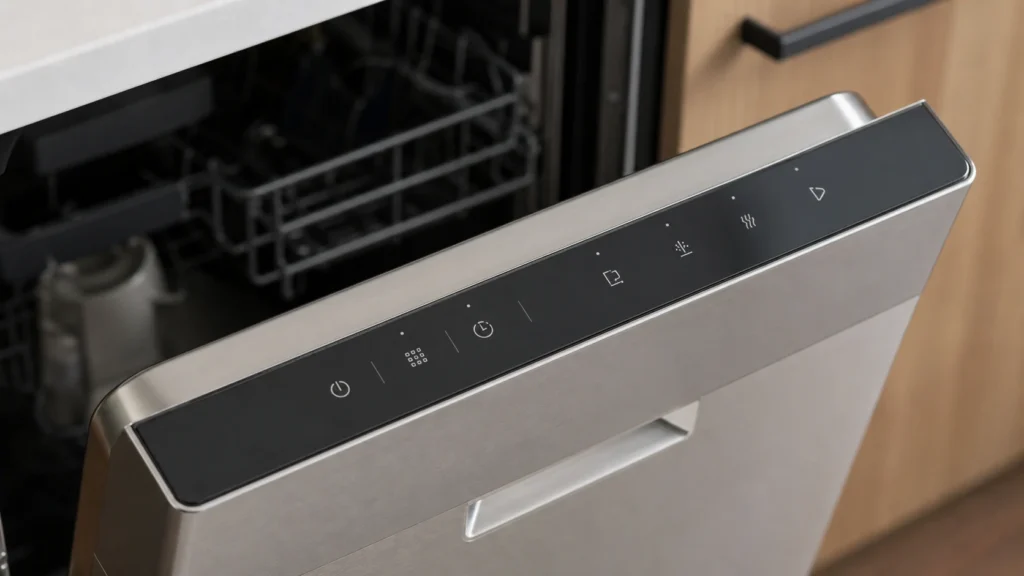
For a dishwasher touch control panel, the cover glass must withstand continuous exposure to moisture, heat, detergents, and mechanical contact—all while maintaining flawless optical clarity and sensitivity. A single defect can compromise the appliance’s user interface, leading to field failures and costly recalls. Our manufacturing approach embeds quality at every stage, from raw material verification to final packaging, aligning with the strict demands of global appliance brands.
Quality Management System and Applicable Standards
Production operates under an ISO 9001-certified quality management system, emphasizing process control, continuous improvement, and full traceability. All materials and processes comply with RoHS and REACH regulations, ensuring that the finished appliance touch panel meets international environmental standards. A controlled cleanroom environment is maintained for final assembly and packaging to prevent particulate contamination.
Incoming Material and In-Process Inspection
Raw glass sheets—typically soda-lime or aluminosilicate—are subjected to incoming inspection for thickness variation, optical defects, and surface flatness using non-contact measurement tools. After CNC cutting and edge grinding, each panel goes through dimensional verification, edge quality checks (smooth C-edge or chamfer, free of chips), and flatness assessment. For chemically strengthened or thermally tempered cover glass, stress profile or fragmentation testing validates that the required strength has been achieved. Any decorative printing or anti-fingerprint coating is inspected for alignment, adhesion (cross-hatch test), and color consistency during the process.
Final Inspection and Pre-Shipment Checks
A 100% visual inspection under calibrated lighting identifies scratches, digs, bubbles, and print defects against agreed limit samples or industry-accepted criteria. Light transmission and haze are measured with a spectrophotometer to ensure visibility of underlying displays or icons. Dimensional and cosmetic attributes are further validated through AQL sampling per ISO 2859-1, with levels customized to customer requirements. Panels also undergo environmental resistance testing—such as thermal shock, high-humidity exposure, and detergent solution immersion—to simulate dishwasher operation. Only units that pass all stages are packed in a cleanroom, using static-safe materials, to maintain cleanliness until installation.
Metrology, Documentation, and Inspection Support
Inspection relies on a suite of advanced metrology tools: vision measuring machines (VMM) for sub-micron dimensional accuracy, surface profilometers for roughness, spectrophotometers for color and transmission, and environmental chambers for accelerated aging. Each production lot is fully traceable from raw glass batch to shipment, accompanied by a certificate of compliance and detailed inspection data sheets. We support third-party audits or inspection at our facility, coordinating with recognized agencies to meet buyer-specific validation protocols.
Request Inspection Documentation for Your Project
Procurement teams and engineers sourcing custom cover glass for dishwasher interfaces can request sample lot documentation, detailed control plans, or arrange a virtual process review. Contact our quality engineering group to discuss your specific inspection and compliance needs.
Critical Quality Attributes for Dishwasher Touch Panel Cover Glass
Procurement teams evaluating dishwasher control glass must verify a specific set of quality attributes that ensure long‑term reliability under moisture, heat, and chemical exposure. When sourcing a custom glass plate for appliance touch interfaces, the following characteristics directly influence field performance and should be audited against documented control plans:
Key Facts for Dishwasher Cover Glass Procurement
- Material choice—borosilicate or chemically strengthened soda‑lime—must resist thermal shock and alkaline detergent attack.
- Surface quality (scratch‑dig and flatness) directly impacts capacitive touch sensitivity and uniformity.
- Screen‑printed graphics and anti‑fingerprint coatings must pass cross‑hatch adhesion and chemical rub tests.
- 100% visual inspection under controlled lighting and AQL sampling for dimensional are standard pre‑shipment controls.
- Full batch traceability, from raw glass lot to shipment, supports downstream quality audits and recall readiness.
Material Selection and Surface Treatments
Borosilicate glass (e.g., Borofloat® 33) is frequently specified for its low thermal expansion, allowing it to endure the rapid temperature swings inside a dishwasher. Soda‑lime float glass, when properly tempered or chemically strengthened, offers a cost‑effective alternative with adequate durability for many appliance grades. Custom glass machining processes—CNC grinding, edge polishing, and hole drilling—create the exact outline and mounting features while maintaining the mechanical integrity required for long‑term press‑fit assembly.
Functional coatings add value: a hydrophobic/oleophobic top layer reduces fingerprint smudging, while screen‑printed black borders and iconography use ceramic frit that fuses to the glass during tempering, ensuring adhesion that withstands steam and detergent cycles. Silver paste circuitry for capacitive touch is bonded and tested for conductivity consistency before lamination.
Supplier Attributes Worth Comparing
The table below consolidates the quality and inspection dimensions that matter most when evaluating a precision glass partner for dishwasher touch control interfaces. All points reference capabilities described in the preceding sections and Part 1 of this article.
| Aspect | Typical Supplier Capability / Options |
|---|---|
| Material Options | Borosilicate glass, chemically strengthened soda‑lime, tempered float glass |
| Dimensional Tolerances | Customer‑specified; precision grinding achieves ±0.05 mm or tighter on critical features |
| Surface Quality | Scratch‑dig per MIL‑PRF‑13830B, flatness via optical interferometer, surface roughness Ra < 1 nm achievable |
| Coatings & Printing | Anti‑fingerprint, screen‑printed frit, silver paste for capacitive touch; adhesion tested per ASTM D3359 |
| Certifications | ISO 9001, ISO 13485 (where applicable), RoHS, REACH; compliance verified by in‑house lab or accredited third party |
| Inspection Equipment | Vision measuring machine (sub‑micron), profilometer, spectrophotometer, environmental chambers for thermal/humidity cycling |
| Documentation & Traceability | Certificate of compliance, full batch traceability report, detailed inspection data sheets |
Custom glass cutting and finishing are tailored to each project’s unique geometry. To move forward, send your drawings or CAD files to our engineering team. We provide a tailored quote, sample lot inspection documentation, and a detailed control plan aligned with your appliance qualification protocol.
Frequently Asked Questions
What type of glass is used for dishwasher touch panels?
Borosilicate glass, such as Borofloat® 33, is common for its low thermal expansion and chemical durability. Tempered or chemically strengthened soda‑lime glass is also used as a cost‑effective alternative. The choice depends on the appliance’s thermal shock requirements and budget.
How is the quality of dishwasher control glass inspected?
Inspection covers multiple stages: incoming material checks for flatness and inclusions, in‑process dimensional verification using vision measuring machines, and final inspection for scratch‑dig, transmission, and coating adhesion. Environmental testing simulates dishwasher cycles to validate long‑term reliability.
Can dishwasher cover glass be customized with logos or symbols?
Yes, screen‑printed ceramic frit or digital printing can apply logos, button icons, and decorative borders. The print is fused to the glass during tempering, ensuring it resists steam, detergents, and abrasion. Adhesion is verified through cross‑hatch and chemical rub tests.
What certifications should a cover glass supplier have for appliance applications?
ISO 9001 certification is a minimum requirement for quality management. Additional certifications like ISO 13485 may apply if the glass is used in medical‑grade appliances. Compliance with RoHS and REACH ensures the materials meet environmental and safety regulations.
How does anti‑fingerprint coating on dishwasher glass work?
A hydrophobic/oleophobic coating reduces the adhesion of skin oils and water, making fingerprints less visible and easier to wipe off. These coatings are deposited via vacuum processes and are tested for durability under repeated cleaning cycles and chemical exposure.