
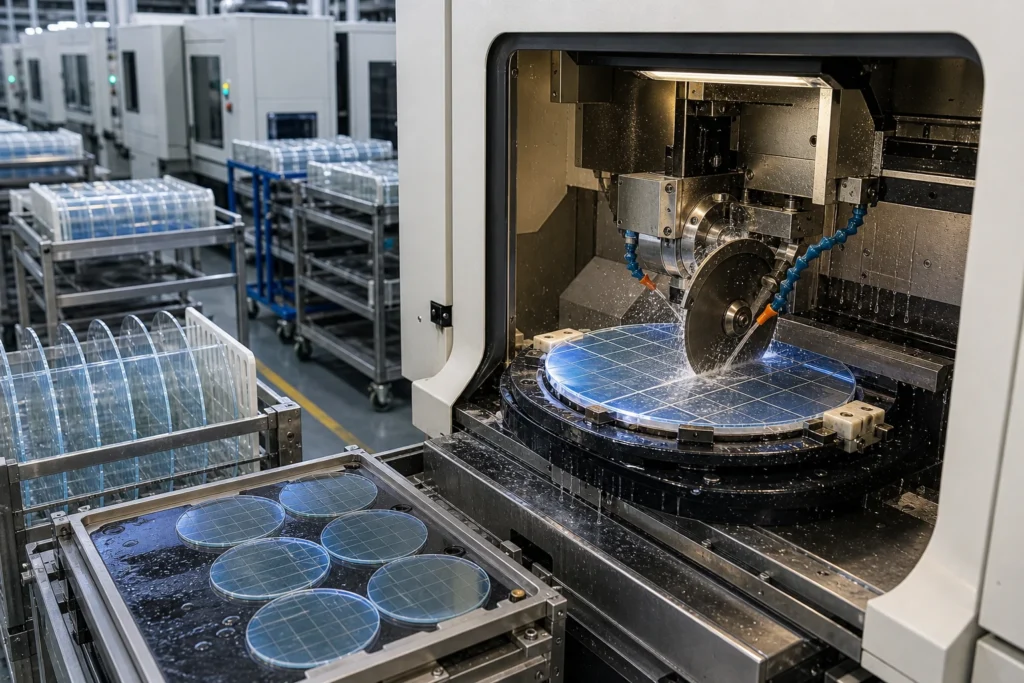
Dicing D263 Thin Glass – D263 Thin Glass (CTE 7.2 x 10^-6 /K, 350 nm – 2.0 um); Dicing to +/-0.01 mm index accuracy. No minimum order; DFM review included with every RFQ.
Ask any process engineer what makes d263 thin glass difficult and the answer is specific: ultra-thin stock cannot take conventional clamping; parts are machined on wax or UV-tape carriers. Our dicing line is tooled around exactly that – automatic dicing saws with resin and metal-bond blades – holding +/-0.01 mm index accuracy on parts from 0.05 – 3 mm thick.
Specification envelope
| Material | D263 Thin Glass (SCHOTT D 263 T eco) |
|---|---|
| Thermal expansion (CTE) | 7.2 x 10^-6 /K |
| Service temperature | 400 C (Tg 557 C) |
| Transmission range | 350 nm – 2.0 um |
| Density | 2.51 g/cm3 |
| Knoop hardness | 590 kg/mm2 |
| Refractive index | 1.523 @ 587 nm |
| Stock thickness | 0.03 – 1.1 mm |
| Maximum blank size | 440 x 360 mm |
| Process | Dicing |
| Working tolerance | +/-0.01 mm index accuracy |
| Minimum feature | 30 um kerf |
| Surface finish | edge chipping under 15 um |
| Thickness window | 0.05 – 3 mm |
| Edge condition | saw edge, optional etch relief |
| RFQ inputs | PDF/DXF/STEP drawing, quantity brackets, surface and edge spec |
Capabilities and limits
The core strength of Dicing is singulating wafers into dies with tight index accuracy and low chipping. The honest limit: straight-line cuts only; contours route to laser cutting instead. Both belong on the drawing before quoting, not after.
One material, many routes: on D263 Thin Glass we also quote grinding, etching, cnc machining, drilling, and multi-step drawings are the norm rather than the exception.
Design guidance
Three items decide most of the cost and lead time on this work:
- Material note: ultra-thin stock cannot take conventional clamping; parts are machined on wax or UV-tape carriers.
- Process boundary: straight-line cuts only; contours route to laser cutting instead.
- Over-specification is the quiet budget killer: a 20/10 scratch-dig face costs roughly three times an 80/50 face, so grade each surface individually.
The full rules live in our tolerance design guide and holes and edges design guide.
Who orders this
The recurring buyers of dicing d263 thin glass: oled packaging (cover lids, frit-seal frames, fill-port plates); microfluidic devices (chips, manifolds, via plates, bonded stacks); led packaging (groove covers, phosphor carriers, package windows). Background reading on the underlying material science: SCHOTT D 263 thin glass.
Dimensions still moving? Configure this part live in the 3D builder below, or open the full custom glass machining 3D builder to start from a blank canvas.
For adjacent specifications, see ultra-thin glass materials, wafer dicing process, glass in laser systems.
Common questions
What tolerances are achievable on D263 Thin Glass parts?
Ground features hold +/-0.01 mm and lapped thickness reaches +/-0.003 mm. Ultra-thin stock cannot take conventional clamping; parts are machined on wax or UV-tape carriers.
What thickness range do you stock for D263 Thin Glass?
Standard stock spans 0.03 – 1.1 mm, with blanks up to 440 x 360 mm. Other formats are sourced per order.
How does D263 Thin Glass behave under heat?
CTE is 7.2 x 10^-6 /K and continuous service reaches 400 C (Tg 557 C), which is what drives its use where down-drawn fire-polished surfaces matters.
What accuracy does dicing hold?
+/-0.01 mm index accuracy with minimum features of 30 um kerf. Straight-line cuts only; contours route to laser cutting instead.
Specifications on this page were last reviewed by our engineering team in July 2026.