
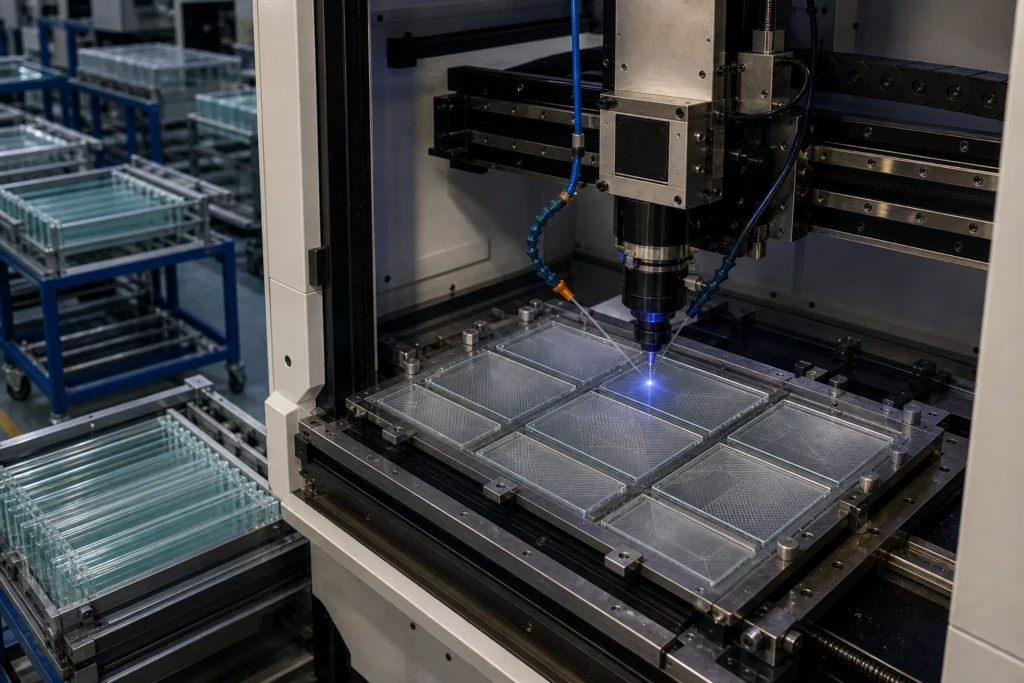
Etching JGS2 Quartz Glass: JGS2 Quartz Glass (CTE 0.55 x 10^-6 /K, 220 nm – 2.5 um); Etching to depth control +/-1 um. Single-piece prototypes to production volumes, quoted from your drawing.
The combination of JGS2 Quartz Glass and Etching comes up constantly in RFQs for a reason – the material offers lower oh than jgs1, and Etching is the right way to get accurate geometry into it. Expect depth control +/-1 um and isotropic smooth walls.
The numbers
| Material | JGS2 Quartz Glass (Optical grade, bubble class 1) |
|---|---|
| Thermal expansion (CTE) | 0.55 x 10^-6 /K |
| Service temperature | 1,100 C continuous |
| Transmission range | 220 nm – 2.5 um |
| Density | 2.20 g/cm3 |
| Knoop hardness | 500 kg/mm2 |
| Refractive index | 1.458 @ 587 nm |
| Stock thickness | 0.20 – 40 mm |
| Maximum blank size | 300 mm diameter |
| Process | Etching |
| Working tolerance | depth control +/-1 um |
| Minimum feature | 10 um channel width (masked HF) |
| Surface finish | isotropic smooth walls |
| Thickness window | 0.1 – 5 mm |
| Edge condition | stress-relief etch available |
| RFQ inputs | PDF/DXF/STEP drawing, quantity brackets, surface and edge spec |
Design guidance
Three items decide most of the cost and lead time on this work:
- Material note: thicker blanks need stress-relief annealing before tight-flatness grinding.
- Process boundary: isotropic undercut roughly equals depth, so masks are compensated at layout time.
- Over-specification is the quiet budget killer: a 20/10 scratch-dig face costs roughly three times an 80/50 face, so grade each surface individually.
The full rules live in our tolerance design guide and holes and edges design guide.
Manufacturing capability
The core strength of Etching is microchannels, cavities and frosted textures without mechanical stress. The honest limit: isotropic undercut roughly equals depth, so masks are compensated at layout time. Both belong on the drawing before quoting, not after.
One material, many routes: on JGS2 Quartz Glass we also quote edge grinding, cnc machining, drilling, coring, and multi-step drawings are the norm rather than the exception.
Where these parts end up
The recurring buyers of etching jgs2 quartz glass: semiconductor equipment (view ports, wafer carriers, plasma rings, chamber windows); laboratory instruments (cuvettes, sight glasses, stir-cell windows); ccd inspection equipment (CCD cover plates, reference grids, stage glass). Background reading on the underlying material science: ScienceDirect: fused quartz.
The fastest route to a quote is geometry: use the 3D builder below, draw a dimensioned 2D drawing from it, or open the site-wide custom glass machining 3D + 2D builder for fully custom parts.
Related reading on this site: fused silica wafers 2-12 inch, precision glass grinding, custom FTO glass.
Frequently asked questions
What equipment runs the etching work?
Buffered HF wet benches and masked lithography line.
Is there a minimum order for etching jgs2 quartz glass?
No. Single prototypes are accepted, and pricing steps down at 10, 100 and 1,000 pieces.
How fast can prototypes ship?
Machined prototypes ship in 5 – 10 working days. Coated or bonded parts add 1 – 2 weeks depending on queue slots.
What files do you need for a quote?
A dimensioned PDF plus DXF or STEP geometry. If only a sketch exists, our drawing review service formalizes it before quoting.
Specifications on this page were last reviewed by our engineering team in September 2026.