
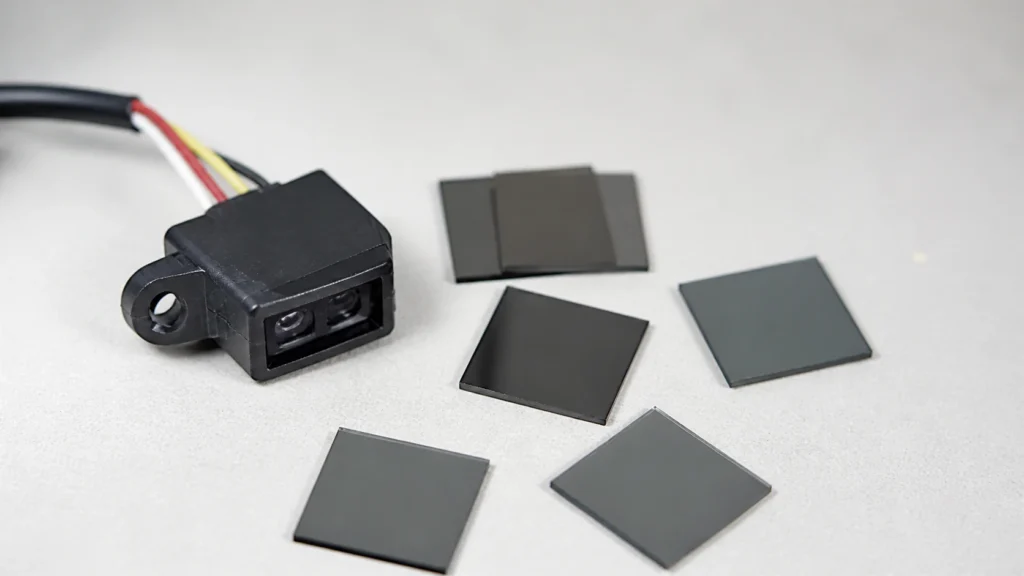
6 Inch (150 mm) Alkali-Free Glass Wafers: Alkali-Free Glass (CTE 3.2 x 10^-6 /K, 350 nm – 2.0 um); 150 mm format, TTV <3 um. Single-piece prototypes to production volumes, quoted from your drawing.
A wafer is a specification bundle, not just a disc. 6 inch (150 mm) alkali-free glass wafers here mean AF32 / EAGLE-class display glass material with certified CTE of 3.2 x 10^-6 /K, TTV controlled per format, and edges profiled for handler compatibility.
The numbers
| Material | Alkali-Free Glass (AF32 / EAGLE-class display glass) |
|---|---|
| Thermal expansion (CTE) | 3.2 x 10^-6 /K |
| Service temperature | 600 C (Tg 717 C) |
| Transmission range | 350 nm – 2.0 um |
| Density | 2.43 g/cm3 |
| Knoop hardness | 590 kg/mm2 |
| Refractive index | 1.51 @ 587 nm |
| Stock thickness | 0.10 – 1.1 mm |
| Maximum blank size | 400 x 300 mm |
| Diameter / format | 150 mm |
| Thickness | 0.5 – 1.1 mm |
| TTV | <3 um |
| Flat / notch | SEMI notch or flat |
| RFQ inputs | PDF/DXF/STEP drawing, quantity brackets, surface and edge spec |
Specification advice
The shop-floor rules that matter here:
- Material note: thin sheets below 0.3 mm demand carrier-supported handling through every step.
- Specify flat or notch orientation relative to your device layout – regrinding orientation later scraps the wafer.
- Over-specification is the quiet budget killer: a 20/10 scratch-dig face costs roughly three times an 80/50 face, so grade each surface individually.
For the complete framework, see the tolerance design guide and the holes and edges design guide.
Capabilities and limits
One material, many routes: on Alkali-Free Glass we also quote etching, dicing, drilling, and multi-step drawings are the norm rather than the exception.
Who orders this
Orders for 6 inch (150 mm) alkali-free glass wafers cluster in ccd inspection equipment (CCD cover plates, reference grids, stage glass); oled packaging (cover lids, frit-seal frames, fill-port plates). Background reading on the underlying material science: SCHOTT AF 32 eco.
Dimensions still moving? Configure this part live in the 3D + 2D builder below, or open the full custom glass machining 3D + 2D builder to start from a blank canvas.
Useful companion pages: alkali-free display glass, alkali-free glass wafers, CNC machining capability.
Buyer questions, answered
Do parts ship with inspection data?
Dimensional reports, surface certificates and material certs per melt are available; specify the level on the RFQ.
What tolerances are achievable on Alkali-Free Glass parts?
Ground features hold +/-0.01 mm and lapped thickness reaches +/-0.003 mm. Thin sheets below 0.3 mm demand carrier-supported handling through every step.
What thickness range do you stock for Alkali-Free Glass?
Standard stock spans 0.10 – 1.1 mm, with blanks up to 400 x 300 mm. Other formats are sourced per order.
How does Alkali-Free Glass behave under heat?
CTE is 3.2 x 10^-6 /K and continuous service reaches 600 C (Tg 717 C), which is what drives its use where no alkali ion migration into TFT or sensor layers matters.
Specifications on this page were last reviewed by our engineering team in October 2026.