
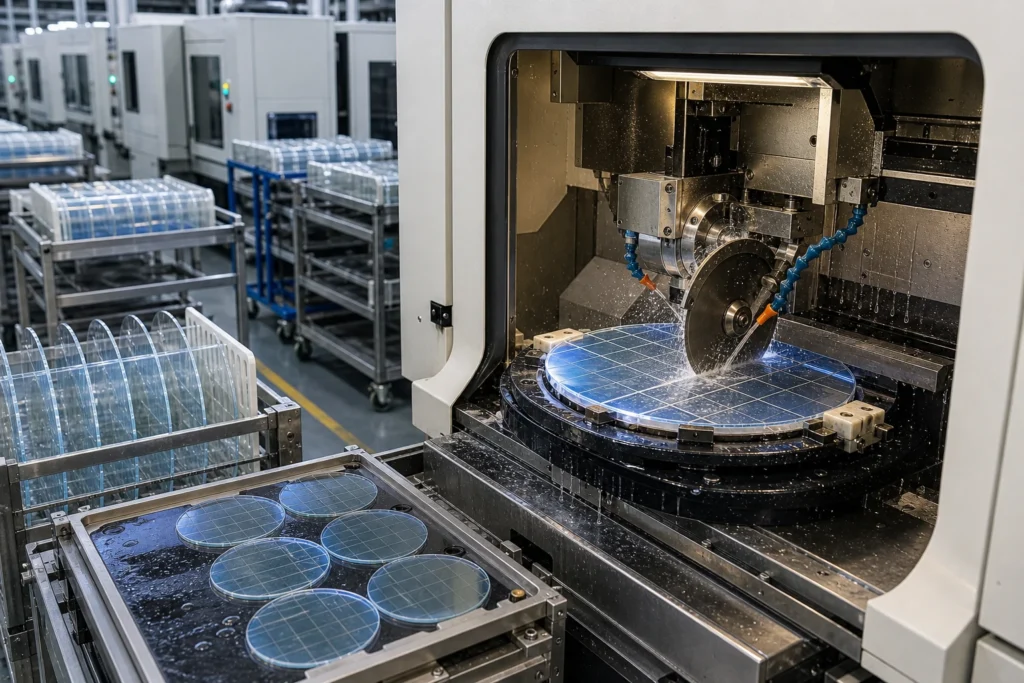
Quick answer: Dicing Quartz Glass covers Quartz Glass (CTE 0.59 x 10^-6 /K, 260 nm – 2.5 um); Dicing to +/-0.01 mm index accuracy. Prototypes ship in 5-10 working days.
We dice Quartz Glass daily, in thicknesses from 0.05 – 3 mm. The controlling numbers: +/-0.01 mm index accuracy working tolerance, 30 um kerf minimum features, and edge chipping under 15 um off the machine. Where the drawing asks for more, downstream lapping and polishing take over.
Specifications at a glance
| Material | Quartz Glass (GE214-equivalent, semiconductor grade) |
|---|---|
| Thermal expansion (CTE) | 0.59 x 10^-6 /K |
| Service temperature | 1,050 C continuous |
| Transmission range | 260 nm – 2.5 um |
| Density | 2.20 g/cm3 |
| Knoop hardness | 500 kg/mm2 |
| Refractive index | 1.459 @ 587 nm |
| Stock thickness | 0.20 – 60 mm |
| Maximum blank size | 450 mm diameter |
| Process | Dicing |
| Working tolerance | +/-0.01 mm index accuracy |
| Minimum feature | 30 um kerf |
| Surface finish | edge chipping under 15 um |
| Thickness window | 0.05 – 3 mm |
| Edge condition | saw edge, optional etch relief |
| RFQ inputs | PDF/DXF/STEP drawing, quantity brackets, surface and edge spec |
Manufacturing capability
The core strength of Dicing is singulating wafers into dies with tight index accuracy and low chipping. The honest limit: straight-line cuts only; contours route to laser cutting instead. Both belong on the drawing before quoting, not after.
One material, many routes: on Quartz Glass we also quote double-side polishing, edge grinding, drilling, etching, and multi-step drawings are the norm rather than the exception.
Design guidance
Before sending the RFQ, check these against your drawing:
- Material note: natural-quartz batches vary in metallic ppm, so semiconductor lots need certs per melt.
- Process boundary: straight-line cuts only; contours route to laser cutting instead.
- Over-specification is the quiet budget killer: a 20/10 scratch-dig face costs roughly three times an 80/50 face, so grade each surface individually.
The full rules live in our tolerance design guide and holes and edges design guide.
Who orders this
Orders for dicing quartz glass cluster in semiconductor equipment (view ports, wafer carriers, plasma rings, chamber windows); laboratory instruments (cuvettes, sight glasses, stir-cell windows). Background reading on the underlying material science: ScienceDirect: quartz glass.
Dimensions still moving? Configure this part live in the 3D + 2D builder below, or open the full custom glass machining 3D + 2D builder to start from a blank canvas.
Useful companion pages: wafer dicing process, ultra-thin glass materials, glass sandblasting.
Common questions
How fast can prototypes ship?
Machined prototypes ship in 5 – 10 working days. Coated or bonded parts add 1 – 2 weeks depending on queue slots.
What files do you need for a quote?
A dimensioned PDF plus DXF or STEP geometry. If only a sketch exists, our drawing review service formalizes it before quoting.
Do parts ship with inspection data?
Dimensional reports, surface certificates and material certs per melt are available; specify the level on the RFQ.
What tolerances are achievable on Quartz Glass parts?
Ground features hold +/-0.01 mm and lapped thickness reaches +/-0.003 mm. Natural-quartz batches vary in metallic ppm, so semiconductor lots need certs per melt.
Specifications on this page were last reviewed by our engineering team in September 2026.