
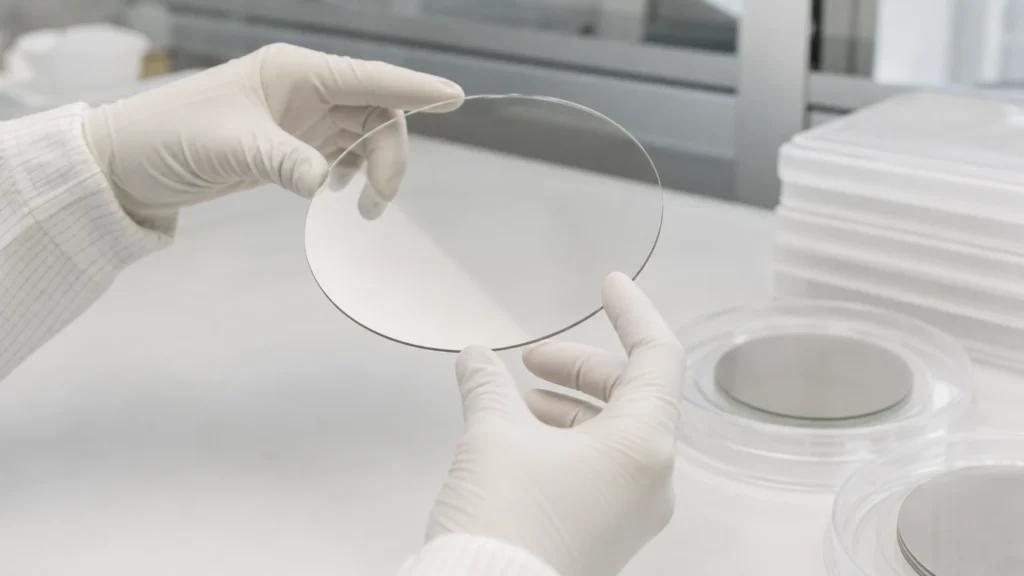
Fused Silica With Slots – Fused Silica (CTE 0.55 x 10^-6 /K, 185 nm – 2.5 um); width from 0.4 mm, length any, ends R0.2 mm min. No minimum order; DFM review included with every RFQ.
When a drawing calls out Fused Silica, three numbers matter before any machining starts: CTE of 0.55 x 10^-6 /K, service temperature to 1,100 C continuous, and a transmission window of 185 nm – 2.5 um. fused silica with slots here begin with those numbers and end with dimensional reports.
Key parameters
| Material | Fused Silica (JGS1 (UV), JGS2 (standard), JGS3 (IR)) |
|---|---|
| Thermal expansion (CTE) | 0.55 x 10^-6 /K |
| Service temperature | 1,100 C continuous |
| Transmission range | 185 nm – 2.5 um |
| Density | 2.20 g/cm3 |
| Knoop hardness | 500 kg/mm2 |
| Refractive index | 1.458 @ 587 nm |
| Stock thickness | 0.10 – 50 mm |
| Maximum blank size | 450 x 450 mm |
| Feature | Slots |
| Capability | width from 0.4 mm, length any, ends R0.2 mm min |
| RFQ inputs | PDF/DXF/STEP drawing, quantity brackets, surface and edge spec |
Design guidance
Three items decide most of the cost and lead time on this work:
- Material note: its hardness and brittleness demand diamond tooling and controlled feeds.
- Feature rule: slot web between features at least 1x thickness.
- Over-specification is the quiet budget killer: a 20/10 scratch-dig face costs roughly three times an 80/50 face, so grade each surface individually.
The full rules live in our tolerance design guide and holes and edges design guide.
Capabilities and limits
One material, many routes: on Fused Silica we also quote etching, cnc machining, double-side polishing, sandblasting, and multi-step drawings are the norm rather than the exception.
These features are produced by cnc machining or laser cutting. Capability: width from 0.4 mm, length any, ends R0.2 mm min. Design rule worth copying onto the drawing: slot web between features at least 1x thickness.
Who orders this
Orders for fused silica with slots cluster in ccd inspection equipment (CCD cover plates, reference grids, stage glass); laboratory instruments (cuvettes, sight glasses, stir-cell windows); microfluidic devices (chips, manifolds, via plates, bonded stacks). Background reading on the underlying material science: RP Photonics: fused silica.
The fastest route to a quote is geometry: use the 3D builder below, draw a dimensioned 2D drawing from it, or open the site-wide custom glass machining 3D + 2D builder for fully custom parts.
Related reading on this site: wafer dicing process, fused silica material guide, special-shaped glass plates.
Frequently asked questions
What files do you need for a quote?
A dimensioned PDF plus DXF or STEP geometry. If only a sketch exists, our drawing review service formalizes it before quoting.
Do parts ship with inspection data?
Dimensional reports, surface certificates and material certs per melt are available; specify the level on the RFQ.
What tolerances are achievable on Fused Silica parts?
Ground features hold +/-0.01 mm and lapped thickness reaches +/-0.003 mm. Its hardness and brittleness demand diamond tooling and controlled feeds.
What thickness range do you stock for Fused Silica?
Standard stock spans 0.10 – 50 mm, with blanks up to 450 x 450 mm. Other formats are sourced per order.
Specifications on this page were last reviewed by our engineering team in October 2026.