
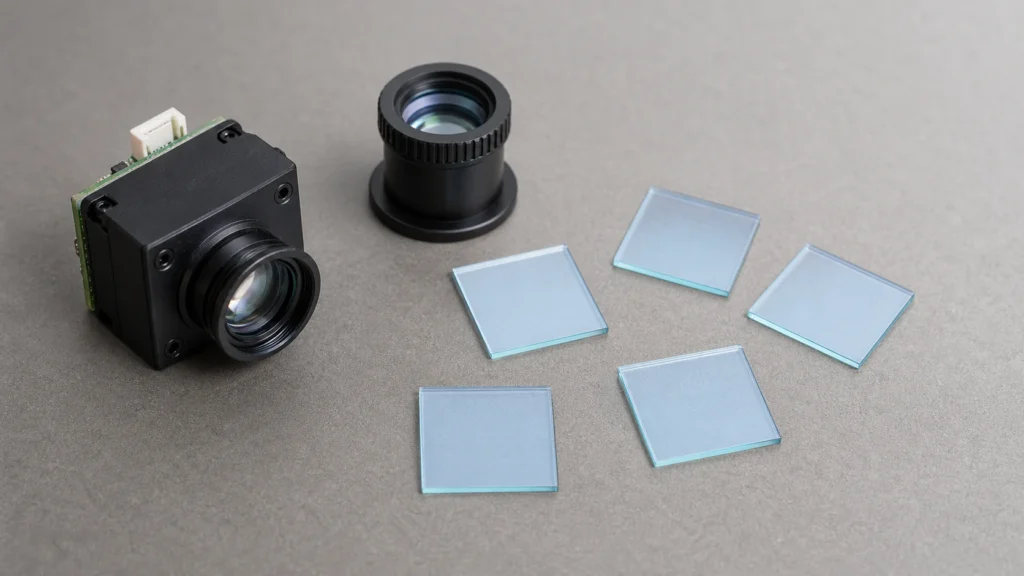
Shortpass Optical Filters – cut-off 400 – 1200 nm, OD4 rejection band. No minimum order; DFM review included with every RFQ.
We supply shortpass optical filters to cut-off 400 – 1200 nm, OD4 rejection band – and because we are a machining house first, non-standard outlines, notches and mounting holes are part of the normal order, not an exception.
Specification envelope
| Optical specification | cut-off 400 – 1200 nm, OD4 rejection band |
|---|---|
| RFQ inputs | PDF/DXF/STEP drawing, quantity brackets, surface and edge spec |
DFM notes from the shop floor
The shop-floor rules that matter here:
- Over-specification is the quiet budget killer: a 20/10 scratch-dig face costs roughly three times an 80/50 face, so grade each surface individually.
The full rules live in our tolerance design guide and holes and edges design guide.
Where these parts end up
shortpass optical filters shows up across laser systems (windows, beam splitters, debris shields); oled packaging (cover lids, frit-seal frames, fill-port plates); aerospace optics (sensor windows, star-tracker flats, radiation-tolerant ports).
The fastest route to a quote is geometry: use the 3D builder below, draw a dimensioned 2D drawing from it, or open the site-wide custom glass machining 3D + 2D builder for fully custom parts.
Related reading on this site: FTO conductive glass, LED groove cover glass, glass hole micromachining.
Common questions
Is there a minimum order for shortpass optical filters?
No. Single prototypes are accepted, and pricing steps down at 10, 100 and 1,000 pieces.
How fast can prototypes ship?
Machined prototypes ship in 5 – 10 working days. Coated or bonded parts add 1 – 2 weeks depending on queue slots.
What files do you need for a quote?
A dimensioned PDF plus DXF or STEP geometry. If only a sketch exists, our drawing review service formalizes it before quoting.
Do parts ship with inspection data?
Dimensional reports, surface certificates and material certs per melt are available; specify the level on the RFQ.
Specifications on this page were last reviewed by our engineering team in September 2026.