
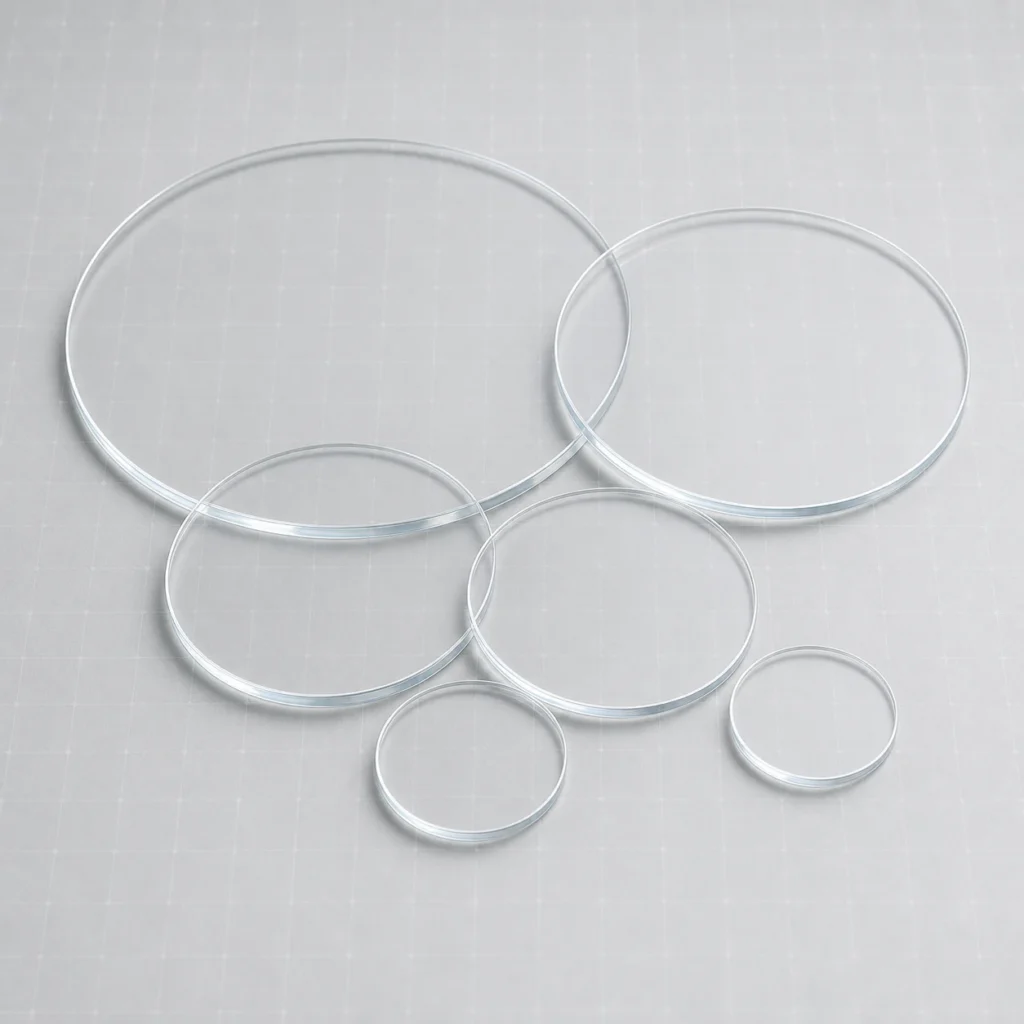
Key Takeaways
- Fused silica provides the highest UV transmission and thermal shock resistance among glass materials, making it the default choice for laser and semiconductor optics.
- Quartz glass (fused quartz) offers a cost-effective alternative for applications where extreme purity is not mandatory, trading slight performance drops for larger geometries.
- Anti-reflection coatings can boost transmission to over 99% at specific wavelengths, but must be matched to the substrate's thermal expansion coefficient to prevent delamination.
- International buyers should specify tolerances, surface quality, and compliance needs early to avoid rework and ensure export documentation is complete.
- Selecting a supplier with in-house CNC machining, polishing, and coating capabilities streamlines production of complex precision glass parts and reduces lead times.
Why Material and Coating Selection Defines Component Performance
For precision glass components—whether used in semiconductor wafer handling, optical instrument windows, or UV lithography optics—the base glass material and its surface treatment are the two most critical decisions an engineer makes. A component’s transmission spectrum, thermal limits, chemical resistance, and mechanical durability all stem from this single choice. Choosing incorrectly leads to early failure, poor signal throughput, or excessive cost. The following sections break down the available glass types and coatings as comparable, labelled options, highlighting honest performance trade-offs to guide your specification process.
Available Glass Materials as Labelled Options
Precision glass suppliers typically offer several distinct material families, each suited to different operating conditions:
- Fused Silica (Synthetic): Produced from high-purity silicon precursors, this material offers the highest UV transmission and lowest impurity content. It is non-crystalline and exhibits near-zero thermal expansion.
- Quartz Glass (Fused Quartz): Made by melting natural quartz crystals, it has excellent thermal and chemical stability. Trace impurities may slightly reduce UV transmittance compared to synthetic fused silica, but it remains a cost-effective high-purity option for many high-temperature applications.
- Borosilicate Glass: Known for low coefficient of thermal expansion (CTE) and good chemical resistance. A versatile, lower-cost choice for viewports, labware, and general optical windows that do not demand deep-UV performance.
- Soda-Lime Glass: The most economical flat glass, often used for cover slips and low-precision windows. It has limited thermal shock resistance and higher CTE.
- Aluminosilicate Glass: Chemically strengthenable for scratch and impact resistance, commonly used for display cover glass and some protective windows. Better thermal durability than soda-lime.
- Sapphire (Single-Crystal Al₂O₃): Extremely hard and scratch-resistant, with broad transmission from UV to mid-IR. The premium choice for abrasive environments and high-pressure viewports, albeit at significantly higher cost.
- Optical Glass (e.g., N-BK7, B270): A broad category of silicate-based glasses with tailored refractive indices and dispersion. Ideal for lenses and prisms where optical properties are paramount, but generally lower thermal resistance than fused silica.
Properties and Trade-offs of Each Material
When comparing these materials, four parameters dominate decision-making: optical transmission window, coefficient of thermal expansion (CTE), chemical durability, and mechanical hardness. Cost is always a constraint.
Optical Transmission: Fused silica transmits from below 200 nm to over 2 µm, making it the go-to for UV lithography and spectroscopy. Quartz glass cuts off slightly higher in the UV due to impurities. Borosilicate and soda-lime block below roughly 300 nm. Sapphire reaches 5 µm in the IR. Optical glasses are designed for visible and NIR performance, often with high transmission but limited UV/IR reach.
Thermal and Chemical Resistance: Fused silica and quartz glass withstand extreme thermal shock (softening point >1600°C) and are inert to most chemicals except hydrofluoric acid and strong alkali. Borosilicate handles rapid temperature changes well (CTE ~3.3 × 10⁻⁶/K vs. fused silica’s ~0.55), but it can deform at lower temperatures. Soda-lime has poor thermal shock resistance. Aluminosilicate, when strengthened, offers improved thermal durability over soda-lime but is not a high-temperature material. Sapphire’s CTE is higher than fused silica’s but it remains stable up to 1800°C.
Hardness and Durability: Sapphire (Mohs 9) resists scratches far better than any glass. Aluminosilicate can be ion-exchanged for surface compression, enhancing impact resistance. Fused silica and quartz glass have moderate hardness (Mohs ~6–7) but are brittle. Borosilicate and soda-lime are softer exceptions.
Cost Trade-offs: Fused silica is more expensive than quartz glass due to synthetic production. Borosilicate is mid-cost, while soda-lime is the cheapest. Sapphire commands a premium. Optical glass prices vary by formulation. For many precision applications, the marginal cost of moving to fused silica is justified by superior UV throughput and thermal stability.
Coating and Surface-Treatment Options
Bare glass surfaces reflect about 4–8% of incident light per surface, depending on index. Coatings modify this and add functionality:
- Anti-Reflection (AR) Coatings: Single-layer MgF₂ or multilevel dielectric stacks reduce reflectance to <0.5% across specific bands (UV, VIS, NIR). A trade-off: AR coatings are sensitive to angle of incidence and can be damaged by high-fluence lasers if not designed for laser-damage threshold (LDT).
- High-Reflectance Mirror Coatings: Metallic (aluminum, silver, gold) or dielectric multilayers achieve >99% reflection. Gold performs well in IR but poorly in visible; aluminum is broad but lower reflectivity.
- ITO (Indium Tin Oxide) Transparent Conductive Coatings: Provide electrical conductivity (for EMI shielding or heating) while maintaining optical transparency. Typical sheet resistance of 10–100 Ω/sq, with some trade-off in visible transmission.
- Hydrophobic and Oleophobic Coatings: Self-assembled monolayers that reduce surface energy, making cleaning easier. Not a permanent barrier; durability varies.
- Tempering and Chemical Strengthening: Thermal tempering introduces compressive stress layers for safety glass; applicable mainly to soda-lime and some borosilicate. Chemical strengthening via ion exchange works for aluminosilicate, achieving high surface compression for scratch resistance. These treatments do not significantly affect optical properties but can change flatness.
How to Match Material and Coatings to Applications
Selecting the optimal combination requires mapping operating conditions to material properties:
- UV/Vacuum UV Optics: Fused silica with UV-grade AR coating is standard. The synthetic purity prevents solarization and transmission drop.
- High-Temperature Furnace Windows: Quartz glass or sapphire, often left uncoated or with a simple MgF₂ AR to withstand thermal cycling.
- Display Cover Glass: Aluminosilicate with chemical strengthening plus hydrophobic/oleophobic coating for fingerprint resistance.
- Laser Beam Delivery: Fused silica with high-damage-threshold AR coatings designed for specific wavelengths (e.g., 1064 nm, 355 nm).
- EMC/EMI Shielded Windows: ITO-coated borosilicate or soda-lime offers conductivity with visible transparency.
Compliance Notes: All glass materials and coatings we supply comply with RoHS and REACH regulations as standard. For applications in medical devices or food contact, additional certifications may be requested; specify your requirements early. Lead-free, cadmium-free, and halogen-free options are available across most coating lines.
Discuss Your Material Requirements
Every component build presents unique trade-offs. Tell us your wavelength range, temperature cycle, chemical environment, and budget, and we will propose a glass material and coating combination that balances performance with manufacturability. Submit your specifications to start a technical discussion.
Precision Component Performance Starts with Material Selection
Selecting the right glass material directly determines the optical clarity, thermal stability, and chemical resistance of your precision component. For applications demanding high transmission in ultraviolet or infrared spectra, fused silica glass remains the benchmark, while quartz glass materials offer a practical balance of performance and cost for less extreme environments. The decision hinges on wavelength range, temperature cycling, mechanical stress, and budgetary constraints.
Key Facts for Engineers
- Fused silica: synthetic SiO₂, ultra-low CTE (~0.55 × 10⁻⁶/K), transmits from 185 nm to 2.5 μm, high laser damage threshold, excellent thermal shock resistance.
- Quartz glass: produced from natural quartz, slightly higher impurity levels, CTE around 5.5 × 10⁻⁷/K, good UV to IR transmission with some absorption bands, more economical for large geometries.
- Coatings: anti-reflection coatings can boost transmission to >99% at design wavelengths, but must match substrate CTE to prevent delamination under thermal cycling.
- Typical applications: semiconductor wafer carriers, laser windows, UV disinfection chambers, optical reflectors, high-temperature viewports.
Specifying Custom Fused Silica and Quartz Glass Parts
When requesting a quote for a custom precision component, provide clear specifications to ensure accurate manufacturability assessments and realistic lead times. Below are the primary attributes to consider.
Material Options
We supply a range of high-purity glass materials, each with distinct properties:
- Fused silica glass (e.g., JGS1, Corning 7980): Highest UV transmission and purity for semiconductor, laser, and metrology optics.
- Quartz glass materials (e.g., JGS2, GE 124): Good optical performance from 220 nm to 2 μm, suitable for lamp envelopes, viewports, and less critical imaging.
- Borosilicate glass (e.g., Borofloat 33): Low thermal expansion, widely used for microfluidic chips, display substrates, and anodic bonding applications.
- Aluminosilicate glass: Enhanced chemical durability and scratch resistance, often chosen for touch panels and protective covers.
- Soda-lime glass: Cost-effective for non-optical components where flatness and surface quality are the primary requirements.
Tolerances and Surface Quality
Dimensional tolerances can be held to within microns, depending on geometry and material. Surface quality down to 20-10 scratch-dig is achievable on polished faces. Specify flatness requirements (e.g., λ/4 or λ/10) and surface roughness (Ra values) early in the design phase.
Production Scaling and Lead Time
MOQs vary with part complexity and material. Prototype quantities are typically feasible, with lead times ranging from weeks to months based on capacity and finishing steps. Large-volume production runs benefit from dedicated tooling and process optimization. Discuss annual usage forecasts to align production planning.
Certification and Compliance
All supplied materials and coatings comply with RoHS and REACH as standard. For medical devices or food contact, additional certifications (e.g., USP Class VI, FDA) may be arranged upon request. Certificates of conformance and material traceability are provided with every shipment.
Core Manufacturing Processes for High-Purity Glass
Transforming raw glass billets or wafers into functional components requires a combination of subtractive and coating technologies. Precision CNC machining of fused silica glass and quartz glass materials involves diamond-tipped tools, grinding, and lapping to achieve micron-level accuracy. For wafers and thin substrates, dicing services can produce singulated dies with minimal edge chipping. Optical surfaces are then refined through double-sided or pitch polishing, followed by deposition of anti-reflection, mirror, or ITO coatings in cleanroom environments.
Global Sourcing: What to Expect
As an exporter serving B2B buyers across Asia, Europe, and North America, we standardize packaging in vacuum-sealed trays with cleanroom-grade protective films to prevent contamination and breakage during transit. Shipments are accompanied by full documentation, including certificates of origin and material test reports. Logistic partnerships with major freight carriers ensure reliable door-to-door delivery with customs clearance support.
| Material Type | Optical Transmission | Thermal / Chemical Resistance | Typical Applications |
|---|---|---|---|
| Fused Silica | 185 nm – 2.5 μm, excellent UV | CTE 0.55×10⁻⁶/K, resists thermal shock, inert to most acids | Laser optics, semiconductor windows, UV disinfection |
| Quartz Glass | 220 nm – 2 μm, some IR absorption | CTE 5.5×10⁻⁷/K, good thermal endurance | Lamp envelopes, viewports, lower-cost imaging |
| Borosilicate | 300 nm – 2.6 μm | CTE 3.3×10⁻⁶/K, resists acids and water | Microfluidics, displays, anodic bonding |
| Aluminosilicate | Visible to near IR | High scratch resistance, chemically durable | Touch panels, protective covers |
| Soda-Lime | Visible only, low UV | Low cost, moderate weather resistance | Non-optical structural parts |
Start Your Component Inquiry
Every precision glass project involves unique trade-offs. Share your technical requirements—material preference, dimensions, tolerances, coatings, and target quantities—and our engineering team will propose a manufacturing solution that aligns with your performance and budget goals. Submit your drawings to begin a technical discussion and receive a custom quote.
Frequently Asked Questions
What is the main difference between quartz glass and fused silica glass?
Quartz glass is produced by melting natural quartz crystals, retaining trace impurities that can affect optical performance. Fused silica is a synthetic material with higher purity and a lower coefficient of thermal expansion. This gives fused silica superior UV transmission and laser damage resistance, making it preferable for demanding photonics applications.
What is fused silica glass used for?
Fused silica glass is used in high-precision optics, semiconductor wafer processing, laser components, and UV-transmissive windows. Its low thermal expansion and high chemical resistance suit it for harsh environments. Typical components include lenses, mirrors, and reactor chambers.
What is the difference between quartz and quartz glass?
Quartz is a natural crystalline mineral, while quartz glass (or fused quartz) is produced by melting high-purity quartz crystals into an amorphous solid. The glass form lacks a crystal structure, giving it isotropic properties and the ability to be molded into complex shapes.
How does AR coating improve fused silica components?
Anti-reflection (AR) coatings reduce surface reflections, increasing light transmission through the glass. On fused silica, tailored AR coatings can achieve over 99% transmission at specific wavelengths, enhancing efficiency in laser and imaging systems. They also reduce ghost images and stray light.
What should I consider when sourcing custom quartz glass parts?
Key factors include the required wavelength range, thermal environment, chemical exposure, dimensional tolerances, and surface quality. Specify any certifications needed (RoHS, REACH) early, and work with a supplier experienced in precision glass CNC machining and coating to ensure a part that meets all functional requirements.