
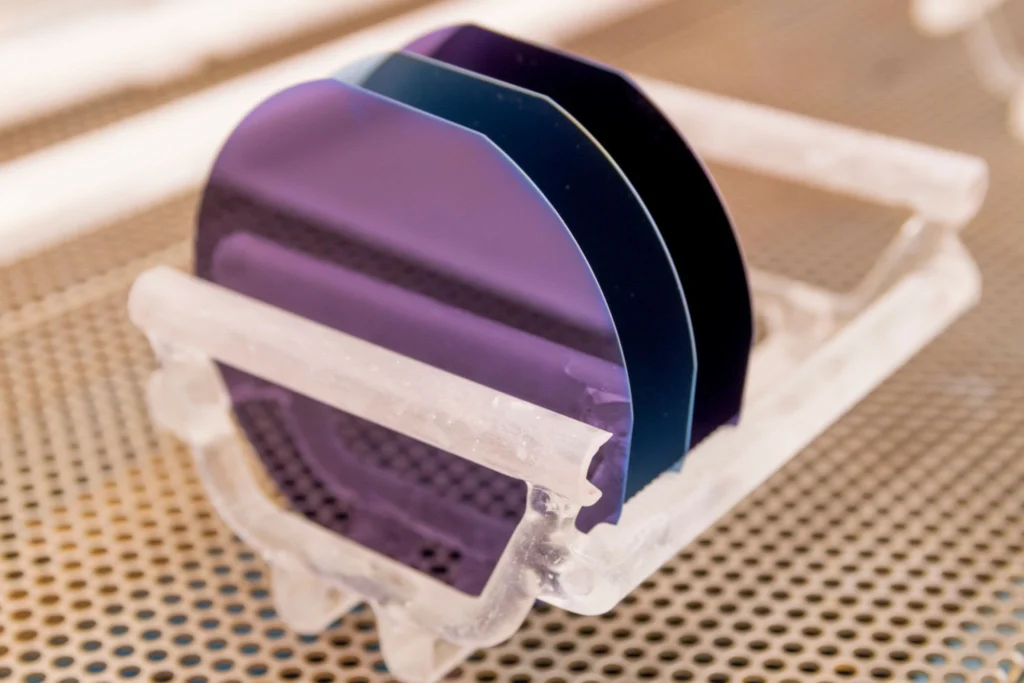
Quick answer: Fused Silica for Laboratory Instruments covers Fused Silica (CTE 0.55 x 10^-6 /K, 185 nm – 2.5 um). Prototypes ship in 5-10 working days.
What fused silica for laboratory instruments actually buys from a glass shop: cuvettes, sight glasses, stir-cell windows. The requirement underneath is chemically durable cells and windows in small lots. Fused Silica is the fit here because it offers near-zero thermal expansion.
Key parameters
| Material | Fused Silica (JGS1 (UV), JGS2 (standard), JGS3 (IR)) |
|---|---|
| Thermal expansion (CTE) | 0.55 x 10^-6 /K |
| Service temperature | 1,100 C continuous |
| Transmission range | 185 nm – 2.5 um |
| Density | 2.20 g/cm3 |
| Knoop hardness | 500 kg/mm2 |
| Refractive index | 1.458 @ 587 nm |
| Stock thickness | 0.10 – 50 mm |
| Maximum blank size | 450 x 450 mm |
| RFQ inputs | PDF/DXF/STEP drawing, quantity brackets, surface and edge spec |
Getting the drawing right
Before sending the RFQ, check these against your drawing:
- Material note: its hardness and brittleness demand diamond tooling and controlled feeds.
- Over-specification is the quiet budget killer: a 20/10 scratch-dig face costs roughly three times an 80/50 face, so grade each surface individually.
For the complete framework, see the tolerance design guide and the holes and edges design guide.
Capabilities and limits
One material, many routes: on Fused Silica we also quote edge grinding, ultrasonic machining, coring, etching, and multi-step drawings are the norm rather than the exception.
Typical applications
Orders for fused silica for laboratory instruments cluster in semiconductor equipment (view ports, wafer carriers, plasma rings, chamber windows); laboratory instruments (cuvettes, sight glasses, stir-cell windows); aerospace optics (sensor windows, star-tracker flats, radiation-tolerant ports). Background reading on the underlying material science: RP Photonics: fused silica.
Dimensions still moving? Configure this part live in the 3D + 2D builder below, or open the full custom glass machining 3D + 2D builder to start from a blank canvas.
For adjacent specifications, see fused silica wafers 2-12 inch, fused silica material guide, glass in laser systems.
Buyer questions, answered
Is there a minimum order for fused silica for laboratory instruments?
No. Single prototypes are accepted, and pricing steps down at 10, 100 and 1,000 pieces.
How fast can prototypes ship?
Machined prototypes ship in 5 – 10 working days. Coated or bonded parts add 1 – 2 weeks depending on queue slots.
What files do you need for a quote?
A dimensioned PDF plus DXF or STEP geometry. If only a sketch exists, our drawing review service formalizes it before quoting.
Do parts ship with inspection data?
Dimensional reports, surface certificates and material certs per melt are available; specify the level on the RFQ.
What tolerances are achievable on Fused Silica parts?
Ground features hold +/-0.01 mm and lapped thickness reaches +/-0.003 mm. Its hardness and brittleness demand diamond tooling and controlled feeds.
Specifications on this page were last reviewed by our engineering team in September 2026.