
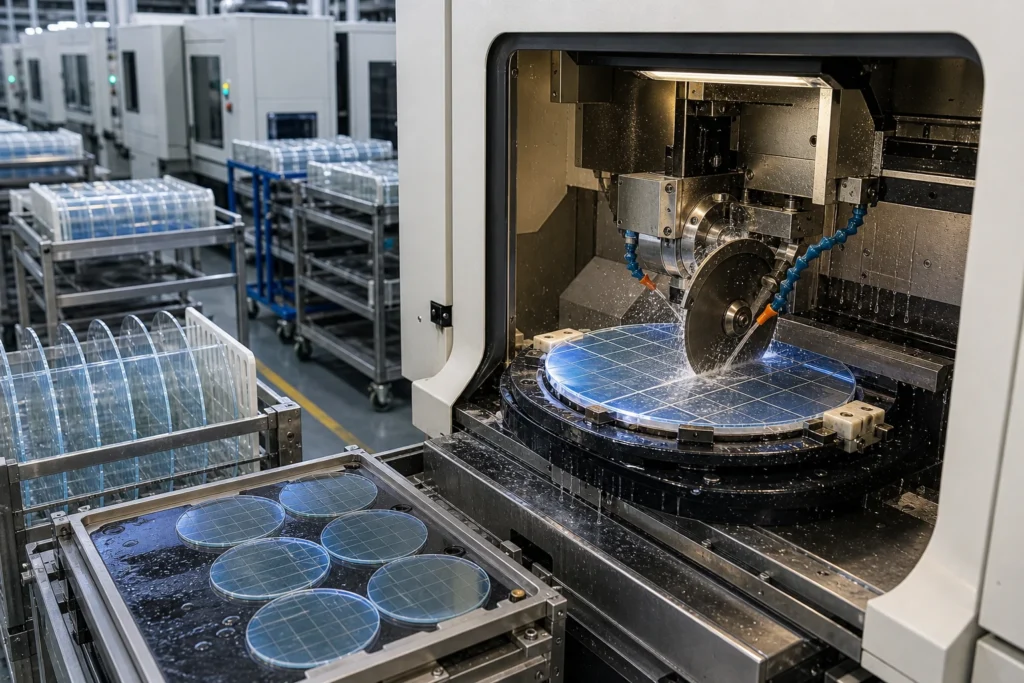
4 Inch (100 mm) Quartz Glass Wafers: Quartz Glass (CTE 0.59 x 10^-6 /K, 260 nm – 2.5 um); 100 mm format, TTV <3 um. Single-piece prototypes to production volumes, quoted from your drawing.
4 inch (100 mm) quartz glass wafers are supplied as finished substrates: edge-rounded, cleaned and packed in wafer cassettes. The material brings fused from natural quartz crystal and plasma and halogen resistance; the format brings SEMI-compatible handling.
Specifications at a glance
| Material | Quartz Glass (GE214-equivalent, semiconductor grade) |
|---|---|
| Thermal expansion (CTE) | 0.59 x 10^-6 /K |
| Service temperature | 1,050 C continuous |
| Transmission range | 260 nm – 2.5 um |
| Density | 2.20 g/cm3 |
| Knoop hardness | 500 kg/mm2 |
| Refractive index | 1.459 @ 587 nm |
| Stock thickness | 0.20 – 60 mm |
| Maximum blank size | 450 mm diameter |
| Diameter / format | 100 mm |
| Thickness | 0.5 or 0.7 mm standard |
| TTV | <3 um |
| Flat / notch | SEMI standard |
| RFQ inputs | PDF/DXF/STEP drawing, quantity brackets, surface and edge spec |
What the process holds
Beyond this page, Quartz Glass routinely runs through drilling, dicing, edge grinding, laser cutting in our shop – most real parts combine two or three of these steps.
DFM notes from the shop floor
Three items decide most of the cost and lead time on this work:
- Material note: natural-quartz batches vary in metallic ppm, so semiconductor lots need certs per melt.
- Specify flat or notch orientation relative to your device layout – regrinding orientation later scraps the wafer.
- Over-specification is the quiet budget killer: a 20/10 scratch-dig face costs roughly three times an 80/50 face, so grade each surface individually.
The full rules live in our tolerance design guide and holes and edges design guide.
Typical applications
Orders for 4 inch (100 mm) quartz glass wafers cluster in semiconductor equipment (view ports, wafer carriers, plasma rings, chamber windows); laboratory instruments (cuvettes, sight glasses, stir-cell windows). Background reading on the underlying material science: ScienceDirect: quartz glass.
Dimensions still moving? Configure this part live in the 3D + 2D builder below, or open the full custom glass machining 3D + 2D builder to start from a blank canvas.
For adjacent specifications, see ultra-thin quartz discs, CNC machining capability, glass wafer coring.
Frequently asked questions
How fast can prototypes ship?
Machined prototypes ship in 5 – 10 working days. Coated or bonded parts add 1 – 2 weeks depending on queue slots.
What files do you need for a quote?
A dimensioned PDF plus DXF or STEP geometry. If only a sketch exists, our drawing review service formalizes it before quoting.
Do parts ship with inspection data?
Dimensional reports, surface certificates and material certs per melt are available; specify the level on the RFQ.
What tolerances are achievable on Quartz Glass parts?
Ground features hold +/-0.01 mm and lapped thickness reaches +/-0.003 mm. Natural-quartz batches vary in metallic ppm, so semiconductor lots need certs per melt.
What thickness range do you stock for Quartz Glass?
Standard stock spans 0.20 – 60 mm, with blanks up to 450 mm diameter. Other formats are sourced per order.
Specifications on this page were last reviewed by our engineering team in September 2026.