
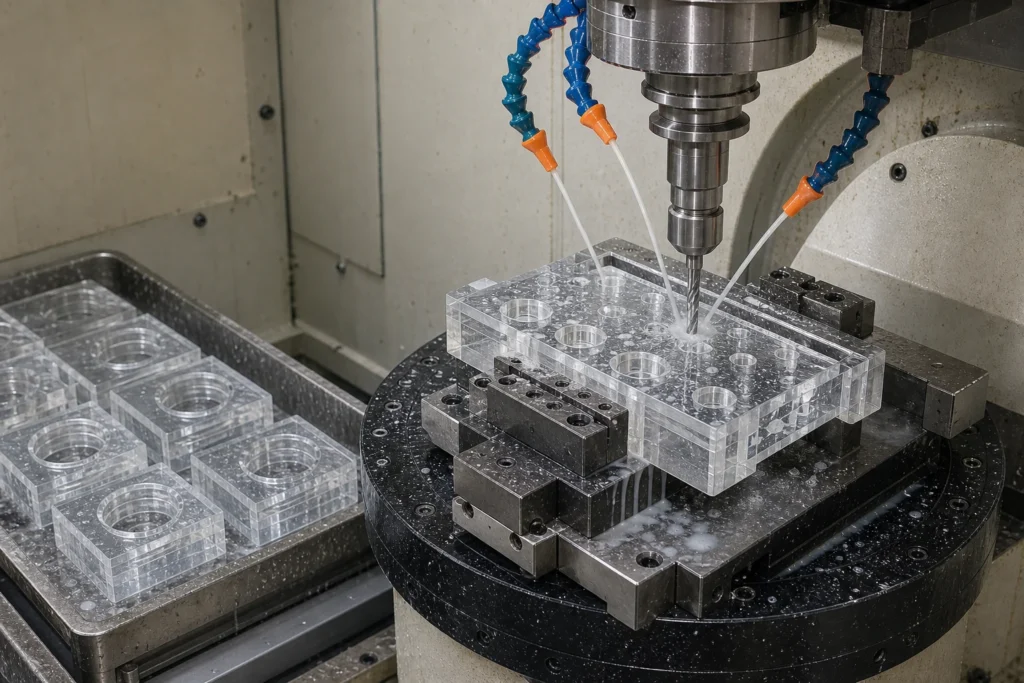
Drilling Quartz Glass – Quartz Glass (CTE 0.59 x 10^-6 /K, 260 nm – 2.5 um); Drilling to +/-0.02 mm hole position. No minimum order; DFM review included with every RFQ.
Ask any process engineer what makes quartz glass difficult and the answer is specific: natural-quartz batches vary in metallic ppm, so semiconductor lots need certs per melt. Our drilling line is tooled around exactly that – diamond core drills, ultrasonic assist and laser percussion heads – holding +/-0.02 mm hole position on parts from 0.1 – 30 mm thick.
Specification envelope
| Material | Quartz Glass (GE214-equivalent, semiconductor grade) |
|---|---|
| Thermal expansion (CTE) | 0.59 x 10^-6 /K |
| Service temperature | 1,050 C continuous |
| Transmission range | 260 nm – 2.5 um |
| Density | 2.20 g/cm3 |
| Knoop hardness | 500 kg/mm2 |
| Refractive index | 1.459 @ 587 nm |
| Stock thickness | 0.20 – 60 mm |
| Maximum blank size | 450 mm diameter |
| Process | Drilling |
| Working tolerance | +/-0.02 mm hole position |
| Minimum feature | 0.15 mm laser / 0.5 mm mechanical |
| Surface finish | exit-chip controlled below 0.1 mm |
| Thickness window | 0.1 – 30 mm |
| Edge condition | optional chamfered hole entry |
| RFQ inputs | PDF/DXF/STEP drawing, quantity brackets, surface and edge spec |
Capabilities and limits
The core strength of Drilling is through-holes, blind holes and countersinks at densities beyond 1,000 holes per part. The honest limit: hole-to-edge distance should stay above 1.5x thickness to protect strength. Both belong on the drawing before quoting, not after.
One material, many routes: on Quartz Glass we also quote coring, sandblasting, dicing, double-side polishing, and multi-step drawings are the norm rather than the exception.
Specification advice
The shop-floor rules that matter here:
- Material note: natural-quartz batches vary in metallic ppm, so semiconductor lots need certs per melt.
- Process boundary: hole-to-edge distance should stay above 1.5x thickness to protect strength.
- Over-specification is the quiet budget killer: a 20/10 scratch-dig face costs roughly three times an 80/50 face, so grade each surface individually.
For the complete framework, see the tolerance design guide and the holes and edges design guide.
Where these parts end up
drilling quartz glass shows up across semiconductor equipment (view ports, wafer carriers, plasma rings, chamber windows); laboratory instruments (cuvettes, sight glasses, stir-cell windows). Background reading on the underlying material science: ScienceDirect: quartz glass.
Dimensions still moving? Configure this part live in the 3D + 2D builder below, or open the full custom glass machining 3D + 2D builder to start from a blank canvas.
Useful companion pages: ultra-thin quartz discs, high-purity quartz guide, custom microfluidic chip.
Buyer questions, answered
How fast can prototypes ship?
Machined prototypes ship in 5 – 10 working days. Coated or bonded parts add 1 – 2 weeks depending on queue slots.
What files do you need for a quote?
A dimensioned PDF plus DXF or STEP geometry. If only a sketch exists, our drawing review service formalizes it before quoting.
Do parts ship with inspection data?
Dimensional reports, surface certificates and material certs per melt are available; specify the level on the RFQ.
What tolerances are achievable on Quartz Glass parts?
Ground features hold +/-0.01 mm and lapped thickness reaches +/-0.003 mm. Natural-quartz batches vary in metallic ppm, so semiconductor lots need certs per melt.
Specifications on this page were last reviewed by our engineering team in September 2026.